Not a hole and not a cosmic vacuum cleaner: here is what a black hole is, how we know they exist, and where the real mysteries begin.
God Plays Dice Editorial · independently fact-checked · corrections welcomeChecked Sep 29, 202611 min read
THE SHORT ANSWER
A black hole is not a hole. It is a huge amount of matter packed into a very small space. Its gravity is so strong that once anything crosses a boundary called the event horizon, it can never get back out, not even light. Black holes are real. Telescopes have pictured the glow around two of them, astronomers have tracked stars racing around one, and detectors have picked up hundreds of signals, many from black holes colliding. What happens deep inside is still unknown.
NASA says black holes are not really holes: they are huge amounts of matter packed into tiny spaces, and nothing that crosses the event horizon can get back out.
When a star with about 20 times the Sun’s mass or more runs out of fuel, its core can collapse into a black hole.
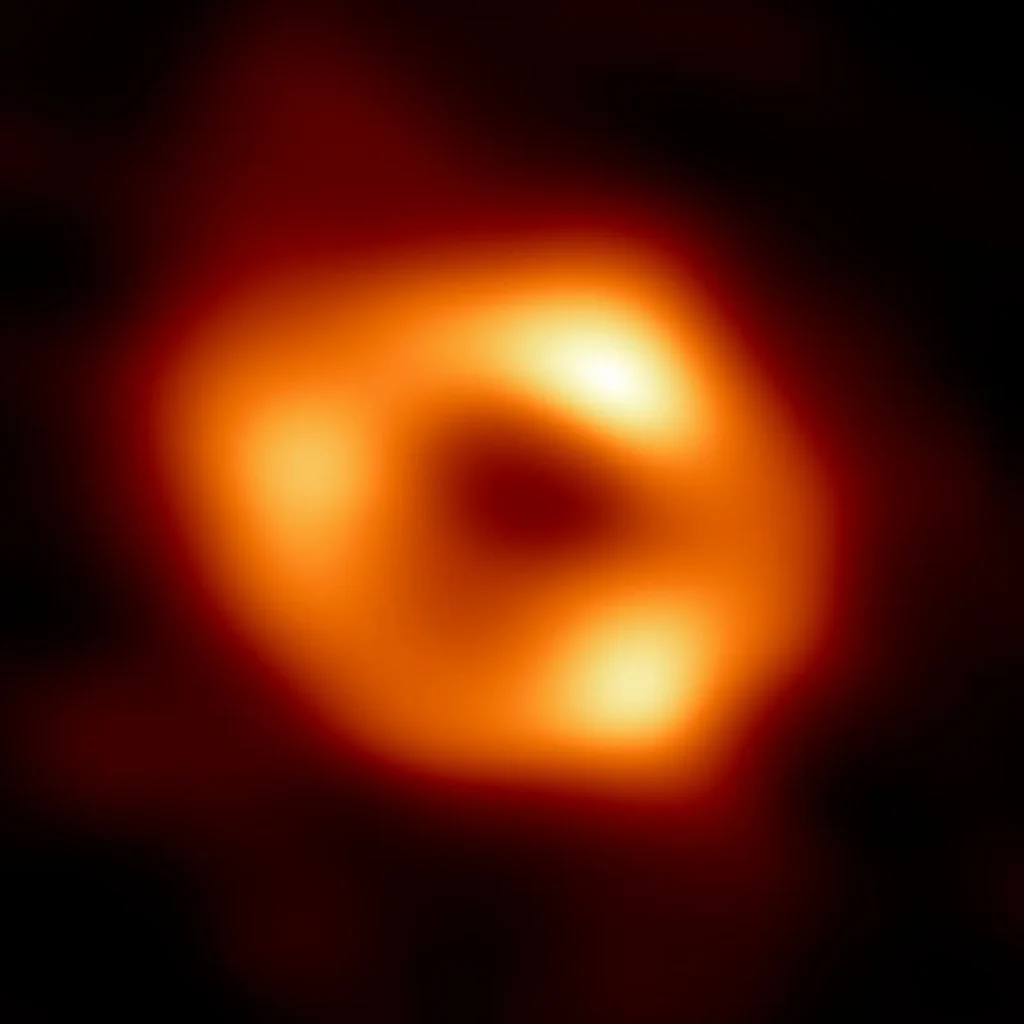
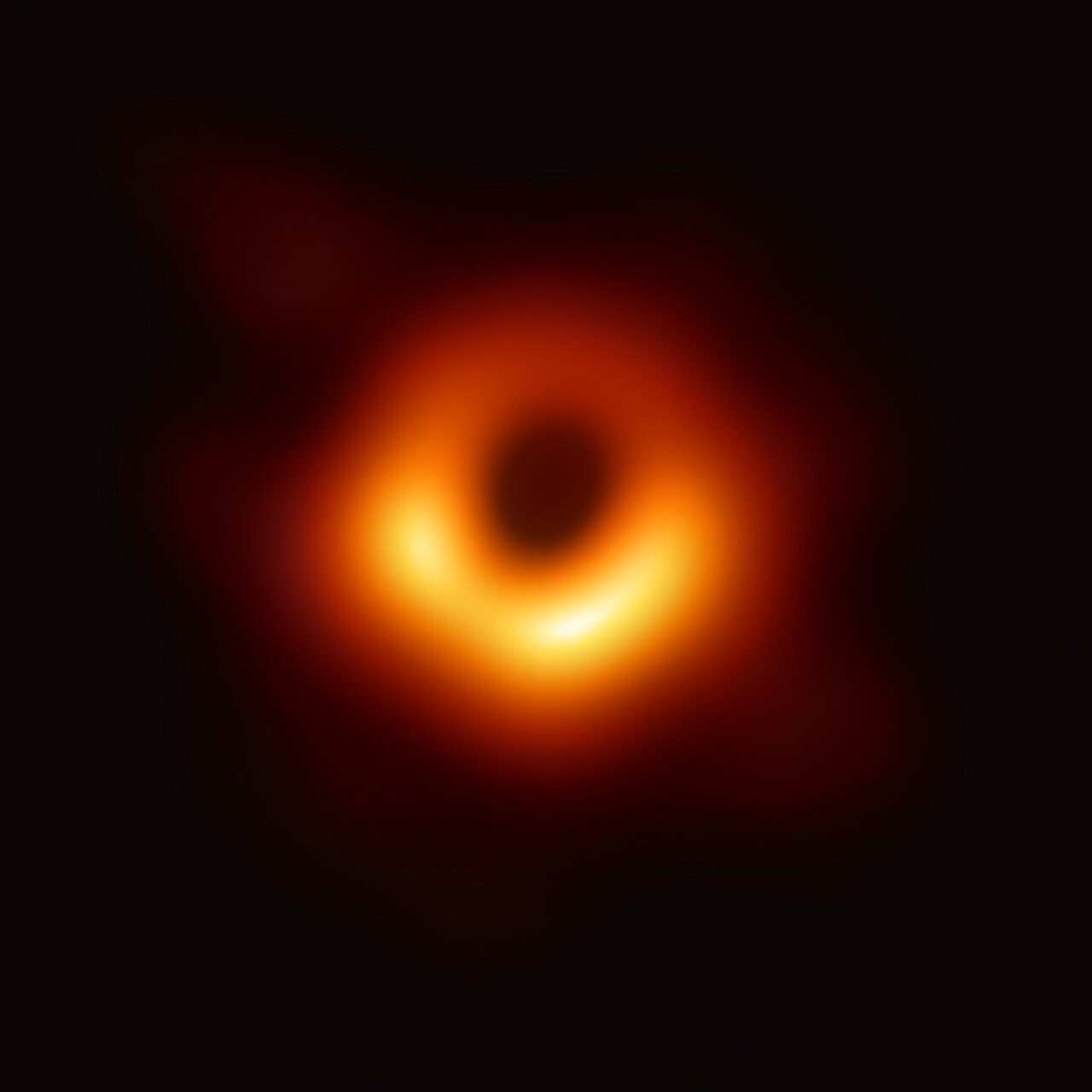
The Event Horizon Telescope showed the dark “shadow” of a black hole in the galaxy M87 in 2019, and of the one at the center of our own galaxy in 2022.
Since the first detection on September 14, 2015, gravitational-wave detectors have logged 390 signals, many from pairs of black holes crashing together.
Black holes do not suck things in like vacuum cleaners: from far enough away, their gravity acts like that of any other object with the same mass.
About this picture
The first image of a black hole’s shadow, released April 10, 2019: the supermassive black hole at the center of the galaxy M87, 55 million light-years away, with 6.5 billion times the Sun’s mass. The dark center is the shadow; the ring is hot gas whose light is bent by the black hole’s gravity.
Event Horizon Telescope Collaboration (ESO release eso1907a), cropped by a Wikimedia Commons uploader, via Wikimedia Commons · CC BY 4.0 · Image source ↗
WHERE THE EVIDENCE STANDS
How sure are we?
Black holes really exist.Stars orbit an invisible object of about four million Suns at our galaxy’s center (2020 Nobel Prize to Genzel and Ghez); the Event Horizon Telescope imaged the shadows of M87* (2019) and Sagittarius A* (2022); LIGO detected merging black holes on September 14, 2015, and the catalog reached 390 signals in 2026.
Black holes suck in everything around them, like cosmic vacuum cleaners.NASA: black holes don’t suck in other matter; from far enough away, their gravitational effects are just like those of other objects of the same mass.
Black holes slowly give off heat, called Hawking radiation, and could in time evaporate.Predicted by Stephen Hawking in 1974 by combining quantum physics with Einstein’s gravity. The Stanford Encyclopedia of Philosophy calls the idea widely accepted but without direct empirical support; for large black holes the glow is far too faint to measure.
Whatever falls into a black hole is erased from the universe for good.This is the information loss paradox, raised by Hawking in 1976. The Stanford Encyclopedia sorts the proposed answers into six broad groups, and physicists still disagree.
A particle collider such as the LHC could make a black hole that swallows Earth.CERN’s 2008 safety review: cosmic rays have hit Earth with higher-energy collisions for billions of years, any tiny black holes are expected to decay before they reach the detector walls, and the fact that Earth, the Sun and other stars still exist shows such collisions cannot be dangerous.
Nobody knows what matter is like inside the event horizon, or whether the “singularity” at the center is a real thing or a sign that Einstein’s theory breaks down there. Nobody knows yet whether information that falls in ever comes back out.
WHAT WOULD CHANGE THIS ANSWER
The main answer would change if a supposed black hole turned out to have a solid surface where the event horizon should be, or if its ringing after a merger broke Einstein’s rules again and again. Spotting Hawking radiation would settle one open part of the story.
A black hole is not a hole in space. It is a place where a huge amount of matter has been squeezed into a very small space. Its gravity is so strong that there is a point of no return around it. That boundary is called the event horizon. Anything that crosses it, even light, can never get back out. Because no light comes out, the black hole itself looks completely black.
People ask about black holes for good reasons. They sound like something from a horror movie. They show up in science fiction as doors to other worlds. And they seem to break the rules: how can anything trap light, the fastest thing there is?
Here is the core picture. Gravity pulls harder the more matter you pack into a small space. To leave Earth, a rocket must reach a minimum speed, called the escape speed. Pack enough matter into a small enough ball, and the escape speed at its edge would be faster than light. Nothing can go faster than light, so nothing gets out. The event horizon marks where that happens. It is not a solid surface. Think of it as a line on a map, not a wall.
Black holes are real, and we know it in three separate ways. Astronomers have watched stars whip around an invisible object at the center of our galaxy. That object has the mass of about four million Suns. Radio telescopes linked across the planet have pictured the dark shadow and glowing ring around two black holes. And since 2015, detectors on Earth have felt ripples in space sent out when black holes crash together.
So the main answer is settled. The deep mysteries are about the inside. Nobody knows what happens at the center of a black hole. Nobody knows if anything that falls in is truly gone forever. Those are real open questions, and they are some of the biggest in physics.
THE LONG ANSWER
THE LONG ANSWER · ABOUT 9 MINUTES
You’ve read your 3 free long answers this month.
The short answer, how sure we are, what we don’t know, what would change our mind and every source stay free on every page, for everyone.
All Access members read the long answer: the evidence piece by piece, the strongest objections, and how to check it yourself.
Author’s hypothesis. In Chapter 6 of his book, Ricardo Maldonado, author of GOD PLAYS DICE, uses black holes as a test for his own idea, not as support for it. His HD-Blast idea, an Author’s hypothesis, proposes that an event in a higher-dimensional space left a mark on the early universe. The book commits that, in the simplest version, gravity today must follow Einstein’s rules. So when two black holes merge, the new black hole should “ring” exactly as Einstein’s theory predicts, set by its mass and spin. The book shows only a demonstration of this check with sample inputs, not real measurements, and says so. If real data ever showed the ringing drifting away from Einstein’s prediction in a robust, repeated way, the simplest version of the idea would be in serious trouble. For now, the collaborations that run the detectors report that the ringing of real merged black holes is overall consistent with Einstein’s theory.
The boundary around a black hole. Once anything crosses it, even light, it cannot get back out. It is not a solid surface.
Singularity
The point at the center of a black hole where Einstein’s theory predicts matter is crushed to infinite density. It may be real, or a sign that the theory breaks down.
Gravitational wave
A ripple in space and time that spreads out when heavy objects, such as black holes, speed up or collide.
Accretion disk
A hot, bright, spinning disk of gas that forms around a black hole as matter spirals toward it. It is the main source of light we see near black holes.
Hawking radiation
A very faint glow that Stephen Hawking predicted black holes should give off, because of quantum effects near the event horizon. It has not been observed.
Spaghettification
The stretching of an object that gets too close to a black hole, because gravity pulls much harder on its near side than its far side.
Sources & further reading
(12) · Checked Sep 29, 2026
Black Holes ↗NASA ScienceNot really holes; event horizon; detected by effects on surroundings; 2020 Nobel for star orbits; not wormholes or portals; “cosmic vacuum cleaners”: black holes don’t suck in other matter; Gaia BH1 about 1,500 light-years away; spaghettification. Companion pages: Types (https://science.nasa.gov/universe/black-holes/types/): more than 8 solar masses gives a supernova, around 20 or more gives a black hole; few to hundreds of solar masses; about 50 found, up to 100 million in the Milky Way; Sagittarius A* 4 million solar masses; some supermassive black holes formed in the first billion years. Anatomy (https://science.nasa.gov/universe/black-holes/anatomy/): escape velocity exceeds light speed inside the horizon; accretion disk; singularity may be physical or mathematical. APOD black hole FAQ (https://science.nasa.gov/apod/frequently-asked-questions-faqs-on-black-holes/): Karl Schwarzschild’s 1916 solution for a spherically symmetric, nonrotating object, “when general relativity was new.”
The Anatomy of Black Holes: falling in ↗NASA Goddard, Imagine the Universe!Tidal force at the horizon is 10 billion times weaker for a million-solar-mass black hole than for a 10-solar-mass one; watchers see the explorer’s clock run slow, redden and hover; the explorer crosses normally.
Astronomers Capture First Image of a Black Hole (eso1907) ↗European Southern Observatory (April 10, 2019)EHT: eight radio telescopes forming an Earth-sized virtual telescope; M87 black hole 55 million light-years away, 6.5 billion solar masses; ring with a dark central shadow. Sagittarius A* release (https://www.eso.org/public/news/eso2208-eht-mw/, May 12, 2022): about 27,000 light-years away, four million solar masses, size of a doughnut on the Moon, ring size agreed with general relativity.
Gravitational Waves Detected 100 Years After Einstein’s Prediction ↗LIGO Laboratory, Caltech (2016)Detected September 14, 2015, by both LIGO detectors (Livingston, Louisiana, and Hanford, Washington); black holes of about 29 and 36 solar masses; event 1.3 billion years ago; about 3 solar masses converted to gravitational waves in a fraction of a second.
GWTC-5.0: Updated LIGO–Virgo–KAGRA Catalog sets new records ↗LIGO Scientific Collaboration (2026)161 new events bring the total since 2015 to 390. Catalog paper arXiv:2605.27225 (submitted May 26, 2026): cumulative total 390 with p_astro ≥ 0.5; of the 161 new candidates, the 104 with detailed source measurements are all consistent with binary black holes.
The Nobel Prize in Physics 2020: press release ↗Royal Swedish Academy of Sciences / NobelPrize.orgHalf to Roger Penrose (January 1965 proof that black holes can form; Einstein did not believe they exist), half jointly to Reinhard Genzel and Andrea Ghez (since the early 1990s; about four million solar masses in a region no larger than our solar system; a supermassive black hole is the only currently known explanation).
Singularities and Black Holes (Erik Curiel) ↗Stanford Encyclopedia of Philosophy (revised July 13, 2025)Hawking temperature of Sagittarius A* about 10^-14 kelvin; black hole thermodynamics as widely accepted as an idea with no direct empirical substantiation can be; the information loss paradox (Hawking 1976), the burned-chair example, six broad groups of responses, Hawking later abandoned his position. Hawking’s 1974 paper: “Black hole explosions?”, Nature 248, 30–31, https://doi.org/10.1038/248030a0 (checked via Crossref).
Review of the Safety of LHC Collisions ↗LHC Safety Assessment Group, CERN (Ellis, Giudice, Mangano, Tkachev, Wiedemann, 2008)Cosmic rays reach higher collision energies than the LHC and have bombarded Earth for billions of years; microscopic black holes expected to decay by Hawking radiation before reaching the detector walls; stability of astronomical bodies means no conceivable danger.
GWTC-4.0: Tests of General Relativity. III. Tests of the Remnants ↗LIGO, Virgo and KAGRA Collaborations (submitted March 19, 2026)Seven tests of merger remnants, three of them ringdown tests; overall consistency with general relativity; no strong evidence for a deviation; no evidence for post-merger echoes.
GOD PLAYS DICE, Volume OneRicardo Maldonado“When Black Holes Ring Like Bells”: in the blast-only version, late-time gravity must look like ordinary Einstein gravity; the ringdown check shown uses demonstration inputs, not real event data; a robust, repeated departure would be a serious problem for the simplest version. Author’s hypothesis.
Research Notebook: Black holes — historical author report ↗Ricardo Maldonado / officialgodplaysdice.comNotebook reviewed 30 September 2026. The author’s account of earlier HRF tiny-reflection/direct-wave-fringe proposals, attributed to versions dated 30 December 2025 and 6 January 2026. No independent confirmation of those predictions is claimed.
An everywhere-present field, a fleeting particle and a famous nickname. What did CERN’s experiments actually measure?
Established4 min read
THE OCCASIONAL LETTER
Stay curious.
New stories, book updates, and notes from God Plays Dice, delivered when there is something worth sharing.
EMAIL UPDATES ↗
500 DIGITAL COPIES • GIVEAWAY PREVIEW
Be first to know when the 500-copy reader giveaway opens.
Join for the book launch, verified retailer links, and the announcement for a planned giveaway of 500 digital copies. The giveaway is not open yet: dates, eligibility, a dedicated entry form, and Official Rules will be published first.
Privacy · Check your inbox to confirm your subscription. Newsletter signup alone is not a giveaway entry.