How do we know dark matter exists if we cannot see it?
We can’t see dark matter, but we can measure its pull in five different ways, so here is the evidence, the case for changing gravity instead, and what is still unknown.
God Plays Dice Editorial · independently fact-checked · corrections welcomeChecked Sep 26, 202612 min read
THE SHORT ANSWER
We know it from its gravity. Stars at the edges of galaxies orbit too fast, galaxy clusters hold together too tightly, and light from distant galaxies bends more than visible matter can explain. The pattern in the oldest light in the universe points the same way. So the pull of unseen mass is well measured. What that mass is made of is still unknown. No lab has clearly caught a dark matter particle, and some scientists think gravity itself needs changing instead. If dark matter consists of weakly interacting particles, they could pass through your body without colliding with its atoms. That is a prediction about a candidate, not a measurement inside you. Possibilities include new particles such as WIMPs or axions, or primordial black holes formed before stars.
In 1933, Fritz Zwicky found that galaxies in the Coma Cluster moved far too fast to be held together by the matter he could see.
In the 1970s, Vera Rubin and Kent Ford found that stars at the edges of spiral galaxies move about as fast as stars closer in, which calls for extra unseen mass.
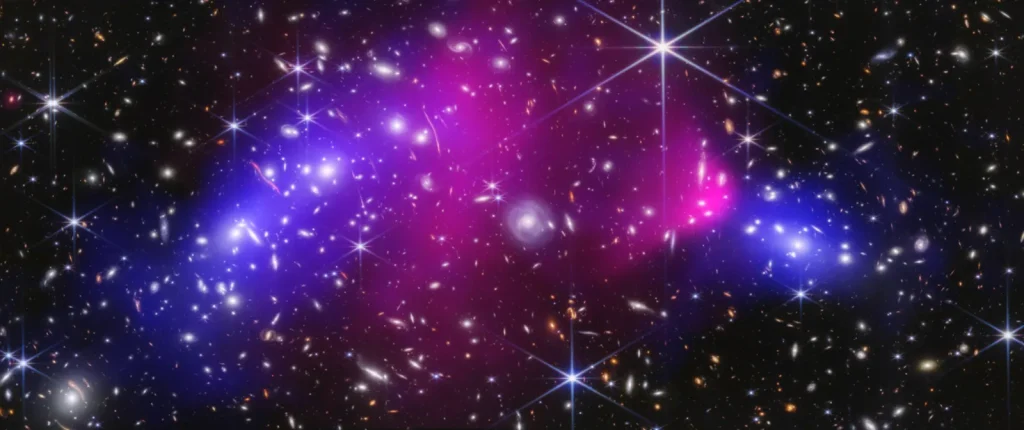
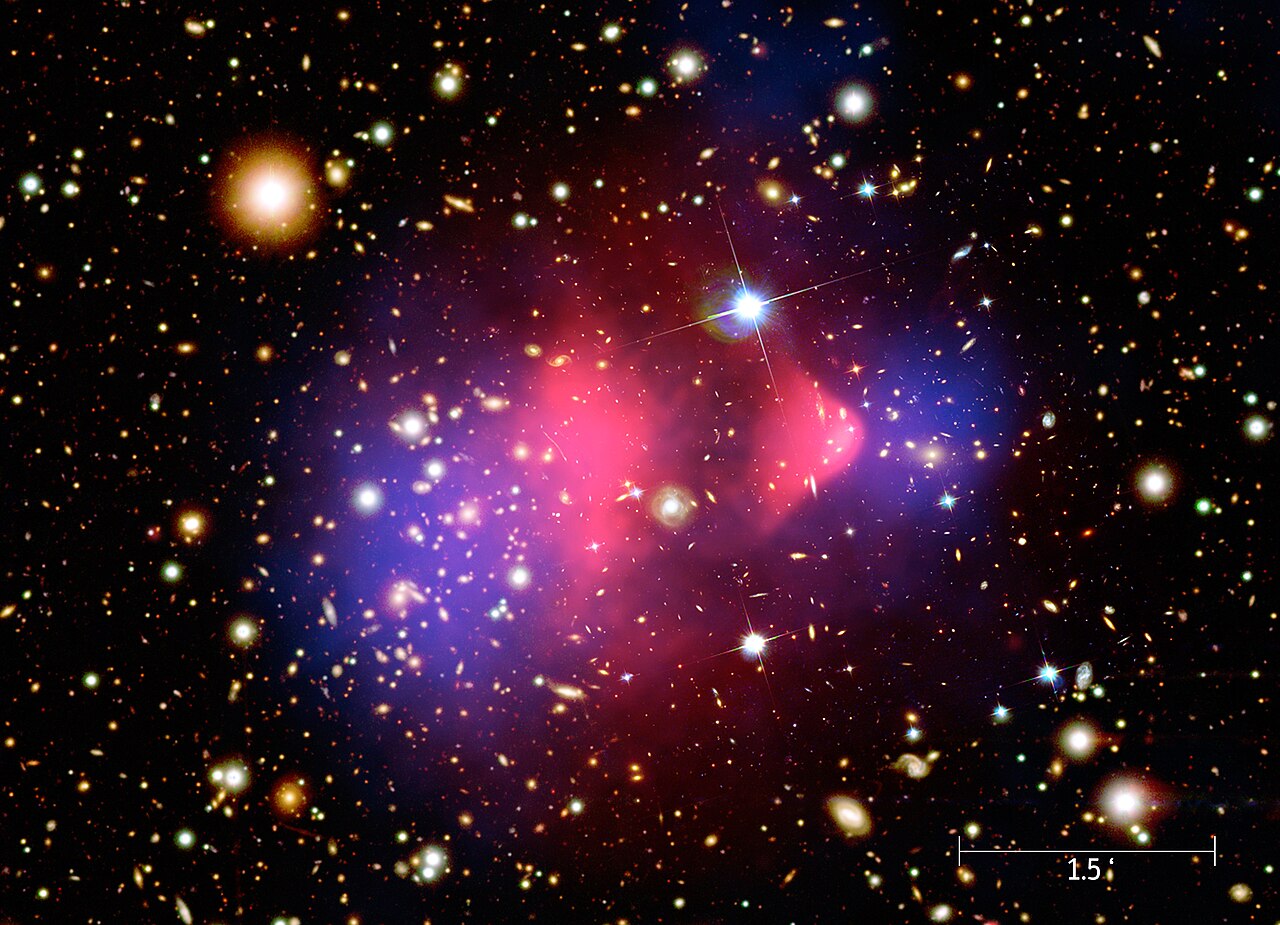
In the Bullet Cluster, two clusters that crashed together, most of the mass sits apart from the hot gas that holds most of the normal matter.
The Planck satellite’s map of the oldest light fits about five times more dark matter than ordinary matter.
The LZ detector found no dark matter signal in its 2025 results, and in 2026 it reported one unexplained event that its team did not claim as a discovery.
About this picture
The Bullet Cluster, two galaxy clusters that collided. Pink shows hot gas seen in X-rays, which holds most of the normal matter. Blue shows where gravitational lensing says most of the mass is. The two don’t line up.
X-ray: NASA/CXC/CfA/M. Markevitch et al.; optical: NASA/STScI, Magellan/U. Arizona/D. Clowe et al.; lensing map: NASA/STScI, ESO WFI, Magellan/U. Arizona/D. Clowe et al., via Wikimedia Commons · Public domain (NASA) · Image source ↗
WHERE THE EVIDENCE STANDS
How sure are we?
Galaxies and galaxy clusters hold far more mass than we can see.Zwicky 1933 (Coma Cluster: density at least 400 times that of the glowing matter); Rubin and Ford’s rotation curves; the Famaey and McGaugh review (2012) reports flat rotation curves again and again; gravitational lensing maps of clusters (NASA).
In the Bullet Cluster, most of the mass sits apart from the normal matter.Clowe and colleagues, Astrophysical Journal Letters (2006): lensing maps show the mass follows the galaxies, not the hot gas that is the main normal-matter component, with an 8-sigma offset.
Dark matter is mostly ordinary matter that is too dim to see, like dead stars or rogue planets.EROS-2 microlensing survey (2007): one candidate event where about 39 were expected; for objects of about 0.4 solar masses, less than 8% of the Milky Way halo’s mass, and ruled out as the main halo ingredient from 0.6 × 10^-7 to 15 solar masses; Planck 2018 measures dark matter at about five times the density of ordinary matter.
Changing the law of gravity can explain all the evidence without any dark matter.Famaey and McGaugh (2012): MOND fits many galaxy patterns but still needs 2 to 3 times the visible mass in clusters and fails the third-peak test in its simple no-dark-matter form; Banik and colleagues (MNRAS, published 2023): Gaia wide binaries prefer Newtonian gravity at 19-sigma and exclude MOND at 16-sigma.
What dark matter is made of is known.NASA lists WIMPs, axions and primordial black holes as candidates, none confirmed; LZ found no excess in 2025 (Physical Review Letters) and one event at 2.6-sigma global significance in 2026 (arXiv preprint).
Nobody knows yet what dark matter is made of. It could be one new kind of particle, several kinds, or something else. Scientists also still argue about why some galaxy patterns fit a simple modified-gravity rule so well.
WHAT WOULD CHANGE THIS ANSWER
A clear, repeated detection of a dark matter particle in a lab would tell us what it is. A single theory of gravity that fits galaxies, the Bullet Cluster and the oldest light with no unseen mass would force scientists to rethink dark matter.
We know dark matter is there because of its gravity. We can’t see it, but we can see what it does. Stars, gas and whole galaxies move as if something heavy and invisible is pulling on them. Light from faraway galaxies bends around it. The same answer shows up again and again, from many kinds of measurements.
People ask this for good reasons. “Invisible stuff that makes up most of the matter in the universe” can sound like a fudge. Why believe in something no one has seen? That is a fair question, and it deserves a straight answer, not “trust the experts.”
Here is the core picture. In 1933, the astronomer Fritz Zwicky studied a group of galaxies called the Coma Cluster. The galaxies moved so fast that the cluster should have flown apart. In the 1970s, Vera Rubin and Kent Ford found something similar inside single galaxies. Stars near the edges moved about as fast as stars closer in. Without extra mass, those outer stars should have moved more slowly.
Later tests came from new directions. Heavy things bend light, so astronomers can weigh a cluster by how much it warps the galaxies behind it. In the Bullet Cluster, two clusters that crashed together, most of the mass sits apart from the hot gas that holds most of the normal matter. And the oldest light in the universe, mapped by the Planck satellite, carries a pattern that fits about five times more dark matter than ordinary matter.
So the extra gravity is well measured. We label that Established. What dark matter is made of is a different question. No lab has clearly caught a dark matter particle yet, and some scientists think our law of gravity needs fixing instead. That part is an Open question, and this page walks through both sides.
THE LONG ANSWER
THE LONG ANSWER · ABOUT 10 MINUTES
You’ve read your 3 free long answers this month.
The short answer, how sure we are, what we don’t know, what would change our mind and every source stay free on every page, for everyone.
All Access members read the long answer: the evidence piece by piece, the strongest objections, and how to check it yourself.
Matter that does not give off, absorb or reflect light, known so far only through its gravity.
Rotation curve
A graph of how fast stars and gas orbit at different distances from a galaxy’s center.
Gravitational lensing
The bending of light by mass. Astronomers use it to map where mass is, whether it shines or not.
Cosmic microwave background
The oldest light in the universe, released about 380,000 years after the Big Bang. Its tiny hot and cold spots record what the early universe contained.
MOND
Modified Newtonian Dynamics, a proposal by Mordehai Milgrom (1983) that gravity changes at very low accelerations, instead of there being unseen mass.
Sigma
A measure of how unlikely a result would be if it were only chance or background. Bigger numbers mean a fluke is less likely.
Sources & further reading
(16) · Checked Sep 26, 2026
Dark Matter ↗NASA ScienceOrdinary matter about 5%, dark matter about 27% of the universe; dark matter doesn’t absorb, reflect or emit light; Zwicky 1933, Coma Cluster, ‘dunkle Materie’, seen as a fringe idea; Rubin in the 1970s; lensing of Abell 209; Bullet Cluster (1E 0657-56) about 3.8 billion light-years away, observed in 2006; cold dark matter simulations match observed structure; candidates WIMPs, axions, primordial black holes, none confirmed; dark matter is not dark energy.
English and Spanish Translation of Zwicky’s (1933) The Redshift of Extragalactic Nebulae ↗H. Andernach (translator), arXiv (2017); original in Helvetica Physica Acta (1933)Abstract: conclusion based on seven galaxies in Coma; 1000+ velocities now measured give a dispersion very close to Zwicky’s. English text (PDF extracted): average density ‘at least 400 times greater’ than luminous matter; ‘dark matter exists in much greater density than luminous matter.’
Who was Vera Rubin? ↗NSF–DOE Vera C. Rubin ObservatoryRubin and Kent Ford studied more than 60 galaxies; stars at the outer edges moved as fast as those toward the center; Ford built a sensitive spectrometer; Rubin met Ford in 1965 at the Carnegie Institution.
A Direct Empirical Proof of the Existence of Dark Matter ↗Clowe et al., The Astrophysical Journal 648, L109 (2006)Abstract (arXiv astro-ph/0608407): weak lensing of the merging cluster 1E0657-558; the gravitational potential traces the galaxies, not the X-ray plasma that is the dominant baryonic mass; 8-sigma offset; cannot be explained by altering the gravitational force law. Chandra’s image page (https://chandra.harvard.edu/photo/2006/1e0657/) explains the pink gas and blue mass.
Planck 2018 results. VI. Cosmological parameters ↗Planck Collaboration, Astronomy & Astrophysics 641, A6 (2020)Abstract (arXiv 1807.06209): results from the final full-mission Planck measurements; dark matter density Omega_c h^2 = 0.120 ± 0.001; baryon density Omega_b h^2 = 0.0224 ± 0.0001 (ratio about 5.4). ESA’s 2013 release (https://www.esa.int/Science_Exploration/Space_Science/Planck/Planck_reveals_an_almost_perfect_Universe): CMB imprinted when the universe was 380,000 years old; normal matter 4.9%, dark matter 26.8%.
Modified Newtonian Dynamics (MOND): Observational Phenomenology and Relativistic Extensions ↗Famaey and McGaugh, Living Reviews in Relativity 15, 10 (2012)PDF text (arXiv 1112.3960): rotation curves approximately flat ‘over and over and over again’ instead of the Keplerian decline; Milgrom’s 1983 proposal; MOND needs 2 to 3 times the observed baryonic mass in clusters; the Bullet Cluster is an outstanding challenge for all MOND theories but its high collision speed is also a challenge to Lambda-CDM; the near-equal second and third CMB peaks falsify the simple no-CDM ansatz.
Strong constraints on the gravitational law from Gaia DR3 wide binaries ↗Banik et al., Monthly Notices of the Royal Astronomical Society 527, 4573 (published November 2023)Abstract (arXiv 2311.03436): 8,611 wide binaries within 250 pc; Newtonian gravity preferred at 19-sigma; MOND excluded at 16-sigma; MOND must be substantially modified on small scales. Crossref: published online 2023-11-03, print 2023-11-27.
Limits on the Macho Content of the Galactic Halo from the EROS-2 Survey of the Magellanic Clouds ↗Tisserand et al., Astronomy & Astrophysics 469, 387 (2007)Abstract (arXiv astro-ph/0607207): 6.7 years monitoring 33 million stars; one candidate where about 39 were expected for a full halo; machos less than 8% of the halo mass (for lenses of about 0.4 solar masses); ruled out as primary halo occupants from 0.6 × 10^-7 to 15 solar masses.
An everywhere-present field, a fleeting particle and a famous nickname. What did CERN’s experiments actually measure?
Established4 min read
THE OCCASIONAL LETTER
Stay curious.
New stories, book updates, and notes from God Plays Dice, delivered when there is something worth sharing.
EMAIL UPDATES ↗
500 DIGITAL COPIES • GIVEAWAY PREVIEW
Be first to know when the 500-copy reader giveaway opens.
Join for the book launch, verified retailer links, and the announcement for a planned giveaway of 500 digital copies. The giveaway is not open yet: dates, eligibility, a dedicated entry form, and Official Rules will be published first.
Privacy · Check your inbox to confirm your subscription. Newsletter signup alone is not a giveaway entry.