Skip to content
BackGOD PLAYS DICE™Big questions, honest answers

THE QUESTION LIBRARY EXTRAORDINARY CLAIMS

Are we living in a computer simulation?

A famous argument says the idea deserves a serious look, so here is what it claims, what a physics test might find, and why the question is still open.

THE SHORT ANSWER

Nobody knows yet, and no evidence shows that we are. In 2003, the philosopher Nick Bostrom argued that at least one of three things is true, and only one of them is that we almost surely live in a simulation. He did not claim to know which. Physicists have proposed tests, such as looking for signs of a hidden grid in cosmic rays, but no such sign has been reported, and a careful simulator could hide one.
  • Nick Bostrom’s 2003 paper argues that at least one of three claims is true, and only one says we are simulated.
  • Bostrom suggested splitting our belief roughly evenly between the three claims, not betting on the simulation.
  • In 2012, three physicists proposed that a simulated universe built on a grid might leave marks in the highest-energy cosmic rays.
  • A 2017 study of about 30,000 such cosmic rays linked their pattern to sources outside our galaxy.
  • The philosopher David Chalmers argues that even a simulated world would still be real to the people living in it.
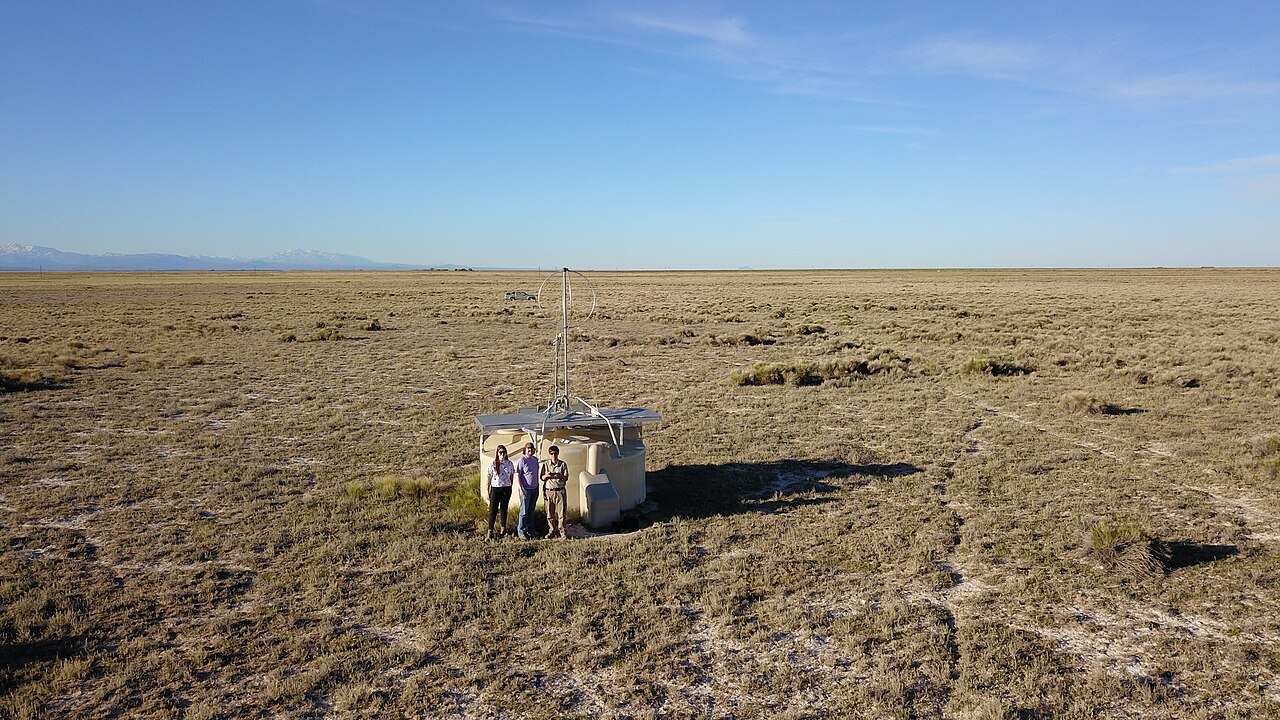
Aerial view of flat, dry grassland under a clear blue sky. A pale, round tank with a small solar panel and a thin mast stands in the middle, with three people beside it for scale and faint mountains on the horizon.
About this picture

One of the cosmic ray detectors of the Pierre Auger Observatory, a water tank 3.6 meters across. In 2012, physicists proposed that the arrival directions of the highest-energy cosmic rays could, in principle, reveal a grid if our universe were simulated.

Tobias Schulz, via Wikimedia Commons · CC BY-SA 4.0 · Image source ↗

WHERE THE EVIDENCE STANDS

How sure are we?

  • Science has shown that we live in a computer simulation.No published measurement has found a sign of simulation. The 2012 proposal by Beane, Davoudi and Savage only set limits on how fine a simulated grid would have to be.
  • If future people run huge numbers of lifelike simulations of their ancestors, most minds like ours would be simulated.This is the core of Bostrom’s 2003 argument in The Philosophical Quarterly. It rests on assumptions that are debated, including that a detailed enough computer model of a brain would be conscious. Bibeau-Delisle and Brassard (2021) argue that the overall chance of being simulated is unlikely to be as high as earlier estimates.
  • Physics could one day detect that our universe is simulated.Beane, Davoudi and Savage suggest a grid could show up as a pattern in the directions of the highest-energy cosmic rays. They add that a better-built simulation would hide most such signs, and Bostrom notes a simulator could edit what we notice.
  • If we live in a simulation, nothing around us is real.This is a question about what counts as real. David Chalmers argues that even in a simulation, bodies, chairs and tables would still exist, with an unexpected nature underneath.
What the labels mean

WHAT WE DON’T KNOW YET

Nobody knows whether computers of the future could hold conscious minds, or whether any civilization would ever build such simulations. Nobody knows how to tell a well-made simulation from a world that is not simulated.

WHAT WOULD CHANGE THIS ANSWER

A clear, repeated sign of a hidden grid, such as the highest-energy cosmic rays arriving in the grid-shaped pattern the 2012 physicists described, would be real evidence. So would a working theory showing that a simulated brain must be conscious, or cannot be.

Nobody knows. No evidence shows that we live in a computer simulation, and no one has found a way to rule it out. That is why this is an open question, not a finding.

The idea pulls people in for good reasons. Video games look more real every year. Films like The Matrix made the idea vivid. And the question touches old ones: What is real? Did someone make the world? Is there more to it than we can see? These are serious questions, and you don’t need to be a physicist to ask them.

The modern version comes from the philosopher Nick Bostrom. In a 2003 paper, he did not say we live in a simulation. He argued that at least one of three things is true. One: almost no civilizations like ours survive to become far more advanced. Two: almost no advanced civilizations choose to run detailed simulations of their ancestors. Three: we are almost surely living in such a simulation.

The logic is about numbers. If just a few advanced civilizations ran many simulated histories, simulated people could far outnumber real ones. Then a person like you would be more likely to be one of the simulated ones. Bostrom himself suggested splitting our belief roughly evenly among the three options.

Can it be tested? In 2012, three physicists proposed one idea. Computer models of tiny particles often chop space into a fine grid. If our universe were built that way, the most energetic cosmic rays, which are particles from space, might favor directions lined up with the grid. No sign of such a grid pattern has been reported. A lopsided pattern found in 2017 points to sources outside our galaxy instead. And even the physicists who proposed the test noted that a better-built simulation would hide most signs like this.

So the honest answer is this: it is a thought-provoking argument, not a demonstrated fact.

THE LONG ANSWER

THE LONG ANSWER · ABOUT 6 MINUTES

You’ve read your 3 free long answers this month.

The short answer, how sure we are, what we don’t know, what would change our mind and every source stay free on every page, for everyone.

All Access members read the long answer: the evidence piece by piece, the strongest objections, and how to check it yourself.

Join All Access · $1 a week Or $6 a month

Billed $52 once a year. Cancel anytime in your account.

Until December 4, 11:59 pm Pacific: the Founding rate is $39 a year, and it stays $39 while you stay a member.

Create a free account: 6 long answers a month, email only.

Paying never buys a different answer. Our Paywall Promise

Words worth knowing (5)
Simulation argument
Nick Bostrom’s 2003 argument that at least one of three claims is true: civilizations like ours rarely become highly advanced, advanced ones rarely run ancestor simulations, or we are almost surely simulated.
Ancestor simulation
A detailed computer model of the history of a civilization’s own ancestors, complete with minds like ours.
Substrate-independence
The idea that a mind could run on something other than a biological brain, such as a computer, if the right activity were copied in enough detail.
Lattice
A grid of points used to divide space and time into small steps so a computer can calculate physics.
Cosmic rays
Particles that arrive from outer space. The most energetic ones are atomic nuclei, and they reach the highest energies observed in nature.

Sources & further reading

(6) · Checked Sep 26, 2026
  1. Are You Living in a Computer Simulation? ↗Nick Bostrom, The Philosophical Quarterly 53(211):243-255 (2003), doi:10.1111/1467-9213.00309The three-way disjunction (abstract and Section VII); substrate-independence “not entirely uncontroversial” but “quite widely accepted”; bland indifference principle; credence split “roughly evenly between (1), (2), and (3)”; simulator could fill in detail as needed and edit brains that notice an anomaly; loose analogies with religious conceptions; (3) should not stop us going about our business; unless we are now simulated, our descendants will almost certainly never run an ancestor-simulation.
  2. Constraints on the Universe as a Numerical Simulation ↗Beane, Davoudi and Savage, The European Physical Journal A 50:148 (2014); arXiv:1210.1847 (2012)Cubic space-time lattice scenario motivated by lattice QCD; bound b^-1 ≳ 10^11 GeV (b ≲ 10^-12 fm; 1 fm = 10^-15 m) from the high-energy cosmic ray cutoff; possible cubic symmetry in the arrival directions of the highest-energy cosmic rays; improvement masks much of our ability to probe the possibility.
  3. Observation of a large-scale anisotropy in the arrival directions of cosmic rays above 8 × 10^18 eV ↗Pierre Auger Collaboration, Science 357:1266-1270 (2017); arXiv:1709.07321Cosmic rays are atomic nuclei from outer space that reach the highest energies observed in nature; about 3 × 10^4 cosmic rays above 8 × 10^18 eV; dipole anisotropy (amplitude 6.5%) at more than 5.2 sigma; direction indicates an extragalactic origin. The abstract does not discuss simulations.
  4. Probability and consequences of living inside a computer simulation ↗Bibeau-Delisle and Brassard, Proceedings of the Royal Society A 477(2247) (March 2021); arXiv:2008.09275A Drake-style equation for the probability of being simulated; the probability is unlikely to be as high as previously reported, especially if simulations are recursive.
  5. The Matrix as Metaphysics ↗David J. Chalmers (written for the official Matrix website, 2003; in Philosophers Explore the Matrix, Oxford University Press, 2005)The Matrix Hypothesis is not a skeptical hypothesis but a metaphysical one: physical processes fundamentally computational; even if in a matrix, ordinary beliefs are largely correct.
  6. Elon Musk believes we are probably characters in some advanced civilization’s video game ↗Vox, Ezra Klein (June 2, 2016)Musk at Recode’s Code Conference: games indistinguishable from reality; “There’s a one in billions chance we’re in base reality”; he also said civilization might cease to exist instead.

See a mistake? Report a problem. Corrections are made openly.

The Architect AI companion · All Access

Your next question can go further.

Included with All Access →Up to 5 questions a day while available.

Put God Plays Dice on your Home Screen

On iPhone: tap Share (on iOS 26, tap ••• first), then Add to Home Screen, then Add.

On Android: In Chrome, you can also open the ⋮ menu and choose Add to Home screen or Install.

The Home Screen version keeps its own memory on iPhone, so your nights and saved answers start fresh there.

Search the Question Library

156 answers to read · 0 questions awaiting answers Your search runs on your device.

Answers about death, grief and crisis are always free, in full. If a question is personal right now →