Skip to content
BackGOD PLAYS DICE™Big questions, honest answers

THE QUESTION LIBRARY THE UNIVERSE

Why is the speed of light the universe’s speed limit?

The limit belongs to the structure of space and time; light in a vacuum travels at that limit because it has no rest mass.

THE SHORT ANSWER

Because space and time obey rules that give every local observer the same speed for light in a vacuum: exactly 299,792,458 meters per second. As an object with mass gets closer to that speed, each extra push adds less speed and requires ever more energy. It cannot reach the limit. Light can travel more slowly through water or glass, but that does not change the vacuum limit for signals and objects moving through space. A sweeping shadow or laser spot can move faster across a surface, but cannot carry a message between its successive positions.
  • The vacuum speed of light is exactly 299,792,458 meters per second.
  • A particle with mass can approach that speed but needs unbounded energy to reach it.
  • Light travels more slowly through materials such as water and glass.
  • Cosmic expansion can increase the distance between faraway regions without sending a local object through space faster than light.
  • A faster-moving light spot is a pattern, not a message travelling along the surface.
  • In a field with canonical kinetic terms, a tachyonic instability does not transmit faster-than-light signals.
  • The reviewed sources establish no detected faster-than-light particle; the 2025 black-hole calculation is a conditional constraint.
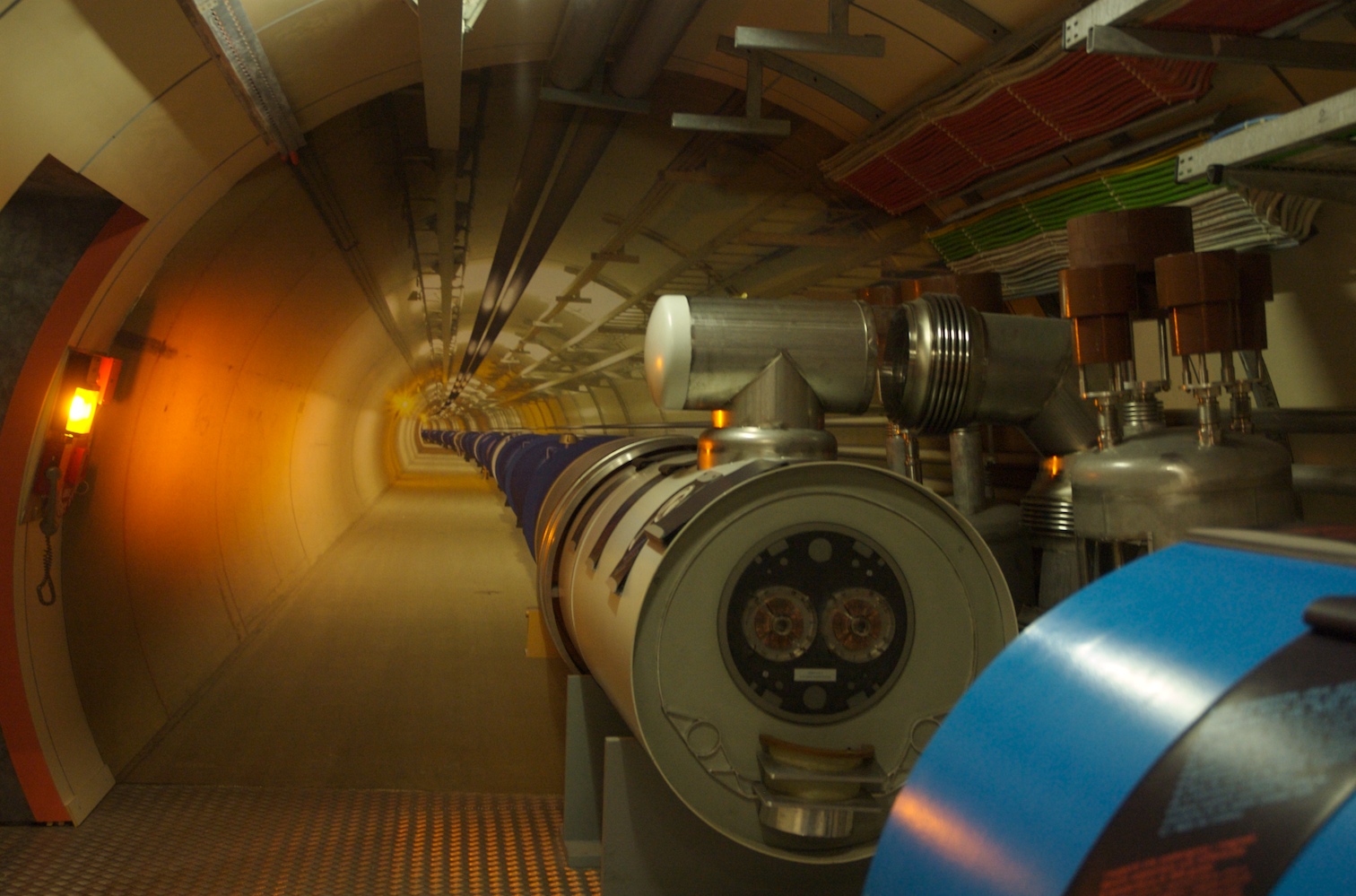
Interior of a CERN particle accelerator tunnel with scientific equipment along the curved passage.
About this picture

CERN accelerators push particles close to the vacuum speed of light, while additional energy yields ever smaller gains in speed.

Simone Cortesi, via Wikimedia Commons · CC BY 2.0 · Image source ↗

WHERE THE EVIDENCE STANDS

How sure are we?

  • The vacuum speed of light is 299,792,458 meters per second.NIST CODATA value, exact by definition.
  • A particle with rest mass can be accelerated all the way to the vacuum speed of light.Fermilab’s energy–speed formula and the Physics FAQ’s energy formula: energy grows without limit as speed approaches c; accelerator particles never exceed it.
  • Light travels more slowly through water than through a vacuum.NIST gives water’s refractive index near 1.33, the ratio of vacuum to material light speed.
  • The expansion of space can increase distant separations faster than light without a local object outrunning a light beam.NASA’s Ask an Astrophysicist: during expansion no matter or information was carried between two points faster than light; the Physics FAQ says the space between galaxies expands.
  • A tachyonic mass term proves faster-than-light communication.For fields with canonical kinetic terms, the signal boundary stays at light speed even when a negative mass-squared term makes the state unstable.
  • The 2025 black-hole calculation is a tachyon detection.The authors calculate constraints on proposed tachyons under model assumptions, rather than report a detected particle.
What the labels mean

WHAT WE DON’T KNOW YET

Relativity has passed many tests, but physicists still seek a theory that joins gravity and quantum physics, and there is no guarantee the light-speed limit will keep the same meaning in such a theory. That open problem does not make a working faster-than-light ship or signal an established possibility.

WHAT WOULD CHANGE THIS ANSWER

A repeatable, well-controlled measurement of information or a massive object moving locally faster than vacuum light, after ruling out timing and distance errors, would force a major revision of relativity.

There is a speed you cannot beat by pushing harder. In empty space, light travels at exactly 299,792,458 meters per second. That number is called c. It is more than a property of lamps and lasers. It is the local speed limit built into Einstein’s description of space and time.

Imagine trying to make a proton go faster in a particle accelerator. At first, adding energy raises its speed noticeably. Near c, the same added energy gives only a tiny increase in speed. CERN describes accelerators that push protons to speeds close to that of light, and Fermilab notes that such particles never exceed it. The closer a particle with mass gets, the more energy it takes for an ever smaller gain. Reaching c would require an unlimited amount of energy.

Why should light get special treatment? A photon has no rest mass. In a vacuum it travels at c; it is not a heavy object that begins at rest and accelerates to that speed. NASA notes that, according to Einstein, all kinds of light, from the colors we see to radio waves, travel at this same speed. The surprise is not that light happens to be fast. It is that the rules of space and time give one speed a special role.

Now put a glass of water in the way. Light moves more slowly through it. That seems to break the rule until we state the rule carefully: c is the speed of light in a vacuum. Materials interact with the light passing through them. NIST describes a material’s refractive index as the ratio of light’s speed in a vacuum to its speed in the material. A slower beam in water does not mean a spaceship could outrun the vacuum limit. It means the material changes how the light travels.

THE LONG ANSWER

THE LONG ANSWER · ABOUT 7 MINUTES

You’ve read your 3 free long answers this month.

The short answer, how sure we are, what we don’t know, what would change our mind and every source stay free on every page, for everyone.

All Access members read the long answer: the evidence piece by piece, the strongest objections, and how to check it yourself.

Join All Access · $1 a week Or $6 a month

Billed $52 once a year. Cancel anytime in your account.

Until December 4, 11:59 pm Pacific: the Founding rate is $39 a year, and it stays $39 while you stay a member.

Create a free account: 6 long answers a month, email only.

Paying never buys a different answer. Our Paywall Promise

Words worth knowing (5)
Vacuum
A region with no material medium; the defined light speed applies here.
Rest mass
The mass an object has when measured in a frame where it is at rest.
Refractive index
The ratio of light’s vacuum speed to its speed in a material.
Cherenkov light
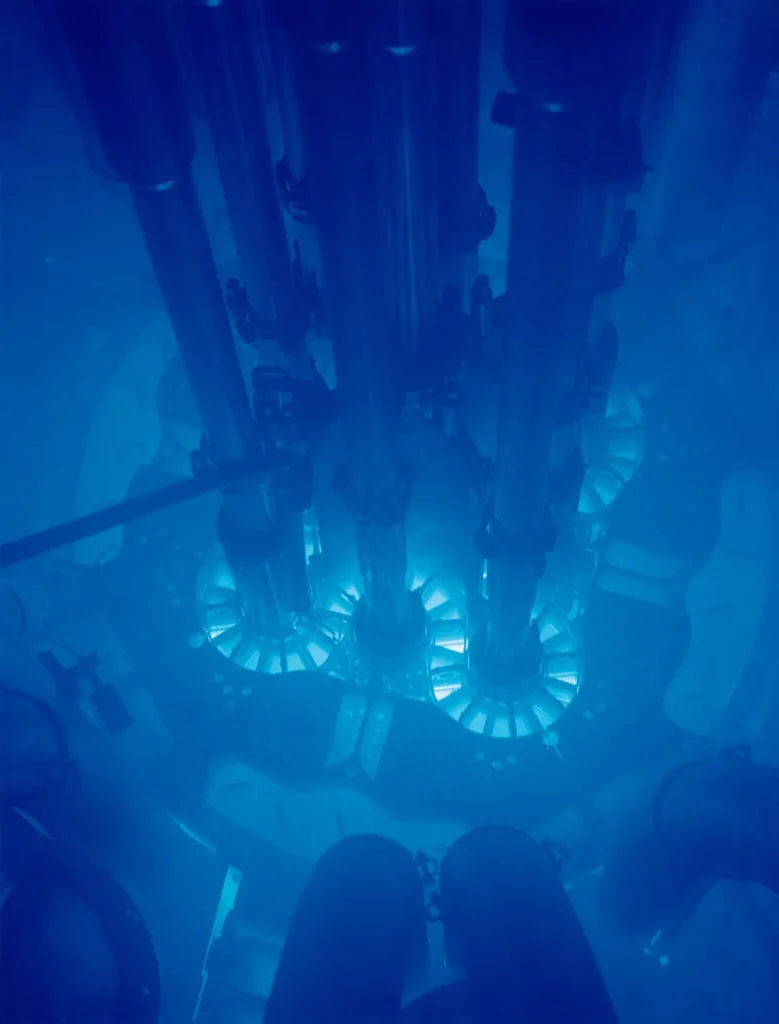
Light emitted when a charged particle moves through a material faster than light waves move through that material.
Tachyon
A hypothetical faster-than-light particle or signal. In a field with canonical kinetic terms, a tachyonic mass term instead indicates an unstable state without faster-than-light signalling.

Sources & further reading

(10) · Checked Sep 29, 2026
  1. CODATA value: speed of light in vacuum ↗NISTExact value of c.
  2. Accelerators ↗CERNAccelerators propel charged particles close to the speed of light; circular machines give an energy boost each turn; LHC protons at 6.5 TeV.
  3. Physics Questions People Ask Fermilab: particle speed ↗FermilabFormula v/c = sqrt(E²−m²c⁴)/E; massless particles always travel at c; accelerator particles travel at nearly but never exceed c; Tevatron protons at 980 GeV move at 99.999954% of c.
  4. Better Accuracy Out of Thin (or Thick) Air ↗NISTRefractive index is the ratio of vacuum light speed to light speed in a medium; air about 1.000277, water 1.33, diamond 2.419.
  5. 10 Things Einstein Got Right ↗NASAAccording to Einstein, all kinds of light travel at the same speed (about 300,000 km per second in round numbers) whatever their energy; GPS must allow for relativistic time effects.
  6. Ask an Astrophysicist: Cosmology — expansion and the speed of light ↗NASA GoddardAnswers 031030b and 070904a: inflation was an expansion of space, and no matter or information was carried between two points faster than light; space itself expands faster than light today.
  7. Cherenkov Radiation, Explained ↗U.S. Department of EnergyCharged particles can travel faster than light moves in water, which slows light to 75 percent of its vacuum speed; the blue glow around reactor cores.
  8. Faster Than Light (The Physics FAQ) ↗The Physics FAQ, hosted at UC Riverside (Philip Gibbs, 1997, 1998)Energy formula E = mc²/sqrt(1 − v²/c²) grows without limit as v approaches c; Cherenkov effect not real FTL (water or glass slow light); expansion of space; FTL in one frame means backward in time in another; no guarantee the limit keeps its meaning in a future theory.
  9. Faster-than-c signals, special relativity, and causality ↗Liberati, Sonego and Visser; Annals of Physics (2002)Section 3.1, footnote 13: hypothetical fast particles differ from field instability with canonical kinetic terms.
  10. Black Holes Rule Out Heavy Tachyons ↗Hertzberg, Loeb and Morehouse; author manuscript revised April 25, 2025Introduction: dated known-particle account. Black-hole constraints assume a proposed model; no tachyon discovery is reported.

See a mistake? Report a problem. Corrections are made openly.

The Architect AI companion · All Access

Your next question can go further.

Included with All Access →Up to 5 questions a day while available.

Put God Plays Dice on your Home Screen

On iPhone: tap Share (on iOS 26, tap ••• first), then Add to Home Screen, then Add.

On Android: In Chrome, you can also open the ⋮ menu and choose Add to Home screen or Install.

The Home Screen version keeps its own memory on iPhone, so your nights and saved answers start fresh there.

Search the Question Library

156 answers to read · 0 questions awaiting answers Your search runs on your device.

Answers about death, grief and crisis are always free, in full. If a question is personal right now →