The UniverseAnswer
Can a Planet Orbit Two Stars?
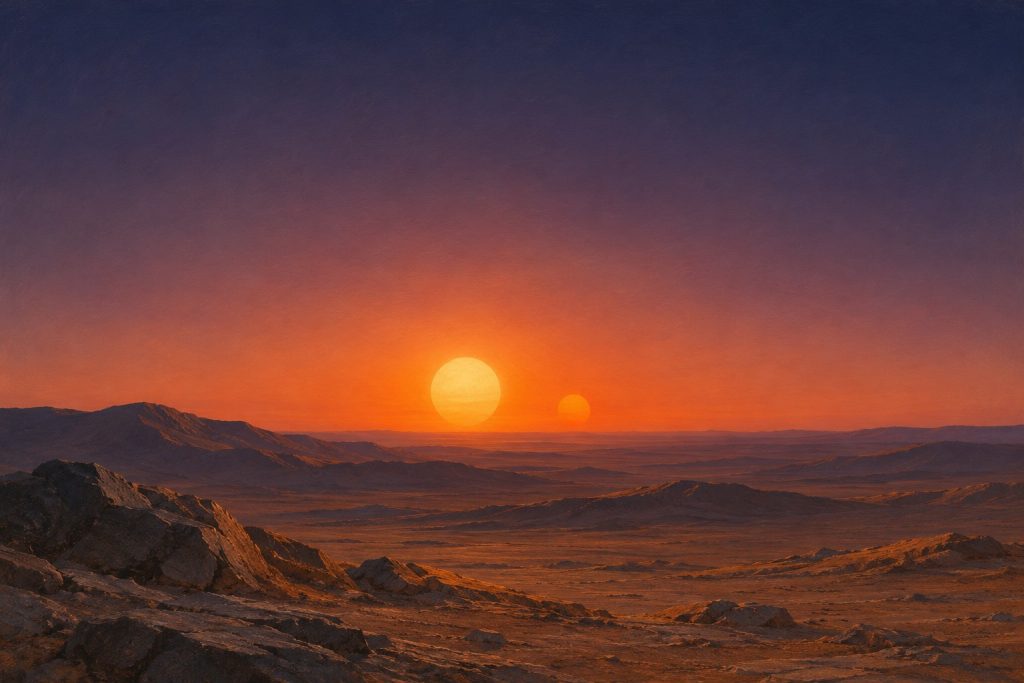
Two stars can circle each other while a planet travels around them both. Astronomers confirmed it by watching the moving stars dim.
THE QUESTION LIBRARY THE UNIVERSE
The force picture and the spacetime picture explain the same world at different levels of detail.
Both: gravity acts as a force in Newton’s model and as curved space and time in Einstein’s. The force model works well for many everyday problems. General relativity gives a deeper account that has passed demanding tests. Planets orbit because their motion carries them onward as gravity bends their paths. The Moon keeps much the same face toward Earth because it spins once during each orbit. A complete quantum account of gravity is still missing.
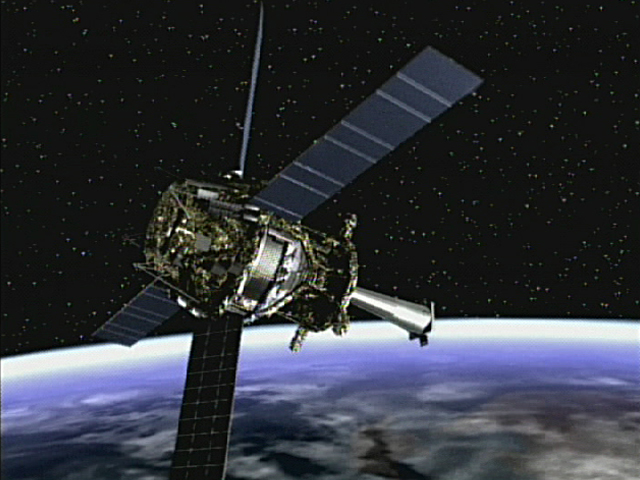
An artist’s concept of Gravity Probe B, which tested predicted spacetime effects with gyroscopes in Earth orbit.
WHERE THE EVIDENCE STANDS
WHAT WE DON’T KNOW YET
Nobody knows yet which full quantum theory of gravity, if any of the proposed accounts, nature follows. That gap does not stop us from testing gravity on larger scales.
WHAT WOULD CHANGE THIS ANSWER
A clear, repeatable mismatch with general relativity would show where a better model is needed. A quantum theory would gain support by making new predictions that tests could distinguish from its rivals.
Both descriptions work: gravity is a force in Newton's model, and a change in the shape of space and time in Einstein's. Which description you need depends on what you are trying to explain. They are ways to describe the same world, with different ranges of use.
The question often starts with a small puzzle. A dropped cup falls, but the Moon stays up. Astronauts float, yet their spacecraft stays near Earth. These scenes can seem to call for different rules. Looking at the motion helps connect them.
An orbiting planet is still falling toward the Sun. Its sideways motion carries it onward while gravity bends its path. A spacecraft in orbit falls too. The people and loose objects inside fall with it, so they float relative to one another. Floating does not mean that Earth's gravity has switched off.
The Moon gives us another useful clue. It turns once on its axis during each trip around Earth. That matched motion keeps much the same side facing us. Earlier in its history, tides changed its spin. This is called tidal locking; it does not mean the Moon stands still.
You do not have to choose between an apple and a curved universe. The force picture helps with everyday motion. The deeper picture connects gravity to spacetime: the combined description of where and when events happen. Tests with satellites and waves from distant events let scientists check that picture against measurements.
There is still a frontier. Physicists do not yet have a tested, complete account joining gravity with the quantum rules used for tiny particles. That gap matters. It does not erase the parts of gravity that we can measure and use.
THE LONG ANSWER · ABOUT 6 MINUTES
The short answer, how sure we are, what we don’t know, what would change our mind and every source stay free on every page, for everyone.
All Access members read the long answer: the evidence piece by piece, the strongest objections, and how to check it yourself.
Join All Access · $1 a week Or $6 a month
Billed $52 once a year. Cancel anytime in your account.
Until December 4, 11:59 pm Pacific: the Founding rate is $39 a year, and it stays $39 while you stay a member.
Create a free account: 6 long answers a month, email only.
Paying never buys a different answer. Our Paywall Promise
Next on the path “Where did everything come from?” · step 5 of 7
How do we know dark matter exists if we cannot see it?
We know it from its gravity.
See this path: Where did everything come from?
God Plays Dice answers big questions in plain words, with sources and one of six honest labels.
See a mistake? Report a problem. Corrections are made openly.
CONTINUE THE THREAD
The UniverseAnswer
Two stars can circle each other while a planet travels around them both. Astronomers confirmed it by watching the moving stars dim.
The UniverseAnswer
An everywhere-present field, a fleeting particle and a famous nickname. What did CERN’s experiments actually measure?
The UniverseAnswer
Why the matter surplus remains unexplained, what Sakharov's conditions require, and how sphalerons and proposed neutrino mechanisms might connect.
The Architect AI companion · All Access
Labels describe the evidence for a claim, not the people who hold it.
Match my phone uses your device’s light or dark setting.