The UniverseExplainer
Is There a Theory of Everything?
Physicists have merged forces of nature before. Gravity is the holdout, and no candidate theory of everything has yet passed a decisive test.
THE QUESTION LIBRARY THE UNIVERSE
The Standard Model describes known particles and three fundamental forces, with tested successes and clear limits.
The Standard Model is a tested set of rules for known basic particles and three forces: the strong force, the weak force, and electromagnetism. It explains a vast range of results from particle experiments. It leaves out gravity and does not identify dark matter or explain dark energy. Its original simplest form also leaves out neutrino masses, which observations require. It is a powerful working theory with unfinished questions.
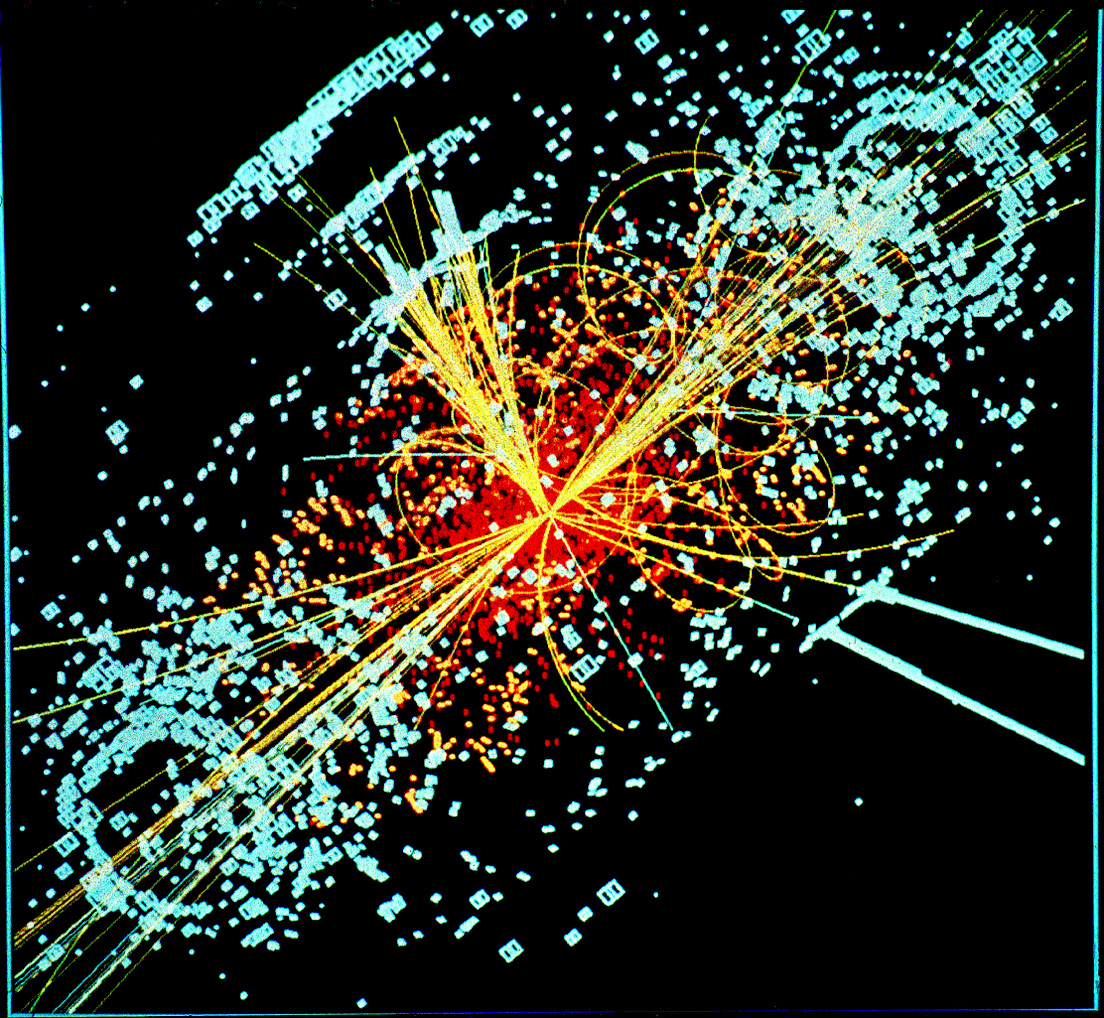
A simulated CMS Higgs event display, not a photograph of a particle or the actual discovery event; lines and colors represent detector information.
WHERE THE EVIDENCE STANDS
WHAT WE DON’T KNOW YET
We do not know the source of neutrinos’ tiny masses or the identity of dark matter. We also lack a complete account that joins gravity with the particle rules.
WHAT WOULD CHANGE THIS ANSWER
A repeatable mismatch between a precise prediction and a measurement could reveal new particles or rules. Any replacement would still need to explain the results that already fit.
An atom is not the last stop in the search for matter’s parts. It contains electrons and a nucleus. The nucleus contains protons and neutrons, which have quarks inside them. The Standard Model describes these basic particles and how they interact. It is more than a chart of names. Its rules let physicists calculate results that experiments can test.
The matter particles fall into two groups. Quarks help make protons and neutrons. Leptons include electrons and neutrinos. An electron is familiar from atoms and electric currents. A neutrino has no electric charge and interacts so rarely that most pass through matter without leaving a trace.
The model also describes three forces. Electromagnetism governs electric charge and light. The strong force holds quarks together. The weak force takes part in particle changes, including some radioactive processes. Gravity is missing from this list. It also leaves dark matter unidentified and does not explain dark energy or the cosmic matter excess.
The Higgs field has another role. Its interactions give mass to basic particles such as electrons and quarks. Scientists found the Higgs boson, a particle associated with that field, in 2012. This was a major successful test. It did not complete every part of physics or explain all the mass of a proton in one step.
Neutrinos show the difference between a successful theory and a finished one. Experiments find that their detected types can change as they travel. This requires differences in masses, with at least some masses above zero. The original simplest Standard Model treated them as massless. Extending the rules can include their masses, but why those masses are so tiny remains unknown. The theory’s successes and this gap are both part of an honest account.
THE LONG ANSWER · ABOUT 6 MINUTES
The short answer, how sure we are, what we don’t know, what would change our mind and every source stay free on every page, for everyone.
All Access members read the long answer: the evidence piece by piece, the strongest objections, and how to check it yourself.
Join All Access · $1 a week Or $6 a month
Billed $52 once a year. Cancel anytime in your account.
Until December 4, 11:59 pm Pacific: the Founding rate is $39 a year, and it stays $39 while you stay a member.
Create a free account: 6 long answers a month, email only.
Paying never buys a different answer. Our Paywall Promise
God Plays Dice answers big questions in plain words, with sources and one of six honest labels.
See a mistake? Report a problem. Corrections are made openly.
CONTINUE THE THREAD
The UniverseExplainer
Physicists have merged forces of nature before. Gravity is the holdout, and no candidate theory of everything has yet passed a decisive test.
The UniverseAnswer
Two stars can circle each other while a planet travels around them both. Astronomers confirmed it by watching the moving stars dim.
The UniverseAnswer
An everywhere-present field, a fleeting particle and a famous nickname. What did CERN’s experiments actually measure?
The Architect AI companion · All Access
Labels describe the evidence for a claim, not the people who hold it.
Match my phone uses your device’s light or dark setting.