Skip to content
BackGOD PLAYS DICE™Big questions, honest answers

THE QUESTION LIBRARY GOD & BELIEF

What are the main arguments for God’s existence, and how do people respond to them?

Five classic families of arguments, plus Pascal’s wager, each at full strength and each with the strongest replies, for believers and skeptics alike.

THE SHORT ANSWER

There are five classic kinds: cosmological arguments (why anything exists, or why the universe began), design and fine-tuning arguments, the ontological argument, moral arguments, and arguments from religious experience. Each has careful defenders and careful critics. None has won over everyone who studies it. Pascal’s wager argues instead that betting on God is wise. Some pieces touch science, like whether the universe began. Whether God exists is beyond what science can settle.
  • Cosmological arguments, such as the kalam argument, reason from the fact that the universe exists, or began, to a first cause.
  • Design arguments point to order in nature, and today often to numbers in physics that seem set just right for life.
  • The ontological argument tries to show from the idea of God alone that God must exist.
  • Moral arguments say God best explains real right and wrong, and experience arguments treat a sense of meeting God as evidence.
  • Every argument has serious replies, and every reply has answers, so reasonable people still disagree.
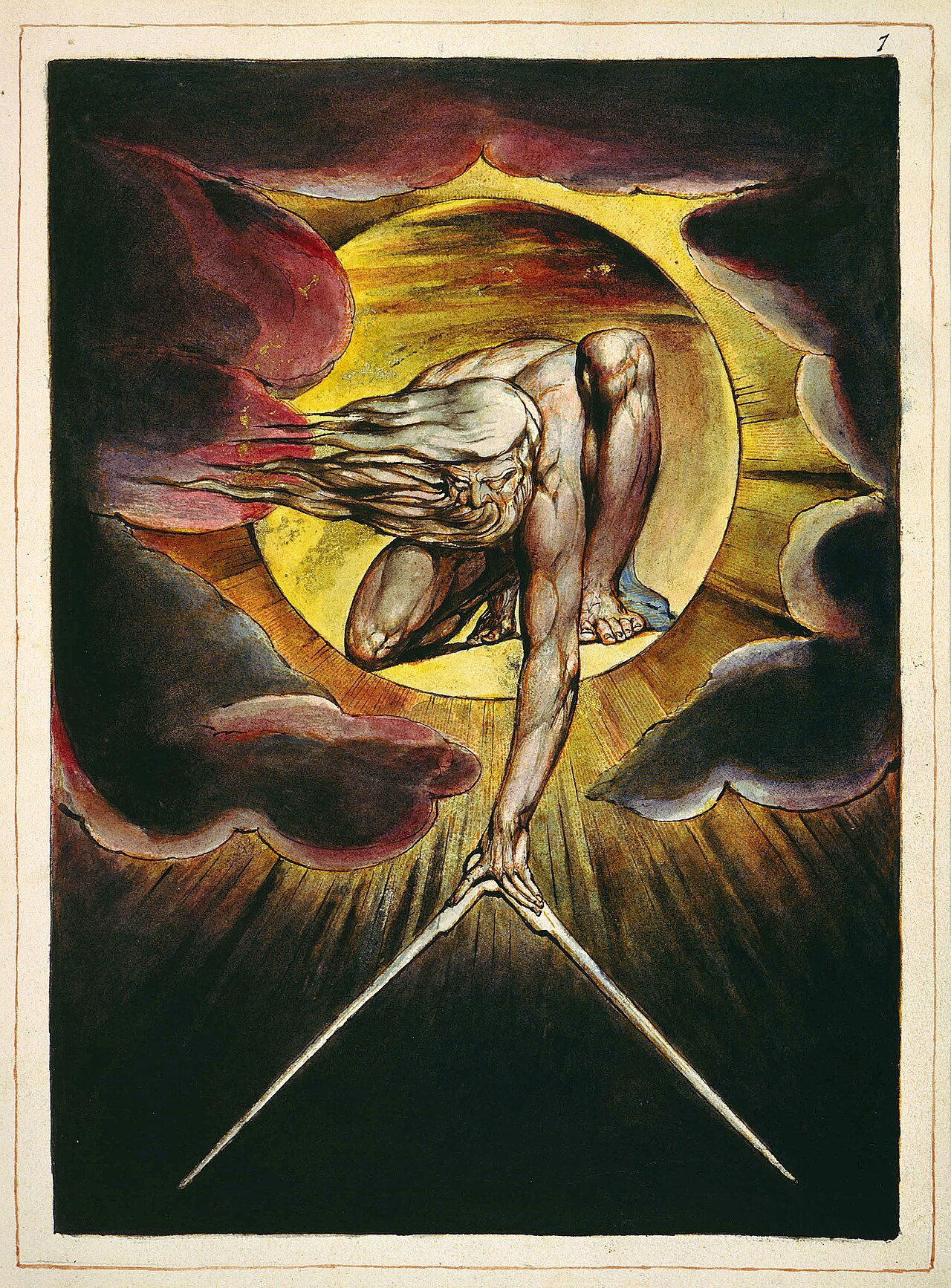
A painting of an old man with long white hair and beard crouching inside a glowing yellow circle among dark red clouds. He reaches down with one arm holding a pair of dividers, a drawing compass whose two points stretch into the darkness below.
About this picture

The Ancient of Days, the opening plate of William Blake’s book Europe a Prophecy, first printed in 1794. The image of a maker measuring out the world has long stood for questions of design, which believers and skeptics read in different ways.

William Blake; Fitzwilliam Museum, Cambridge (copy K), via the William Blake Archive and Wikimedia Commons · Public domain · Image source ↗

WHERE THE EVIDENCE STANDS

How sure are we?

  • The universe had an absolute beginning, as the kalam argument’s second step needs.The Stanford Encyclopedia (Cosmological Argument, sections 8.4–8.5) says this step leans on cosmology, is only probably true, and faces changing models, doubts that general relativity applies at the very start, and the view that the Big Bang is not an event.
  • Whether a universe can support life depends delicately on the values of some constants of nature.The Stanford Encyclopedia (Fine-Tuning) reports this as the view of many physicists, with examples such as the strong force and the cosmological constant; whether it calls for any special explanation is disputed.
  • Fine-tuning shows that a designer set the constants.The Stanford Encyclopedia entries on fine-tuning and design arguments list rival responses (a lucky coincidence, future physics, a designer, a multiverse, observer selection) and major criticisms of each. Choosing a designer over its rivals is a philosophical judgment; no measurement decides it.
  • One of the classic arguments settles God’s existence for every careful thinker.The Stanford Encyclopedia says every thesis in the cosmological debate is seriously contested and that no moral argument is a proof; each argument keeps prominent defenders and critics.
  • God exists, or God does not exist.The arguments on both sides are philosophical, resting on premises about causes, necessity, value and experience that experiments cannot test directly.
What the labels mean

WHAT WE DON’T KNOW YET

Nobody knows yet whether the universe had a true first moment, or why some numbers in physics have the values they do. Thinkers still disagree about which steps in these arguments are true.

WHAT WOULD CHANGE THIS ANSWER

New physics could change the science pieces. It might show the universe had no beginning, or explain why the numbers are what they are. The main answer would change only if God’s existence became something we could test directly.

There are five classic kinds of arguments for God. Cosmological arguments start from the fact that the world exists, or began. Design arguments start from order in nature, such as the way some laws of physics seem set just right for life. The ontological argument starts from the idea of God itself. Moral arguments start from right and wrong. And arguments from experience start from people’s sense of meeting God.

Each one has serious defenders, and each one has serious critics. After many centuries of debate, no single argument has won over everyone who studies it with care. That does not mean one side is foolish. The Stanford Encyclopedia of Philosophy, a leading guide, says every claim in the debate over the first kind is seriously disputed. Its entry on moral arguments says no version counts as a proof, since each rests on steps that many thoughtful people reject. It adds that most defenders today do not claim to offer proofs in that strict sense.

People ask about these arguments for many reasons. A believer may want to know whether faith has good reasons behind it. Someone who grew up religious may wonder whether the arguments they heard hold up. A skeptic may want to know the best case, not the weakest one. All of these are fair reasons to ask, and all of them deserve the strongest version of each side.

So this page lays out each argument at full strength, then the best replies, then how defenders answer back. It also covers Pascal’s wager. That is not an argument that God exists. It says it is wise to bet that God does.

Some pieces touch science, such as whether the universe had a beginning, or whether some numbers in physics are finely set for life. We label those pieces on their own. But the main question, whether God exists, is one science cannot settle. We label it Beyond science. You are welcome here, whatever you believe.

THE LONG ANSWER

THE LONG ANSWER · ABOUT 9 MINUTES

You’ve read your 3 free long answers this month.

The short answer, how sure we are, what we don’t know, what would change our mind and every source stay free on every page, for everyone.

All Access members read the long answer: the evidence piece by piece, the strongest objections, and how to check it yourself.

Join All Access · $1 a week Or $6 a month

Billed $52 once a year. Cancel anytime in your account.

Until December 4, 11:59 pm Pacific: the Founding rate is $39 a year, and it stays $39 while you stay a member.

Create a free account: 6 long answers a month, email only.

Paying never buys a different answer. Our Paywall Promise

See this path: Can faith and science share a table?

Words worth knowing (6)
Contingent
Able to have not existed. People, planets and stars are contingent.
Necessary being
A being that could not fail to exist. Cosmological arguments from contingency conclude that such a being exists.
Kalam argument
A cosmological argument, developed by medieval Muslim theologians and defended today by William Lane Craig: whatever begins to exist has a cause, the universe began, so it has a cause.
Fine-tuning
The claim that a universe can support life only if some physical constants fall within very narrow ranges.
Multiverse
The idea that there are many universes with different physical settings. It is proposed, not observed.
Premise
A step an argument assumes. If a premise is false, the argument fails, even if its logic is fine.

Sources & further reading

(8) · Checked Sep 29, 2026
  1. Cosmological Argument ↗Stanford Encyclopedia of Philosophy (substantive revision 1 July 2026)History (Plato, Aristotle, Ibn Sina, Aquinas, al-Ghazali 1058–1111); Craig’s kalam steps; Russell’s “just there, and that’s all”; Morriston and quantum objections and Craig’s replies; premise 2 only probably true and dependent on changing cosmology; Big Bang as a non-event; the gap from a first cause to God; every thesis seriously contested; Oppy on reasonable disagreement.
  2. Teleological Arguments for God’s Existence ↗Stanford Encyclopedia of Philosophy (substantive revision 5 April 2023)Paley’s watch (1802); Hume’s objections in the Dialogues (1779); Darwinian natural selection as an alternative; fine-tuning examples including the strong force (the entry says 0.4%, citing Oberhummer et al. 2000; the paper itself says 0.5%, so this page uses the paper); weak anthropic principle, Sober’s fishing-net analogy, probability worries, multiverse and its critics; appeals to future science as a promissory note.
  3. Fine-Tuning ↗Stanford Encyclopedia of Philosophy (substantive revision 26 February 2026)Fine-tuning for life is the view of many physicists; the responses (coincidence, future theory, a designer, a multiverse); whether improbability calls for any response is contested; the inverse gambler’s fallacy charge identified by Ian Hacking (1987).
  4. Stellar Production Rates of Carbon and Its Abundance in the Universe ↗Science 289: 88–90 (2000), H. Oberhummer, A. Csótó and H. SchlattlAbstract: outside a narrow window of 0.5% (strong force) and 4% (Coulomb force), stellar production of carbon or oxygen drops by factors of 30 to 1,000. Abstract read from the arXiv record astro-ph/0007178; bibliographic details from Crossref.
  5. Ontological Arguments ↗Stanford Encyclopedia of Philosophy (substantive revision 3 June 2024)Anselm’s Proslogion (eleventh century), Descartes, Plantinga’s modal version; Gaunilo’s perfect-island parody; Kant on existence as a predicate; the reverse (symmetry) objection; Russell’s remark; Plantinga’s claim that the argument shows belief is rational rather than proving it.
  6. Moral Arguments for the Existence of God ↗Stanford Encyclopedia of Philosophy (substantive revision 4 October 2022)The two-step template; C. S. Lewis’s Mere Christianity (1952); subjectivist and error-theory replies; Wielenberg’s godless normative realism; the Euthyphro dilemma and Adams’s reply; conclusion that no version is a proof but each spells out the cost of rejecting God.
  7. Religious Experience ↗Stanford Encyclopedia of Philosophy (substantive revision 26 August 2022)Swinburne’s Principle of Credulity (1979); Alston and Plantinga; religious diversity and naturalistic explanations as the two main defeaters; the reply that every experience has a matching brain state; James on evidence for the experiencer versus the hearer.
  8. Pascal’s Wager ↗Stanford Encyclopedia of Philosophy (substantive revision 11 September 2022)Pensées §233: reason cannot decide, yet we must wager; infinite gain; the many gods objection (Diderot 1746); Pascal’s advice to act as believers do; Clifford (1877) and Voltaire’s objections.

See a mistake? Report a problem. Corrections are made openly.

The Architect AI companion · All Access

Your next question can go further.

Included with All Access →Up to 5 questions a day while available.

Put God Plays Dice on your Home Screen

On iPhone: tap Share (on iOS 26, tap ••• first), then Add to Home Screen, then Add.

On Android: In Chrome, you can also open the ⋮ menu and choose Add to Home screen or Install.

The Home Screen version keeps its own memory on iPhone, so your nights and saved answers start fresh there.

Search the Question Library

156 answers to read · 0 questions awaiting answers Your search runs on your device.

Answers about death, grief and crisis are always free, in full. If a question is personal right now →