The UniverseExplainer
What Is a Black Hole, Really?
Not really holes and not cosmic vacuum cleaners, black holes are places where matter is packed so tightly that not even light can climb back out.
THE QUESTION LIBRARY THE UNIVERSE
Mass, horizon size and a glowing image tell different parts of the story; spin adds another clue.
Black holes span masses from a few Suns to billions, and our galaxy has one at its center: Sagittarius A*, with about four million solar masses. Mass, horizon width and the shadow seen against glowing gas are different measurements. Spin changes motion nearby and is inferred from gas or merger signals. Tiny primordial black holes remain hypothetical. We do not have a settled universal smallest or largest size.
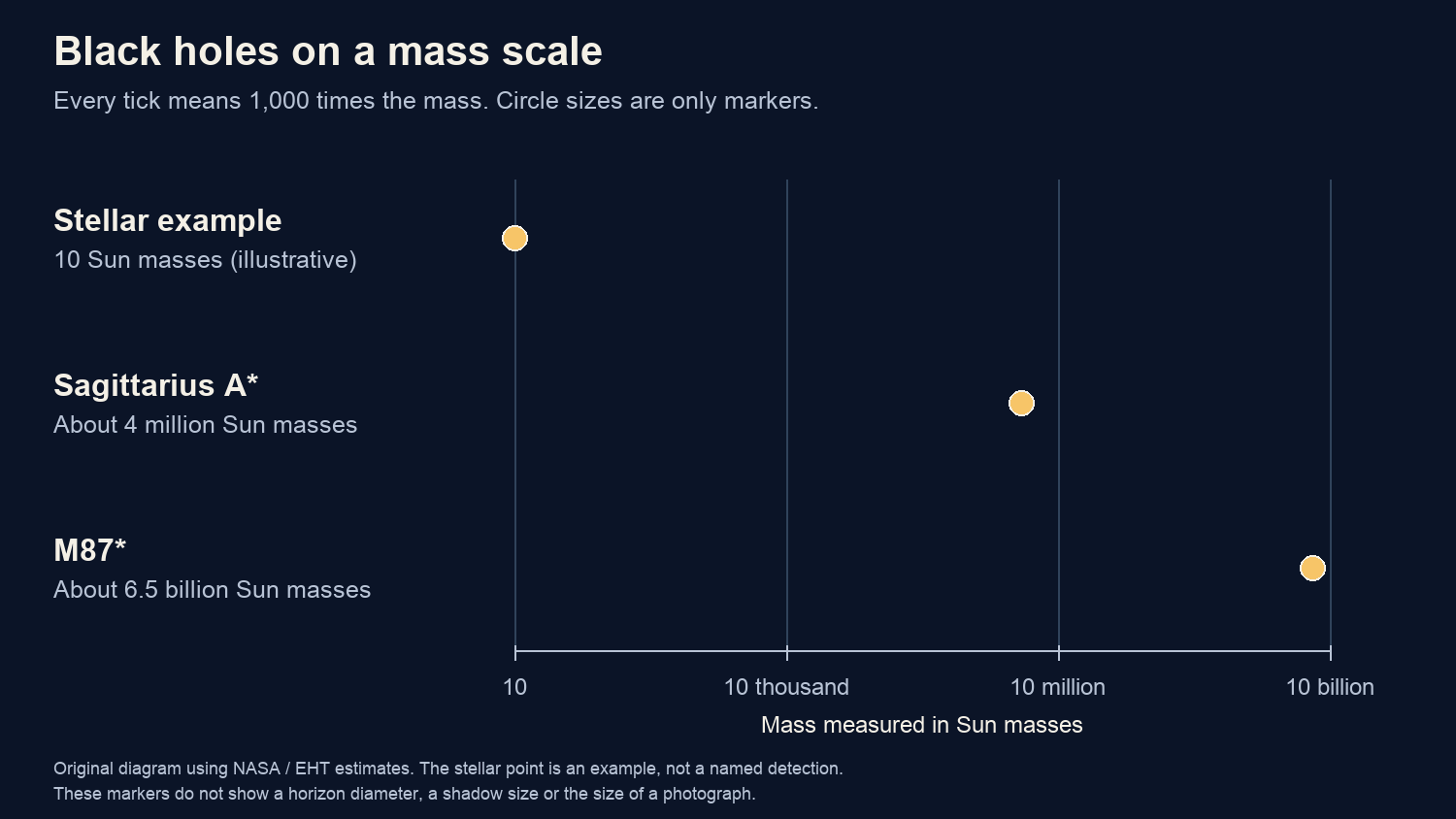
Original mass diagram on a logarithmic scale. The 10-Sun point is illustrative; Sagittarius A* is about four million Sun masses. M87* uses the Event Horizon Telescope’s 2019 estimate of about 6.5 billion. Equal circles mark mass, not horizon widths or image sizes.
WHERE THE EVIDENCE STANDS
WHAT WE DON’T KNOW YET
We do not know how the giant population first formed or whether primordial black holes exist. Some low-mass objects remain hard to classify. The exact spin inferred for an object can change when measurements or models improve.
WHAT WOULD CHANGE THIS ANSWER
A clear tiny-black-hole detection would change the observed size range. Better tests could settle ambiguous light objects and sharpen spin estimates. A universal mass limit would need a supported physical argument, not a current record alone.
Black holes range from objects with a few times the Sun's mass to giants with billions of times its mass. Yes, one sits at the center of our galaxy. It is called Sagittarius A*, and it has about four million Suns' worth of mass. That is enormous, but it is far less massive than some black holes in other galaxies.
The word big needs care. Mass tells you how much an object contributes to gravity. The event horizon is its boundary of no return. Its shadow is the dark region seen against light from nearby gas. These are related, but they are not the same measurement. A gas disk can extend well beyond the horizon.
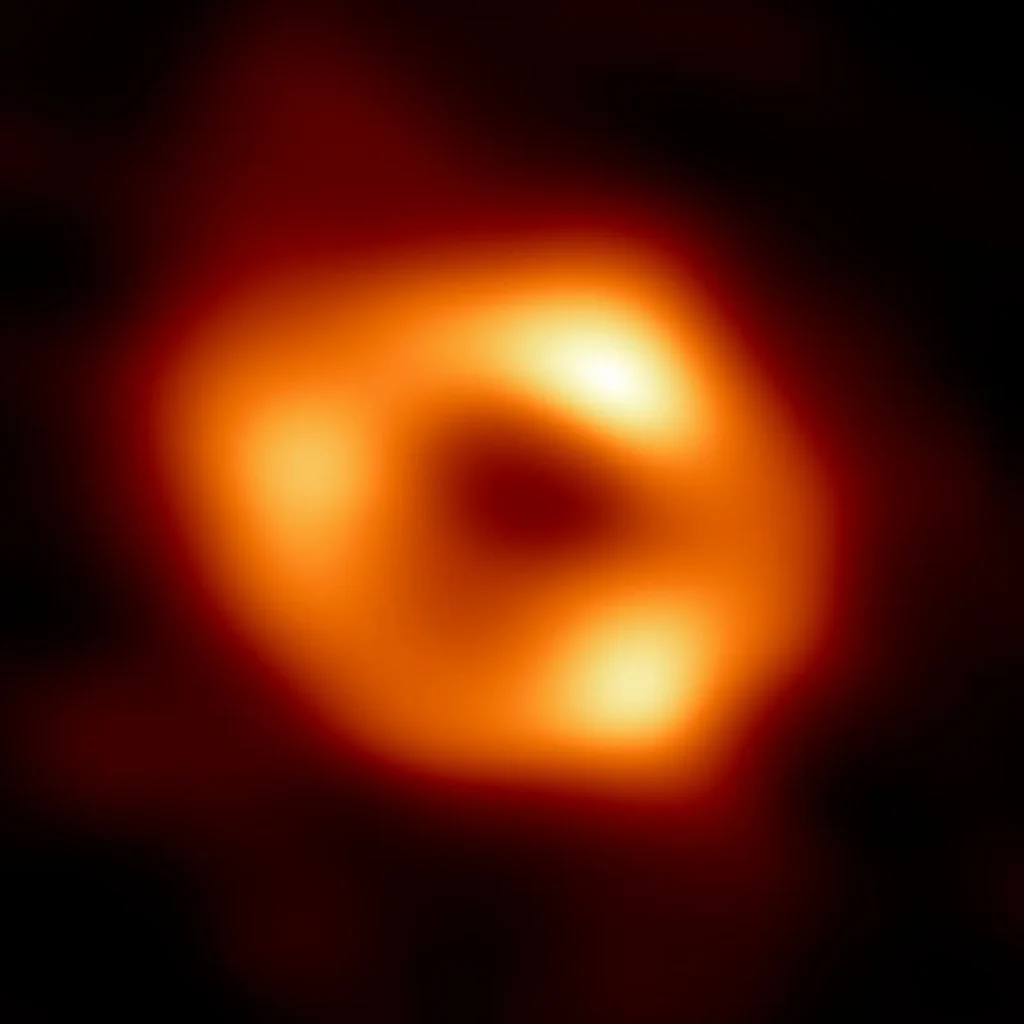
The image released in 2019 showed the shadow and bright gas around M87*, in another galaxy. The 2022 image showed Sagittarius A*. Neither lets us see inside a black hole. Nor does a picture's size on your screen tell you how large the object is in space.
Small black holes need a separate explanation. The low end of the observed mass range can be hard to distinguish from very dense stellar remnants called neutron stars. Much tinier black holes appear in theories about the early universe. Those primordial black holes have not been confirmed. An atom-sized horizon is a hypothetical possibility, not a photographed example.
Black holes can also spin. Here spin means angular momentum, the physical quantity associated with rotation. It changes motion near the hole and helps researchers interpret gas and wave signals. A black hole is not a solid ball with a marked spot to watch turning. Scientists infer its spin from effects on its surroundings or a merger signal.
THE LONG ANSWER · ABOUT 6 MINUTES
The short answer, how sure we are, what we don’t know, what would change our mind and every source stay free on every page, for everyone.
All Access members read the long answer: the evidence piece by piece, the strongest objections, and how to check it yourself.
Join All Access · $1 a week Or $6 a month
Billed $52 once a year. Cancel anytime in your account.
Until December 4, 11:59 pm Pacific: the Founding rate is $39 a year, and it stays $39 while you stay a member.
Create a free account: 6 long answers a month, email only.
Paying never buys a different answer. Our Paywall Promise
God Plays Dice answers big questions in plain words, with sources and one of six honest labels.
See a mistake? Report a problem. Corrections are made openly.
CONTINUE THE THREAD
The UniverseExplainer
Not really holes and not cosmic vacuum cleaners, black holes are places where matter is packed so tightly that not even light can climb back out.
The UniverseAnswer
Two stars can circle each other while a planet travels around them both. Astronomers confirmed it by watching the moving stars dim.
The UniverseAnswer
An everywhere-present field, a fleeting particle and a famous nickname. What did CERN’s experiments actually measure?
The Architect AI companion · All Access
Labels describe the evidence for a claim, not the people who hold it.
Match my phone uses your device’s light or dark setting.