A visitor from another star raised a fair question, so here is what was observed, what was inferred, whether the evidence supports an alien probe, and what is still unresolved.
What’s rated: “3I/ATLAS was an alien probe or carried alien technology.”God Plays Dice Editorial · independently fact-checked · corrections welcomeChecked Sep 29, 202610 min read
THE SHORT ANSWER
No evidence shows that it was. 3I/ATLAS, found on July 1, 2025, is only the third object known to have visited us from another star system. It had a dusty coma and tails and released comet gases such as carbon dioxide and water. NASA and ESA call it a comet, and radio searches found no artificial signals. Astrophysicist Avi Loeb argued that its oddities deserved a technology check. Some puzzles remain, but even he wrote that it is most likely natural.
3I/ATLAS is the third known object to pass through our solar system from interstellar space, after ‘Oumuamua in 2017 and 2I/Borisov in 2019.
More than a dozen NASA missions, including Hubble and Webb, saw comet behavior: dust, tails, and gases including carbon dioxide, water, carbon monoxide and methane.
Radio searches with the Allen Telescope Array, the Green Bank Telescope, MeerKAT and FAST found no artificial signals, though MeerKAT did pick up natural radio lines from hydroxyl gas.
The July 2025 paper that asked whether it was alien technology called itself largely a teaching exercise and said a natural object, probably a comet, was by far the most likely outcome.
By our arithmetic, the small extra push in NASA JPL’s orbit fit is roughly a thousand times weaker than the push that paper said it would need to reach Jupiter.
About this picture
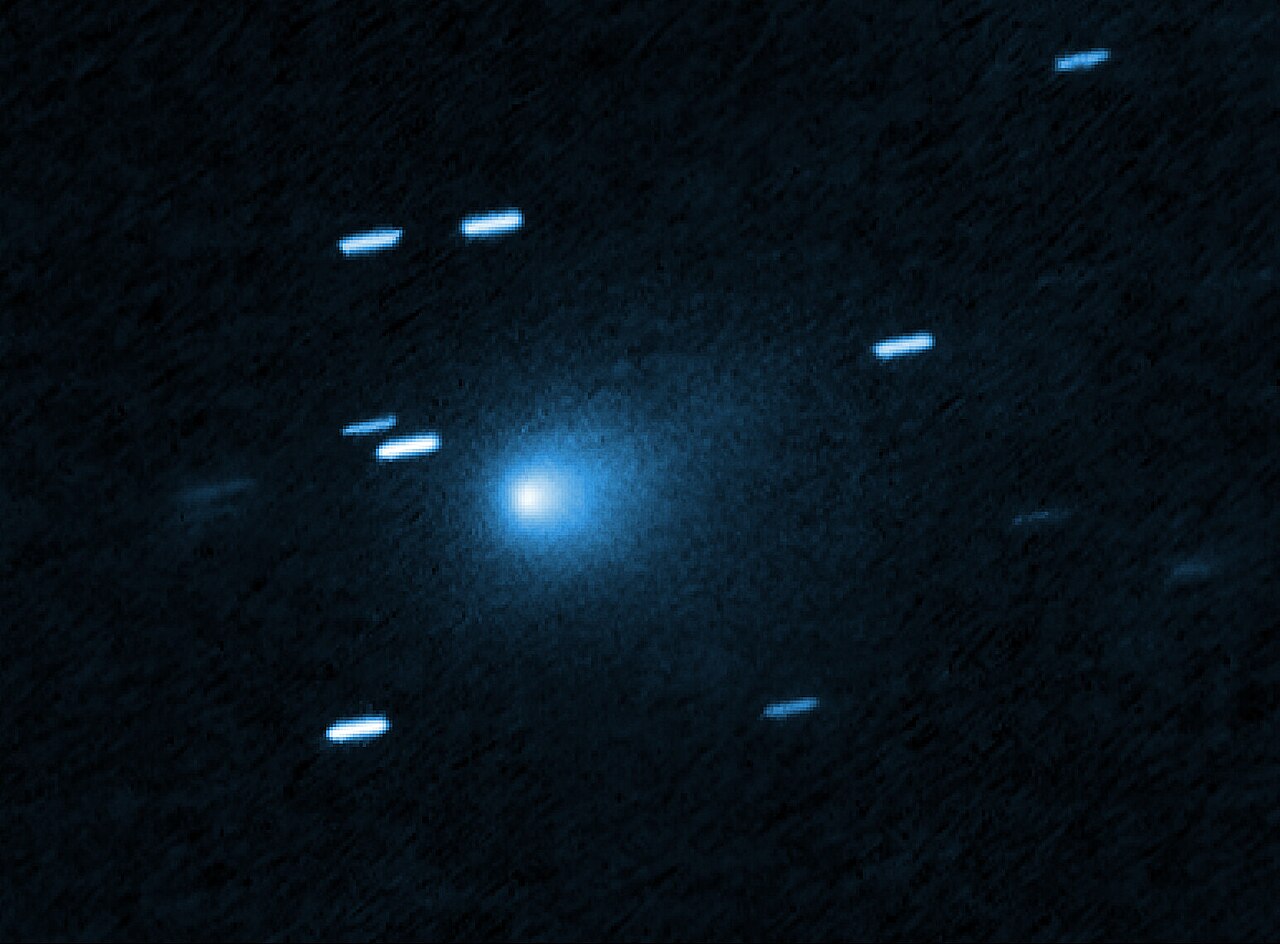
Hubble photographed 3I/ATLAS on July 21, 2025, and showed a teardrop-shaped cocoon of dust coming off its solid, icy core. NASA said its dust behaved much like that of comets from our own solar system. The short streaks are background stars, smeared because Hubble was tracking the moving comet.
NASA, ESA, D. Jewitt (UCLA); image processing: J. DePasquale (STScI), via ESA/Hubble and Wikimedia Commons · CC BY 4.0 · Image source ↗
WHERE THE EVIDENCE STANDS
How sure are we?
3I/ATLAS came from outside our solar system.Its path is strongly hyperbolic, with an eccentricity of about 6.1 (discovery team; JPL Small-Body Database, 6.14), so it moved too fast for the Sun’s gravity to hold it.
3I/ATLAS behaves like a comet, releasing dust and gas as it warms.Hubble saw a dusty coma and a plume from the Sun-warmed side; Webb found carbon dioxide, water and carbon monoxide (plus a tentative sign of carbonyl sulfide), and later methane. NASA and ESA both describe it as a comet.
3I/ATLAS was an alien probe or carried alien technology.Radio searches with the Allen Telescope Array (1–9 GHz), the Green Bank Telescope (1–12 GHz), MeerKAT and FAST found no artificial signals (MeerKAT did detect radio lines from hydroxyl gas, which matched what its observers expected from a comet); NASA says its small path changes fit outgassing; the 2025 alien-technology paper itself judged a completely natural object, probably a comet, by far the most likely outcome.
Scientists have explained its carbon dioxide-rich gas and its early excess of nickel.Webb measured a carbon dioxide-to-water ratio of 7.6, among the highest seen in a comet. Nickel appeared before iron; a 2026 preprint explains the metals with compounds that turn to gas easily and break apart in sunlight. These explanations are still being tested.
3I/ATLAS formed billions of years ago, before our Sun.Webb found about 30 times more deuterium than in solar system comets and only traces of carbon-13 (NASA). The team’s Nature paper (June 2026) says it may have formed as long as 12 billion years ago and notes significant uncertainties in that age; it adds that ALMA and Very Large Telescope teams also found unusual isotope ratios. ESA calls it billions of years old, based on its speed. The age estimate comes from one team’s model.
Nobody knows exactly how big its solid core is: Hubble limits as of August 2025 put it between 440 meters and 5.6 kilometers across. Scientists are still working out why its gas was so rich in carbon dioxide and why nickel showed up early. Its home star is unknown.
WHAT WOULD CHANGE THIS ANSWER
A narrow radio signal traced to the object, a change of course that escaping gas cannot explain, or objects released from it, confirmed by independent teams using public data, would change this answer. Loeb himself named releases near Jupiter, artificial lights or unexpected maneuvers as possible signs.
No. Nothing found so far shows that 3I/ATLAS was an alien probe, and every test points to a natural comet from another star system. But the question is fair, and it deserves a careful look, not a laugh.
3I/ATLAS was spotted on July 1, 2025, by the NASA-funded ATLAS survey telescope in Chile. The name tells its story. The “I” stands for interstellar, and the “3” means it is the third known object to pass through our solar system from outside it, after ‘Oumuamua in 2017 and 2I/Borisov in 2019. It moved too fast for the Sun’s gravity to hold it, so it made one pass and headed back out.
Why did people wonder? Its path lies close to the flat plane the planets move in, but it travels the opposite way. It was hidden behind the Sun, as seen from Earth, at its closest point to the Sun. Early data showed a glow pointing toward the Sun and more nickel than iron in its gas. Avi Loeb, a Harvard astrophysicist, co-wrote a paper asking whether it could be alien technology. Rumors of an alien ship spread, and NASA officials later moved to dispel them.
Then the data poured in. More than a dozen NASA missions, including Hubble and Webb, watched it, along with European spacecraft at Mars and on the way to Jupiter. They saw what comets do: a cloud of dust and gas, tails, and gases such as carbon dioxide, water, carbon monoxide and methane. Radio telescopes found no artificial signals, though they did pick up natural radio fingerprints of gases around it. NASA and the European Space Agency both call it a comet.
Some puzzles remain. Its gas was unusually rich in carbon dioxide, and its chemistry hints that it may be older than our Sun. Those are real mysteries, but they are mysteries about a comet. Asking “could it be artificial?” was reasonable. So far, the evidence says no.
THE LONG ANSWER
THE LONG ANSWER · ABOUT 8 MINUTES
You’ve read your 3 free long answers this month.
The short answer, how sure we are, what we don’t know, what would change our mind and every source stay free on every page, for everyone.
All Access members read the long answer: the evidence piece by piece, the strongest objections, and how to check it yourself.
An object, such as a comet, that comes from outside our solar system. 3I/ATLAS is the third one known.
Hyperbolic orbit
An open path past the Sun. The object moves too fast for the Sun’s gravity to hold it, so it passes once and leaves.
Coma
The cloud of gas and dust that surrounds a comet’s icy core as it warms up.
Non-gravitational acceleration
A small push on a comet’s path that gravity does not explain, usually caused by gas escaping from the comet like a weak rocket.
Technosignature
Evidence of technology made by someone elsewhere in the universe, such as a narrow radio signal.
Loeb Scale
A 0-to-10 scale proposed by Avi Loeb and colleagues for rating interstellar objects, from 0 for a natural comet or asteroid to 10 for alien technology that could threaten humanity.
Sources & further reading
(10) · Checked Sep 29, 2026
Comet 3I/ATLAS ↗NASA ScienceOverview: ATLAS in Rio Hurtado, Chile, reported it to the Minor Planet Center on July 1, 2025; pre-discovery images back to June 14 (three ATLAS telescopes, ZTF); closest to Earth about 1.8 au (270 million km); closest to the Sun around Oct. 30, 2025 at about 1.4 au, just inside Mars’s orbit; Hubble nucleus limits 440 m to 5.6 km (as of Aug. 20, 2025); list of NASA assets. Facts & FAQs (https://science.nasa.gov/solar-system/comets/3i-atlas/3i-atlas-facts-and-faqs/): 221,000 km/h at discovery, 246,000 km/h at perihelion; characteristics, color, speed and direction consistent with a comet; outgassing perturbations small and compatible; ‘Oumuamua 2017, 2I/Borisov 2019; Earth on the opposite side of the Sun at perihelion; associate administrator Amit Kshatriya. Hubble release, Aug. 7, 2025 (https://science.nasa.gov/missions/hubble/as-nasa-missions-study-interstellar-comet-hubble-makes-size-estimate/): teardrop-shaped cocoon of dust, plume from the Sun-warmed side; Jewitt: no one knows where it came from. Webb methane, June 1, 2026 (https://science.nasa.gov/blogs/3iatlas/2026/06/01/nasas-webb-detects-methane-on-interstellar-comet-3i-atlas/): first direct methane detection on an interstellar visitor; ApJL doi:10.3847/2041-8213/ae5700. Webb origin, June 22, 2026 (https://science.nasa.gov/missions/webb/nasas-webb-finds-clues-to-ancient-distant-origin-of-comet-3i-atlas/): deuterium about 30 times solar system comets, traces of carbon-13, could have formed 10 to 12 billion years ago, Sun formed 4.5 billion years ago, paper in Nature June 22; separate VLT study led by Cyrielle Opitom. The paper: Cordiner et al., “Isotopic evidence for a cold and distant origin of 3I/ATLAS,” Nature 655, 870-874 (2026), doi:10.1038/s41586-026-10771-6: water D/H = (0.98 ± 0.06)%, 12C/13C 141-191 (CO2) and 123-172 (CO); may have accreted as long ago as 12 billion years (isotopic age 11-12 Gyr in one model); uncertainties significant; exact time and place of origin highly uncertain; ALMA (Salazar Manzano et al.) and VLT (Opitom et al.) also found increased D/H and 12C/13C; notes the earlier JWST observations of 6 August 2025. Open data, Mar. 20, 2026 (https://science.nasa.gov/open-science/interstellar-comet-3i-atlas-data/): TESS caught it in May 2025; more than a dozen NASA missions; data in MAST, IRSA and PDS; an interstellar object may pass about once per year. JPL Small-Body Database API (https://ssd-api.jpl.nasa.gov/sbdb.api?sstr=3I): orbit solution 2026-02-19, 782 observations, e = 6.14, q = 1.36 au, i = 175 deg; non-gravitational A1 = 5.32e-8, A2 = 1.148e-8, A3 = -6.854e-9 au/d^2 with g(r) = (1 au/r)^2 for CO2.
Comet 3I/ATLAS – frequently asked questions ↗European Space AgencyShape and behaviour indicate it is a comet; about 250,000 km/h at closest approach to the Sun, the highest ever recorded for a Solar System visitor; closest to Earth about 270 million km (Dec. 19, 2025); perihelion 29 Oct. 2025, just inside Mars’s orbit; Mars Express and ExoMars TGO observed it around its Mars approach on Oct. 3, 2025 at about 29 million km; Juice data arrived February 2026 and are being analysed; XRISM and XMM-Newton saw diffuse X-ray glow.
Discovery and Preliminary Characterization of a Third Interstellar Object: 3I/ATLAS ↗arXiv (2025), Seligman, Micheli, Farnocchia and colleagues (discovery team)Discovered 2025 July 1 UT; eccentricity about 6.1, perihelion about 1.36 au, inclination about 175 degrees, hyperbolic excess speed about 58 km/s; deep CFHT and VLT images resolve a compact coma.
JWST Detection of a Carbon-dioxide-dominated Gas Coma Surrounding Interstellar Object 3I/ATLAS ↗The Astrophysical Journal Letters 991, L43 (2025), Cordiner and colleaguesarXiv:2508.18209. NIRSpec at 3.32 au inbound: observed UT 2025-08-06; CO2-dominated coma with H2O, CO, water ice and dust, and OCS (the arXiv v3 abstract lists OCS as present; the published ApJL abstract calls it a tentative detection); CO2/H2O = 7.6 ± 0.3, among the highest ever observed in a comet; possible explanations: ices exposed to more radiation, or formation near the CO2 ice line.
Is the Interstellar Object 3I/ATLAS Alien Technology? ↗arXiv (July 16, 2025), Hibberd, Crowl and LoebAbstract: “largely a pedagogical exercise”; hypothesizes it could be technological and possibly hostile (Dark Forest); close approaches to Venus, Mars and Jupiter with probability ≲0.005%; perihelion eclipse would allow a clandestine braking manoeuvre. Table 1: orbital plane virtually in the ecliptic though retrograde (i = 175.11 deg, p ~ 0.2%), too large to be an asteroid, no spectral signs of outgassing. Jupiter-intercept acceleration about 5.85e-5 au/day^2 normalized at 1 au. Conclusion: by far the most likely outcome is a completely natural object, probably a comet. Related: Keto and Loeb, MNRAS (2025), doi:10.1093/mnras/staf2054 (anti-tail as sunlit extension of the sublimating ice-grain snow line); Thoss, Loeb and Burkert, arXiv:2603.15735 (submitted to A&A; radius 0.42 km if CO2 dominates); Eldadi, Tenenbaum and Loeb, arXiv:2508.09167 (Loeb Scale: levels 0-3 natural, 4-7 increasingly anomalous, 8-10 confirmed artificial origin; 3I/ATLAS Level 4).
Updating the Loeb Classification Scale of 3I/ATLAS ↗Avi Loeb, Medium (Dec. 21, 2025)Medium blocks scripts; read via Internet Archive snapshot 20260715025957. Scale from 0 (natural comets or asteroids) to 10 (alien technology that is a potential threat to humanity); ranked 4; 3I/ATLAS is most likely a natural object; black swan rationale; without a clear technological signature he will revise the rank downward; release of objects near Jupiter, artificial lights or unexpected maneuvers would count. Also: “Anomalies of 3I/ATLAS, Organized by Likelihood” (Nov. 23, 2025; snapshot 20251123220148; names the NASA press conference of November 19, 2025): forecast perijove of 53.445 million km vs Jupiter’s Hill radius of 53.502 million km, which "might mean" it intends to release devices as artificial satellites of Jupiter; nickel vs iron compared to industrial nickel alloys, sunward jet, mass, polarization, brightening, Wow! Signal within 9 degrees; “3I/ATLAS is Fading Away…” (Mar. 12, 2026; snapshots 20260312190550 and 20260325213304): 22 anomalies; “Where is 3I/ATLAS Now?” (Apr. 23, 2026; snapshot 20260517233229): no evidence of artificial light in the fading light curve, waiting for Juno data from around March 16, 2026, perijove 53.6 million km vs Hill radius 53.5 million km, iron detected after perihelion, still Level 4. “First Radio Signal from 3I/ATLAS” (Nov. 8, 2025; snapshot 20251108132841): calls MeerKAT’s OH absorption the first radio detection of 3I/ATLAS. Bio: head of the Galileo Project; Baird Professor of Science at Harvard.
Origin and evolution of NiI and FeI in the coma of the interstellar comet 3I/ATLAS throughout its trajectory ↗arXiv (May 2026, submitted to A&A), Hutsemékers, Manfroid, Opitom and colleaguesNot yet peer reviewed. Metal emission strong shortly after perihelion; Ni/Fe ratio, anomalously large before perihelion, evolved toward solar-system comet values near 2 au; carbonyl hypothesis (Fe(CO)5, Ni(CO)4). Earlier detection: Rahatgaonkar and colleagues, ApJL 995, L34 (2025), doi:10.3847/2041-8213/ae1cbc (Ni lines, Fe undetected). Context: ESO press release eso2108, May 19, 2021 (https://www.eso.org/public/news/eso2108/): Fe and Ni in about 20 Solar System comets, some more than 480 million km from the Sun, in approximately equal amounts; nickel vapour in 2I/Borisov (Nature, doi:10.1038/s41586-021-03435-0 and doi:10.1038/s41586-021-03485-4).
Breakthrough Listen Observations of 3I/ATLAS with the Green Bank Telescope at 1–12 GHz ↗Research Notes of the AAS (Dec. 24, 2025), Jacobson-Bell and colleaguesarXiv:2512.19763. Observed 2025 Dec. 18, about one day before closest approach to Earth; no isotropic continuous-wave transmitters above 0.1 W (cell phone about 1 W); probes, like Voyager 1 and 2, expected to use narrowband radio; all data to be public. Other searches: MeerKAT (SARAO, South Africa), ATel #17473 (https://www.astronomerstelegram.org/?read=17473; Pisano et al.): OH absorption at 1665 and 1667 MHz on 24 Oct. 2025, consistent with the expected OH level population for the comet; ATel #17499 (https://www.astronomerstelegram.org/?read=17499): OH absorption on 5-6 Nov. and emission on 11-12 Nov. 2025, and a BLUSE narrowband technosignature search on 5 Nov. 2025 in which all 23,689 signals were inconsistent with the comet’s position (likely human interference), limit 0.17 W over 900-1670 MHz; Sheikh and colleagues, Allen Telescope Array, 1–9 GHz, nothing worth follow-up (arXiv:2512.18142, accepted to AJ); Li, Tao and Zhang, FAST, four dates Oct. 2025–Jan. 2026, no credible signals above 2.862e-3 W (ApJ 1006, 163, 2026, doi:10.3847/1538-4357/ae8025); Li and colleagues, FAST periodic search, nothing above 0.146 W (AJ 172, 172, 2026, doi:10.3847/1538-3881/ae8755).
NASA releases close-up pictures of interstellar comet 3I/Atlas ↗PBS News / Associated Press (Nov. 20, 2025)Published Nov. 20, 2025; NASA unveiled the pictures "on Wednesday" (Nov. 19; Loeb’s Nov. 23 post also names a NASA press conference on November 19, 2025). NASA officials dispelled rumors of an alien ship and said the federal government shutdown kept them from responding to all the theories; Kshatriya: the agency is always on the hunt for life beyond Earth, "but 3I/Atlas is a comet"; Mars spacecraft saw it from about 29 million km; Juice is bound for Jupiter.
Loeb’s 3I/ATLAS “Anomalies” Explained ↗Jason Wright, AstroWright blog, Penn State (Nov. 9, 2025)Director of the PSETI Center; probabilities computed for features chosen after they were known; no two comets seem quite alike; nickel, polarization, water abundance and brightening are real puzzles that interest planetary scientists. Also: Davenport and colleagues, “Technosignature Searches of Interstellar Objects,” arXiv:2508.16825 (2025): examination of ISOs for technosignatures must become routine; care must be taken identifying technosignatures based mainly on comparison to Solar System objects.
What evidence exists for Bigfoot and the Loch Ness monster? Examine tested hairs, the Loch Ness DNA survey, detection limits and what a verified discovery would require.
Can animals sense earthquakes or storms? Separate early-wave detection and observed storm avoidance from reliable prediction, with evidence and limits.
Supported, still debated3 min read
THE OCCASIONAL LETTER
Stay curious.
New stories, book updates, and notes from God Plays Dice, delivered when there is something worth sharing.
EMAIL UPDATES ↗
500 DIGITAL COPIES • GIVEAWAY PREVIEW
Be first to know when the 500-copy reader giveaway opens.
Join for the book launch, verified retailer links, and the announcement for a planned giveaway of 500 digital copies. The giveaway is not open yet: dates, eligibility, a dedicated entry form, and Official Rules will be published first.
Privacy · Check your inbox to confirm your subscription. Newsletter signup alone is not a giveaway entry.