Life showed up early on a young Earth, and nature can make some of its raw parts, but the step from chemistry to the first living cell is still one of science’s big open questions.
God Plays Dice Editorial · independently fact-checked · corrections welcomeChecked Sep 26, 20268 min read
THE SHORT ANSWER
Nobody knows yet. Life was on Earth by about 3.5 billion years ago, and maybe earlier, on a planet about 4.54 billion years old. Experiments show that some of life’s building blocks can form without life, and asteroid samples carry amino acids and all five nucleobases used in DNA and RNA. But no experiment has yet shown the whole path from chemistry to a living cell, and scientists still debate where it happened.
Earth formed about 4.54 billion years ago, according to the U.S. Geological Survey.
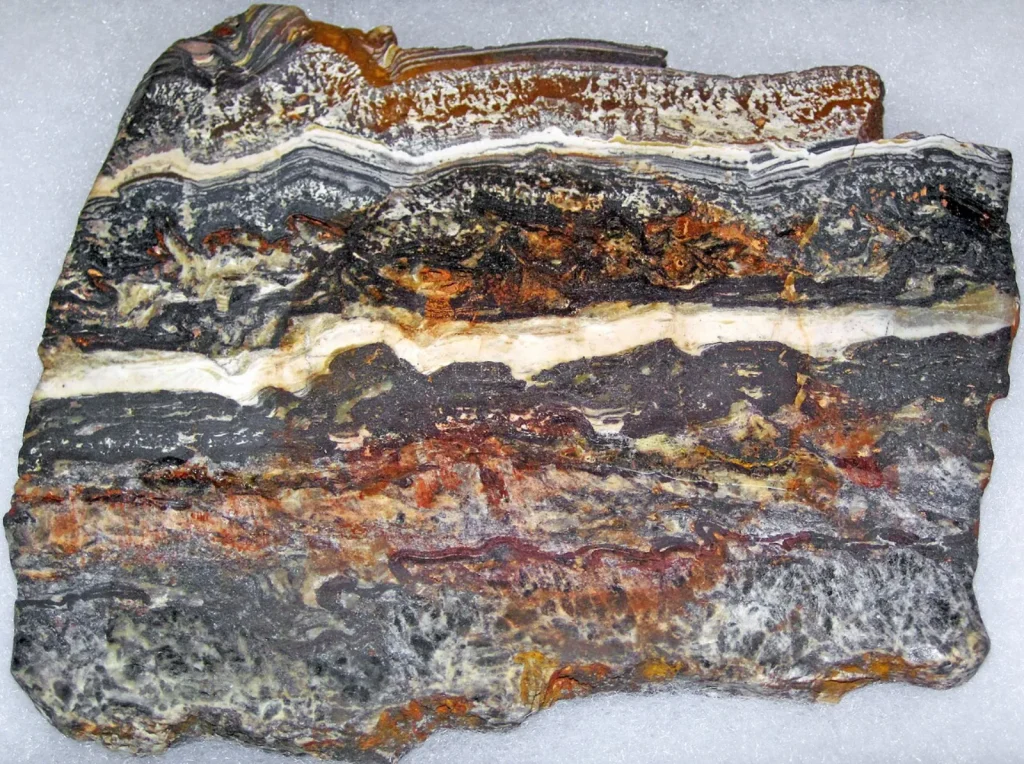
Rocks in Western Australia hold widely accepted signs of life from about 3.48 billion years ago; older signs, some claimed to be more than 4 billion years old, are debated.
In the 1950s, the scientist Stanley Miller made amino acids by sending electric sparks through a mix of gases and water.
RNA can both carry genetic information and speed up chemical reactions, which is why many scientists think early life relied on it.
Samples from asteroid Bennu contain 14 of the 20 amino acids life uses to build proteins and all five nucleobases found in DNA and RNA.
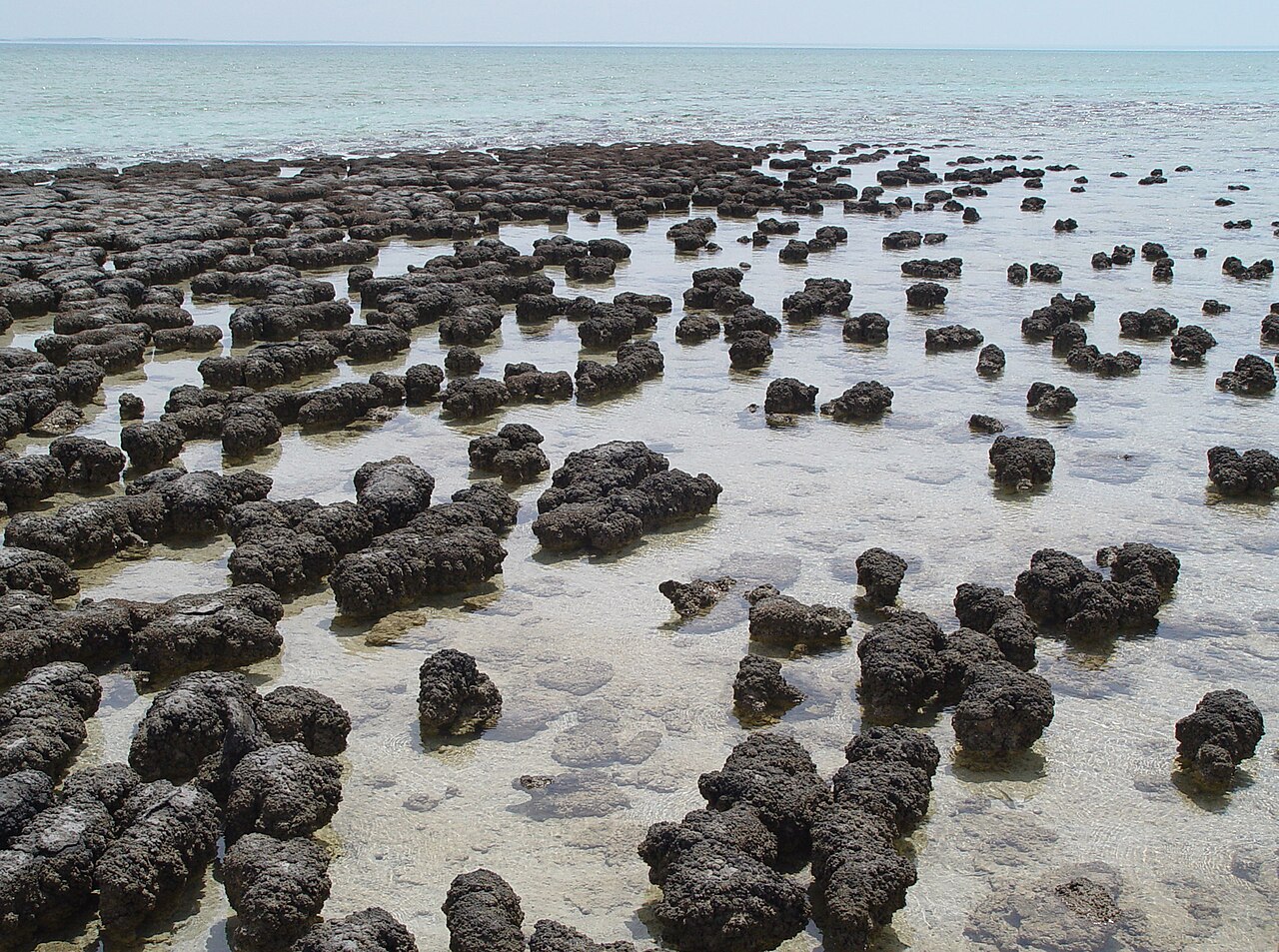
About this picture
Living stromatolites in Hamelin Pool, Shark Bay, Western Australia, photographed in 2005. Mounds like these are built by mats of microbes, and similar layered structures in 3.48-billion-year-old Australian rock are among the oldest widely accepted signs of life.
Life existed on Earth by about 3.5 billion years ago, and possibly a few hundred million years earlier.The 3.48-billion-year-old Dresser Formation in Western Australia holds some of the earliest convincing evidence (Djokic et al. 2017). Older claims, such as 3.7-billion-year-old Greenland “stromatolites” (Nutman et al. 2016, challenged by Allwood et al. 2018), Canadian vent structures at least 3.77 billion years old (Dodd et al. 2017) and 4.1-billion-year-old carbon in a zircon (Bell et al. 2015), are debated.
Some of life’s chemical building blocks can form without life.Miller’s spark experiments of the 1950s made amino acids (reanalyzed by Johnson et al. 2008 and Parker et al. 2011). Meteorites carry nucleobases (Oba et al. 2022), Ryugu samples carry uracil (Oba et al. 2023), and Bennu samples carry 14 of the 20 protein amino acids and all five nucleobases (Glavin et al. 2025).
Early life relied on RNA before DNA and proteins took over (the RNA world).Altman and Cech showed that RNA can act as an enzyme (Nobel Prize in Chemistry 1989), and the Nobel committee called it very likely that RNA molecules were the first to carry both genetic information and catalysis. Walter Gilbert’s 1986 Nature paper was titled “The RNA world.” Damer and Deamer (2020) argue that life’s start cannot be reduced to a single kind of molecule.
We know where and how the first living cells formed.Dodd et al. (2017) state that it is not known when or where life began. Deep-sea vents (Martin et al. 2008) and hot-spring pools on land (Damer and Deamer 2020) are rival, testable ideas, and key steps are still unsolved.
Whether life’s origin has an ultimate purpose or a Creator behind it.The U.S. National Academies say supernatural entities are not part of nature and cannot be investigated by science, and that pinning unexplained things on God weakens both science and religion.
Nobody knows where life started, which chemical steps came first, or how the first cell took shape. Key steps, such as a working self-sustaining set of reactions, have not been shown in the lab, and the oldest dates for life are still argued over.
WHAT WOULD CHANGE THIS ANSWER
A lab system that starts from simple chemicals and begins to copy itself and evolve under early-Earth conditions would move the “how” much closer to an answer. Finding life that began separately, on Mars or an icy moon, would show whether life starts easily.
Nobody knows yet. That is the honest answer, and it is also an exciting one. Scientists know a lot about when life appeared and what it is made of. What they don’t know is exactly how non-living chemicals first became something alive.
People come to this question from many directions. Some grew up with a creation story and wonder what science says. Some saw a headline about “life’s ingredients” found on an asteroid. Some simply lie awake wondering how anything alive could come from rock, water and air. All of these are good reasons to ask.
Here is the core picture. Earth formed about 4.54 billion years ago. By about 3.48 billion years ago, microbes were building layered mounds called stromatolites in what is now Western Australia. Some scientists see signs of life hundreds of millions of years earlier, but those older cases are still argued over.
We also know that nature can make some of life’s raw parts. In the 1950s, the scientist Stanley Miller sent sparks, like tiny lightning bolts, through gases and water and got amino acids, the building blocks of proteins. Rocks from space carry similar molecules. Samples from the asteroid Bennu hold 14 of the 20 amino acids that life uses, and all five nucleobases, the “letters” of DNA and RNA.
But having parts is not the same as having life. Think of it as an analogy: a pile of bricks is not a house. (The analogy breaks down because bricks never arrange themselves, while molecules do react and link up on their own. The open question is how far that can go.) Scientists still debate whether life started at hot vents on the sea floor or in warm pools on land. Many think early life ran on RNA, a cousin of DNA. None of this is settled, so we label the “how” an Open question.
Science describes these natural steps. It does not rule on whether life has an ultimate purpose. That question is Beyond science, and readers of every belief are welcome to explore it here.
THE LONG ANSWER
THE LONG ANSWER · ABOUT 6 MINUTES
You’ve read your 3 free long answers this month.
The short answer, how sure we are, what we don’t know, what would change our mind and every source stay free on every page, for everyone.
All Access members read the long answer: the evidence piece by piece, the strongest objections, and how to check it yourself.
A layered rock mound built up over time by mats of microbes. Some still grow today, for example in Shark Bay, Western Australia.
Amino acid
A small molecule that living things link into long chains to make proteins. Life on Earth uses 20 main kinds.
Nucleobase
One of the chemical “letters” in DNA and RNA, such as adenine or uracil.
RNA world
The idea that early life used RNA both to store genetic information and to speed up chemical reactions, before DNA and proteins took over those jobs.
Last universal common ancestor (LUCA)
The most recent population from which all life on Earth today descends. It was already a cell, so it came after life began.
Abiogenesis
The natural process by which life might arise from non-living chemistry.
Sources & further reading
(10) · Checked Sep 26, 2026
Age of the Earth ↗U.S. Geological SurveyBest age for Earth and the Solar System 4.54 billion years, uncertainty less than 1 percent; Isua rocks of West Greenland 3.7 to 3.8 billion years; Western Australian zircon crystals as much as 4.3 billion years old.
Earliest signs of life on land preserved in ca. 3.5 Ga hot spring deposits (Djokic et al.) ↗Nature Communications 8, 15263 (2017)The ca. 3.48 Ga Dresser Formation, Pilbara Craton, holds some of Earth’s earliest convincing evidence of life (stromatolites, isotopes, microfossils) plus hot-spring deposits with microbial signs. Nutman et al. (Nature 2016, doi:10.1038/nature19355) also call the 3,480-million-year Dresser evidence the previous most convincing and generally accepted.
Potentially biogenic carbon preserved in a 4.1 billion-year-old zircon (Bell et al.) ↗PNAS 112, 14518–14521 (2015)Graphite in a 4.10-billion-year-old Jack Hills zircon with isotopes consistent with a biogenic origin (“may be evidence”). Also read: Dodd et al., Nature 543, 60 (2017), doi:10.1038/nature21377, putative microfossils at least 3,770 and possibly 4,280 million years old, “it is not known when or where life on Earth began”; Moody et al., Nature Ecology & Evolution 8, 1654 (2024), doi:10.1038/s41559-024-02461-1, LUCA about 4.2 Ga (4.09–4.33 Ga), a prokaryote-grade cell.
Primordial synthesis of amines and amino acids in a 1958 Miller H2S-rich spark discharge experiment (Parker et al.) ↗PNAS 108, 5526–5531 (2011)Miller’s 1950s experiments (Science 117, 528, 1953, doi:10.1126/science.117.3046.528) used H2, H2O, CH4 and NH3, then thought to represent the early atmosphere; many geoscientists now favor a weakly reducing early atmosphere; volcanic-plume conditions. Johnson et al., Science 322, 404 (2008), doi:10.1126/science.1161527: the volcanic apparatus produced a wider variety of amino acids than the classic one.
The Nobel Prize in Chemistry 1989: press release ↗NobelPrize.orgSidney Altman and Thomas Cech, catalytic properties of RNA; the discovery “came as a complete surprise to scientists”; “very likely” that RNA molecules were the first biomolecules to carry both genetic information and catalysis. Walter Gilbert, “Origin of life: The RNA world,” Nature 319, 618 (1986), doi:10.1038/319618a0 (Crossref metadata). Koonin, “Frozen Accident Pushing 50,” Life 7, 22 (2017), doi:10.3390/life7020022: Crick’s frozen accident; any change in codon assignment would be highly deleterious; the code is highly robust to errors; no compelling explanation for codon assignments.
The Hot Spring Hypothesis for an Origin of Life (Damer and Deamer) ↗Astrobiology 20, 429–452 (2020), open access (PMC7133448)Wet-dry cycling in volcanic hot-spring pools; concentration in small freshwater pools versus dilution in the ocean; Darwin’s 1871 “warm little pond” letter to Hooker; Orgel epigraph; self-sustaining reaction cycles a key unsolved problem. Rival view: Martin, Baross, Kelley and Russell, “Hydrothermal vents and the origin of life,” Nature Reviews Microbiology 6, 805 (2008), doi:10.1038/nrmicro1991.
NASA’s Asteroid Bennu Sample Reveals Mix of Life’s Ingredients (Jan. 29, 2025) ↗NASA14 of the 20 amino acids and all five nucleobases; delivered 2023; no evidence for life itself; equal mix of left- and right-handed amino acids; why life “turned left” remains a mystery. Paper: Glavin et al., Nature Astronomy 9, 199 (2025), doi:10.1038/s41550-024-02472-9. Ryugu: Oba et al., Nature Communications 14, 1292 (2023), doi:10.1038/s41467-023-36904-3 (uracil). Meteorites: Oba et al., Nature Communications 13, 2008 (2022), doi:10.1038/s41467-022-29612-x (all five canonical nucleobases).
About Life Detection (NASA definition of life) ↗NASA Astrobiology“Life is a self-sustaining chemical system capable of Darwinian evolution.” Virus definition: NHGRI Talking Glossary (https://www.genome.gov/genetics-glossary/Virus), a virus cannot replicate alone and must infect cells. Koonin and Starokadomskyy, Studies in History and Philosophy of Biological and Biomedical Sciences 59, 125 (2016), doi:10.1016/j.shpsc.2016.02.016: whether viruses are alive depends entirely on the definition of life.
Evolution Resources: science and religion questions ↗National Academies of Sciences, Engineering, and MedicineSupernatural entities are not part of nature and cannot be investigated by science; claims that attribute the unexplained to a deity weaken both science and religion; “god of the gaps.”
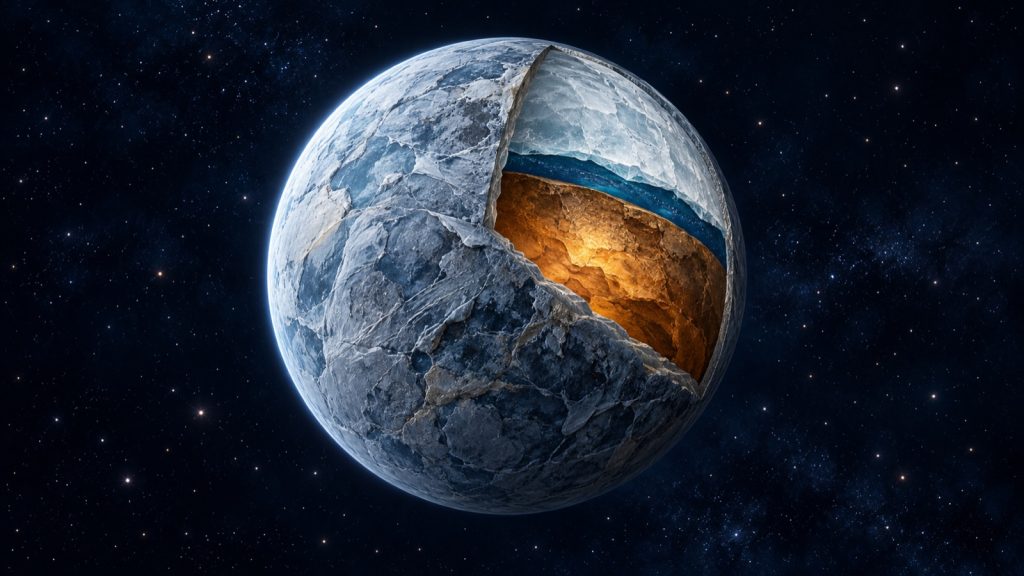
A world with no sunrise could still have internal heat. The question is whether it can keep water liquid and supply usable energy.
Open question4 min read
THE OCCASIONAL LETTER
Stay curious.
New stories, book updates, and notes from God Plays Dice, delivered when there is something worth sharing.
EMAIL UPDATES ↗
500 DIGITAL COPIES • GIVEAWAY PREVIEW
Be first to know when the 500-copy reader giveaway opens.
Join for the book launch, verified retailer links, and the announcement for a planned giveaway of 500 digital copies. The giveaway is not open yet: dates, eligibility, a dedicated entry form, and Official Rules will be published first.
Privacy · Check your inbox to confirm your subscription. Newsletter signup alone is not a giveaway entry.