The UniverseAnswer
Can a Planet Orbit Two Stars?
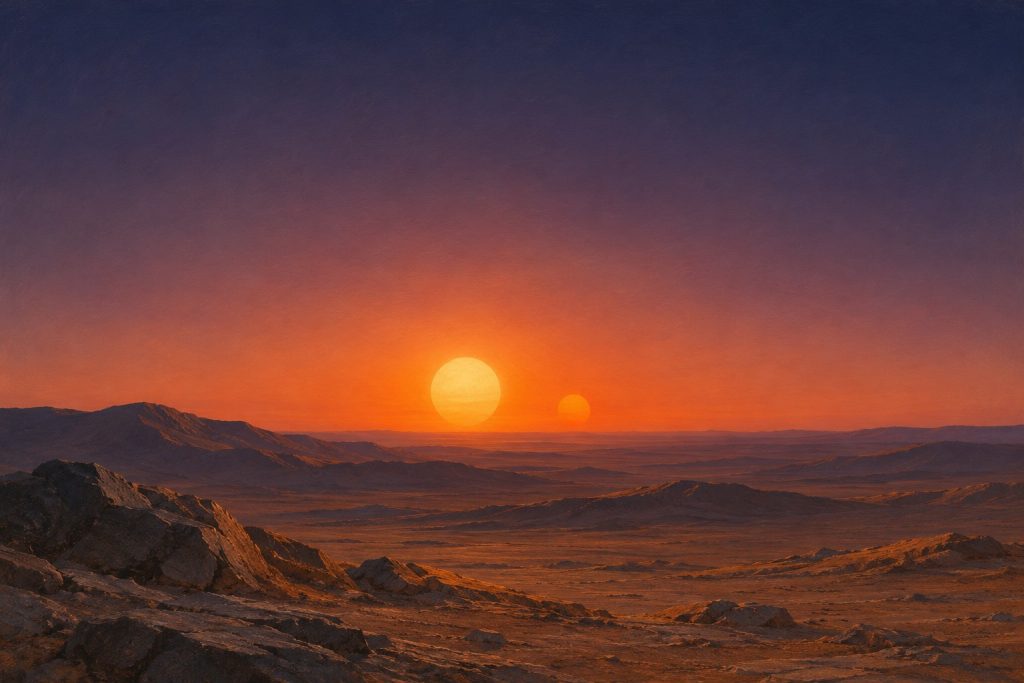
Two stars can circle each other while a planet travels around them both. Astronomers confirmed it by watching the moving stars dim.
THE QUESTION LIBRARY THE UNIVERSE
The Sun’s broad future is well understood, while the final path of Earth depends on uncertain tides and mass loss.
The Sun will become a red giant and later leave a white dwarf, a dense remnant that slowly cools. In roughly five billion years, it will leave its current core-hydrogen phase. Earth will grow too hot for familiar surface life before the largest giant stages. Whether the rocky planet is swallowed remains uncertain. The Sun is too small to end in a collapse supernova or become a black hole.
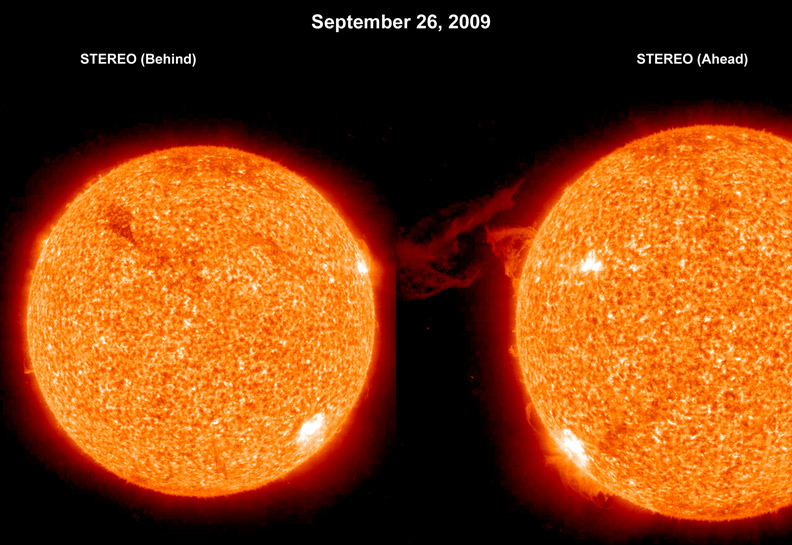
The STEREO spacecraft observed the same solar eruption from different angles. An eruption is not the Sun beginning its final stellar stages.
WHERE THE EVIDENCE STANDS
WHAT WE DON’T KNOW YET
Nobody knows yet the exact final orbit of Earth. Uncertain mass loss and tides affect whether the rocky planet survives the Sun’s giant phases.
WHAT WOULD CHANGE THIS ANSWER
Better measurements of mass loss and tidal effects in aging stars could narrow the Earth-survival forecast. They would help test the inputs that cause different stellar models to give different outcomes.
The Sun will swell into a red giant and later leave a white dwarf, a small, dense remnant that slowly cools. It will not end in the kind of supernova that marks the collapse of a much more massive star. Its future is a long sequence of changes, rather than one sudden event.
It is easy to picture the Sun as a permanent fixture. It rises, sets and comes back. The word death can make its future sound like a single final day. For a star, though, the word describes changes in its fuel, its structure and the way it shines.
Right now, the Sun joins hydrogen nuclei together in its core, making helium and releasing energy. This is nuclear fusion. Its current long phase is called the main sequence. Astronomers expect it to leave that phase in roughly five billion years. Later, the outer layers expand while the core changes. Eventually, much of the outer material is shed.
Earth's future needs its own careful answer. A hotter, brighter Sun will make our planet less hospitable long before its largest giant stages. Whether the rocky planet is physically swallowed is a different question. That depends on how much material the Sun loses and how tides change Earth's orbit. Models do not all give the same outcome.
The larger pattern is well supported: astronomers see ordinary stars, giants and white dwarfs elsewhere. The precise future of Earth's orbit remains less settled. Keeping those two levels separate helps us avoid turning an uncertain detail into doubt about the whole picture.
And if you have heard a question about the Sun suddenly disappearing, treat it as a thought experiment. Stars do not vanish on command. In that impossible setup, changes in light and gravity would take about eight minutes to reach Earth. Without the Sun’s pull, Earth would keep moving onward rather than stop. This is not a forecast for our Sun.
THE LONG ANSWER · ABOUT 6 MINUTES
The short answer, how sure we are, what we don’t know, what would change our mind and every source stay free on every page, for everyone.
All Access members read the long answer: the evidence piece by piece, the strongest objections, and how to check it yourself.
Join All Access · $1 a week Or $6 a month
Billed $52 once a year. Cancel anytime in your account.
Until December 4, 11:59 pm Pacific: the Founding rate is $39 a year, and it stays $39 while you stay a member.
Create a free account: 6 long answers a month, email only.
Paying never buys a different answer. Our Paywall Promise
Will the universe end, and if so, how?
Nobody knows yet.
God Plays Dice answers big questions in plain words, with sources and one of six honest labels.
See a mistake? Report a problem. Corrections are made openly.
CONTINUE THE THREAD
The UniverseAnswer
Two stars can circle each other while a planet travels around them both. Astronomers confirmed it by watching the moving stars dim.
The UniverseAnswer
An everywhere-present field, a fleeting particle and a famous nickname. What did CERN’s experiments actually measure?
The UniverseAnswer
Why the matter surplus remains unexplained, what Sakharov's conditions require, and how sphalerons and proposed neutrino mechanisms might connect.
The Architect AI companion · All Access
Labels describe the evidence for a claim, not the people who hold it.
Match my phone uses your device’s light or dark setting.