Dice, coins and weather follow fixed rules we can’t track, but quantum events are different, and whether they are random at the deepest level is still argued.
God Plays Dice Editorial · independently fact-checked · corrections welcomeChecked Sep 28, 20268 min read
THE SHORT ANSWER
Nobody knows yet. Most everyday randomness, like dice, coins and weather, comes from details too small to track, not from nature itself. Quantum events are different. Quantum theory gives only the odds of when a single radioactive atom will decay, and experiments honored by the 2022 Nobel Prize ruled out one kind of hidden cause: local, pre-set instructions carried by particles. But some readings of quantum theory keep the world fully determined. So quantum outcomes are unpredictable in practice, while whether they are random at the root is still open.
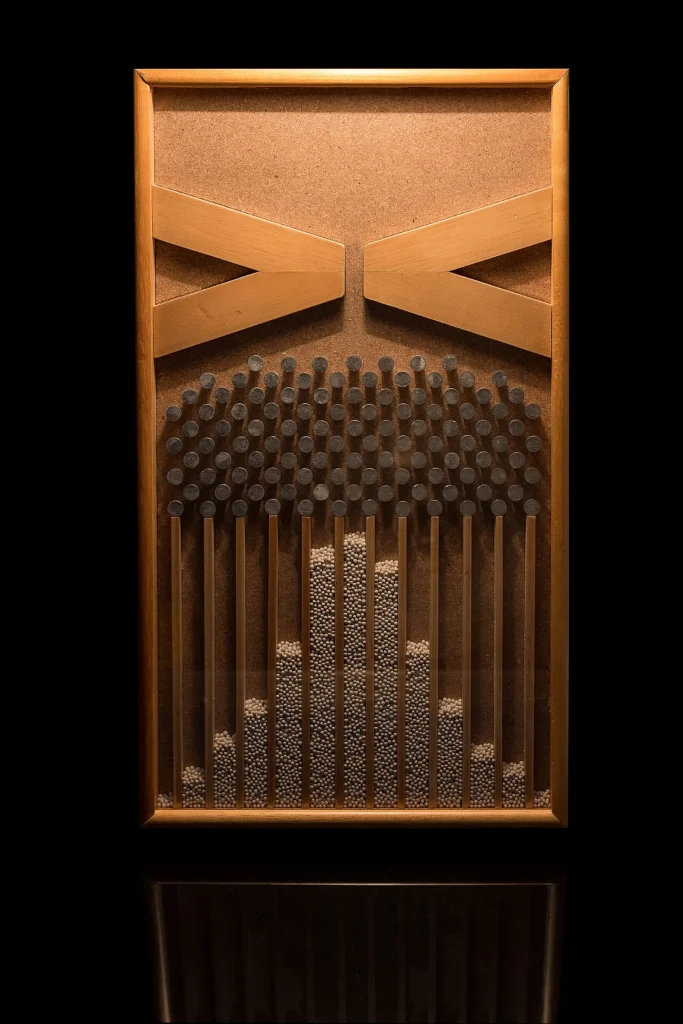
Coins follow ordinary physics: in 350,757 recorded flips, they landed on the side they started on 50.8% of the time.
Chaotic systems like weather follow fixed rules, but tiny differences in their starting point grow so fast that long-range prediction fails.
Quantum theory gives only the odds for events such as when a single radioactive atom decays.
Bell tests, honored by the 2022 Nobel Prize in Physics, ruled out local hidden variables, which are pre-set instructions carried inside each particle with no faster-than-light influence.
Some readings of quantum theory, such as Bohmian mechanics and many-worlds, have no fundamental randomness, so the deepest question is still open.
About this picture
Tracks of radioactive decay in a cloud chamber. Each V shape marks a thoron (radon-220) atom giving off an alpha particle, followed moments later by a second one from the atom it became. Quantum theory gives the odds of when such an atom decays, but not the moment.
Dice, coins and weather follow fixed physical rules, and their randomness comes from details we can’t track.Stanford Encyclopedia of Philosophy (Chaos): chaotic behavior is always deterministic; Lorenz (1963) showed a weather model is sensitive to tiny changes. Bartoš et al. (2025): 350,757 flips landed same side up 50.8% of the time, as a physics model of tossing predicted.
In practice, no one can predict the result of a single quantum measurement, such as the moment one radioactive atom decays.Quantum theory gives only probabilities (Stanford Encyclopedia, EPR entry). NIST turned this unpredictability into certified random numbers in 2018 and into a public randomness beacon in 2025.
Quantum results come from pre-set instructions inside each particle, with no faster-than-light influence between them.Bell (1964) showed such local hidden variables must obey a limit. Tests from Freedman and Clauser (1972) to the loophole-free tests of 2015 broke it; the 2022 Nobel Prize honored this work. The Stanford Encyclopedia notes one remaining way out, superdeterminism, which cannot be tested this way.
Nature is random at its deepest level.Stanford Encyclopedia: Bohmian mechanics is deterministic and makes the same predictions as standard quantum theory; many-worlds lets nature avoid “playing dice”; superdeterminism has advocates. A 2025 Nature survey found physicists disagree.
Quantum randomness can be turned into certified random numbers, assuming no signal travels faster than light.NIST (2018): 1,024 certified bits from 55,110,210 Bell-test trials. NIST and CU Boulder (2025): the CURBy beacon produced numbers in 7,434 of 7,454 attempts in its first 40 days.
Nobody knows whether quantum outcomes are random at the root, or follow a deeper order we cannot see, such as hidden particle positions, branching worlds, or a shared cause in the distant past. Bohmian mechanics, for one, predicts the same measurement results as standard quantum theory, so today’s experiments cannot tell them apart.
WHAT WOULD CHANGE THIS ANSWER
An experiment that caught quantum results following a hidden pattern would change this answer. So would a new theory that explains the quantum odds and makes a new prediction that passes a test.
Nobody knows yet, but we know much more than we used to. Scientists separate two kinds of randomness. The first comes from ignorance: causes fix the outcome, but we can’t track them. The second is fundamental randomness: nothing at all fixes the outcome until it happens. Most of what we call random in daily life is the first kind. Quantum physics, the science of atoms and light, is where the second kind might live.
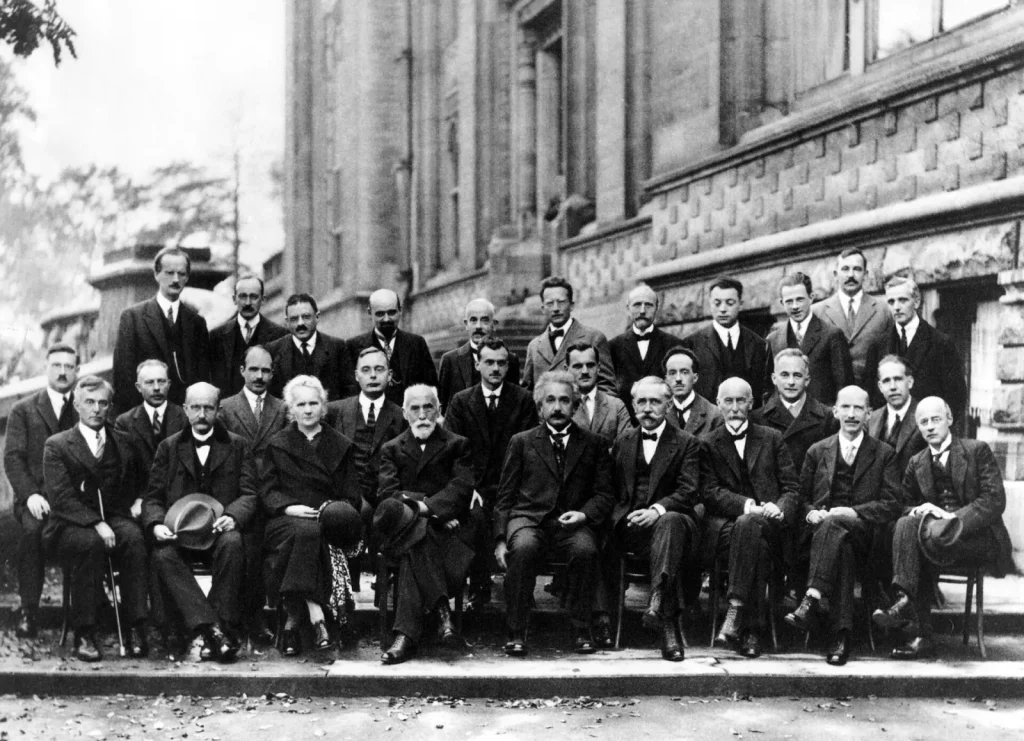
People ask for many reasons. A gambler wonders if dice can be beaten. A believer wonders whether chance leaves room for God. A skeptic wonders whether everything is set in advance. The question also has a birthday this year. On December 4, 1926, Albert Einstein wrote to his friend Max Born that he was convinced “He is not playing at dice.” “He” meant “the Old One,” Einstein’s name here for God, used as a figure of speech for nature’s deepest laws.
Start with dice. A die obeys the ordinary laws of motion. Its top face depends on the throw, the spin, the air and the table. Coins work the same way. In a study of 350,757 coin flips, coins landed on the side they started on 50.8% of the time, close to what a physics model predicted. Weather adds chaos: the rules are fixed, but tiny differences grow so fast that forecasts fail.
Quantum events are different. Quantum theory can give the odds that a radioactive atom will decay, but not the moment a given atom will. Einstein hoped hidden details would fill that gap. Experiments that began in 1972, honored by the 2022 Nobel Prize in Physics, ruled out the simplest version of that hope: pre-set instructions carried inside each particle.
Yet some ways of reading quantum theory keep the world fully determined. So quantum outcomes are unpredictable in practice, which is Established. Whether they are random at the root is an Open question.
THE LONG ANSWER
THE LONG ANSWER · ABOUT 7 MINUTES
You’ve read your 3 free long answers this month.
The short answer, how sure we are, what we don’t know, what would change our mind and every source stay free on every page, for everyone.
All Access members read the long answer: the evidence piece by piece, the strongest objections, and how to check it yourself.
Behavior of a system that follows fixed rules but is so sensitive to its starting point that long-range prediction fails.
Entanglement
A link between particles that have interacted, so that measurements on them stay related even when they are far apart.
Local hidden variables
Pre-set instructions that a particle might carry, fixing its results in advance, with no influence faster than light.
Bell’s theorem
John Bell’s 1964 proof that any theory with local hidden variables must obey a limit that quantum theory predicts can be broken.
Half-life
The time it takes for half of the radioactive atoms in a sample to decay.
Superdeterminism
The idea that a shared cause in the past set up both the particles and the experimenters’ choices in a Bell test.
Sources & further reading
(10) · Checked Sep 28, 2026
Press release: The Nobel Prize in Physics 2022 ↗Royal Swedish Academy of Sciences / NobelPrize.orgAspect, Clauser and Zeilinger “for experiments with entangled photons, establishing the violation of Bell inequalities and pioneering quantum information science.” Popular information page (https://www.nobelprize.org/prizes/physics/2022/popular-information/): Bell (1928–1990) at CERN; Clauser and Freedman 1972; Aspect switched settings after emission, filters six metres away, a few billionths of a second; plain-language line “quantum mechanics is correct and there are no hidden variables” (quoted as the page’s own wording, not as a finding). Dates of the 1972 and 1982 papers checked in Crossref: Freedman and Clauser, Phys. Rev. Lett. 28, 938 (April 3, 1972), doi:10.1103/PhysRevLett.28.938; Aspect, Dalibard and Roger, Phys. Rev. Lett. 49, 1804 (December 20, 1982), doi:10.1103/PhysRevLett.49.1804.
Bell’s Theorem (Wayne Myrvold, Marco Genovese, Abner Shimony) ↗Stanford Encyclopedia of Philosophy (revised January 25, 2024)Experiments since the 1970s; before 2015 each had a communication or detection loophole; 2015 tests blocked both (Hensen, Giustina, Shalm); if the results are accepted, some condition behind the inequalities must be rejected; freedom-of-choice loophole closed except for superdeterminism; superdeterminism advocated by ’t Hooft, Hossenfelder and Palmer; critics call it “conspiratorial.” Section 7: a loophole-free Bell test can yield numbers “unpredictable to any adversary that is limited only by general physical principles, such as special relativity (Bierhorst 2018)”, even if a deterministic theory such as de Broglie-Bohm applies at the fundamental level.
Bohmian Mechanics (Sheldon Goldstein) ↗Stanford Encyclopedia of Philosophy (revised September 20, 2025)Deterministic motion guided by the wave function; nonlocal; empirically equivalent to orthodox quantum theory; quantum randomness arises from averaging over ignorance of positions.
Many-Worlds Interpretation of Quantum Mechanics (Lev Vaidman) ↗Stanford Encyclopedia of Philosophy (revised June 17, 2026)The MWI removes fundamental randomness; “Adopting the MWI allows Nature to avoid ‘playing dice’”; no experimental evidence favors collapse over the MWI.
Chaos (Robert Bishop) ↗Stanford Encyclopedia of Philosophy (revised October 11, 2024)Butterfly in Argentina, tornado in Texas three weeks later; chaotic behavior is always deterministic; confusion comes from equating determinism with predictability; Lorenz (1963) meteorological model.
Fair coins tend to land on the same side they started: Evidence from 350,757 flips ↗Bartoš et al., Journal of the American Statistical Association (2025); preprint arXiv:2310.04153Diaconis, Holmes and Montgomery (2007) predicted about 51% same side; observed 0.508 (95% CI 0.506–0.509); heads 0.500; considerable between-people variation. Published online August 11, 2025 (Crossref).
NIST’s New Quantum Method Generates Really Random Numbers ↗National Institute of Standards and Technology (April 11, 2018)Bierhorst et al., Nature 556, 223–226 (2018), doi:10.1038/s41586-018-0019-0, “Experimentally Generated Random Numbers Certified by the Impossibility of Superluminal Signaling”; 55,110,210 trials; 1,024 bits uniform to within one trillionth of 1 percent.
NIST and Partners Use Quantum Mechanics to Make a Factory for Random Numbers ↗National Institute of Standards and Technology (June 11, 2025)CURBy public beacon with CU Boulder; 7,434 of 7,454 attempts (99.7%) in the first 40 days; 512 random bits per output; the release says “Scientists have since proved that Einstein was wrong.”
The Einstein-Podolsky-Rosen Argument in Quantum Theory (Arthur Fine) ↗Stanford Encyclopedia of Philosophy (revised October 31, 2017)Einstein asked whether an atom’s decay might occur at a definite moment not implied by the quantum state; quantum probabilities were not understood as arising from ignorance. Also used: EPA Radioactive Decay page (https://www.epa.gov/radiation/radioactive-decay) for the half-life definition, and Nature’s 2025 survey feature (doi:10.1038/d41586-025-02342-y), whose headline and summary were read; the full text is paywalled.
What happened to OPERA's 2011 faster-than-light claim, how relativity is tested, and why successful measurements do not prove every possible prediction.
Established3 min read
THE OCCASIONAL LETTER
Stay curious.
New stories, book updates, and notes from God Plays Dice, delivered when there is something worth sharing.
EMAIL UPDATES ↗
500 DIGITAL COPIES • GIVEAWAY PREVIEW
Be first to know when the 500-copy reader giveaway opens.
Join for the book launch, verified retailer links, and the announcement for a planned giveaway of 500 digital copies. The giveaway is not open yet: dates, eligibility, a dedicated entry form, and Official Rules will be published first.
Privacy · Check your inbox to confirm your subscription. Newsletter signup alone is not a giveaway entry.