Is free will real, or does the brain decide before we do?
A famous experiment seemed to show that the brain makes our choices before we know it, so here is what it really found, what later work showed, and what is still open.
God Plays Dice Editorial · independently fact-checked · corrections welcomeChecked Sep 26, 202610 min read
THE SHORT ANSWER
Nobody knows yet, but the famous brain experiments do not show that your brain decides before you do. In a 1983 study, Benjamin Libet found a slow brain signal that built up before people reported feeling the urge to move. Later work suggests that buildup may be random brain noise, not a hidden choice. Whether free will is real also depends on what free will means. In a 2020 survey, most responding philosophers favored the view that free will can exist even if every event is fixed by earlier causes.
In Libet’s 1983 study of five volunteers, a slow brain signal began at least several hundred milliseconds before people reported the urge to move.
In 2012, Aaron Schurger and colleagues showed that random ups and downs in brain activity, averaged together, can reproduce that slow rise.
In a 2019 study, the rise showed up before random key presses but not before choices about which charity would get a real donation.
In a 2020 survey of 1,785 philosophers, 59.2% of those who answered favored compatibilism, the view that free will can exist even if every event is fixed by earlier causes; 18.8% favored libertarian free will, and 11.2% no free will.
Quantum physics is well tested, but experts disagree on whether it is truly random, and random events alone would not make a choice yours.
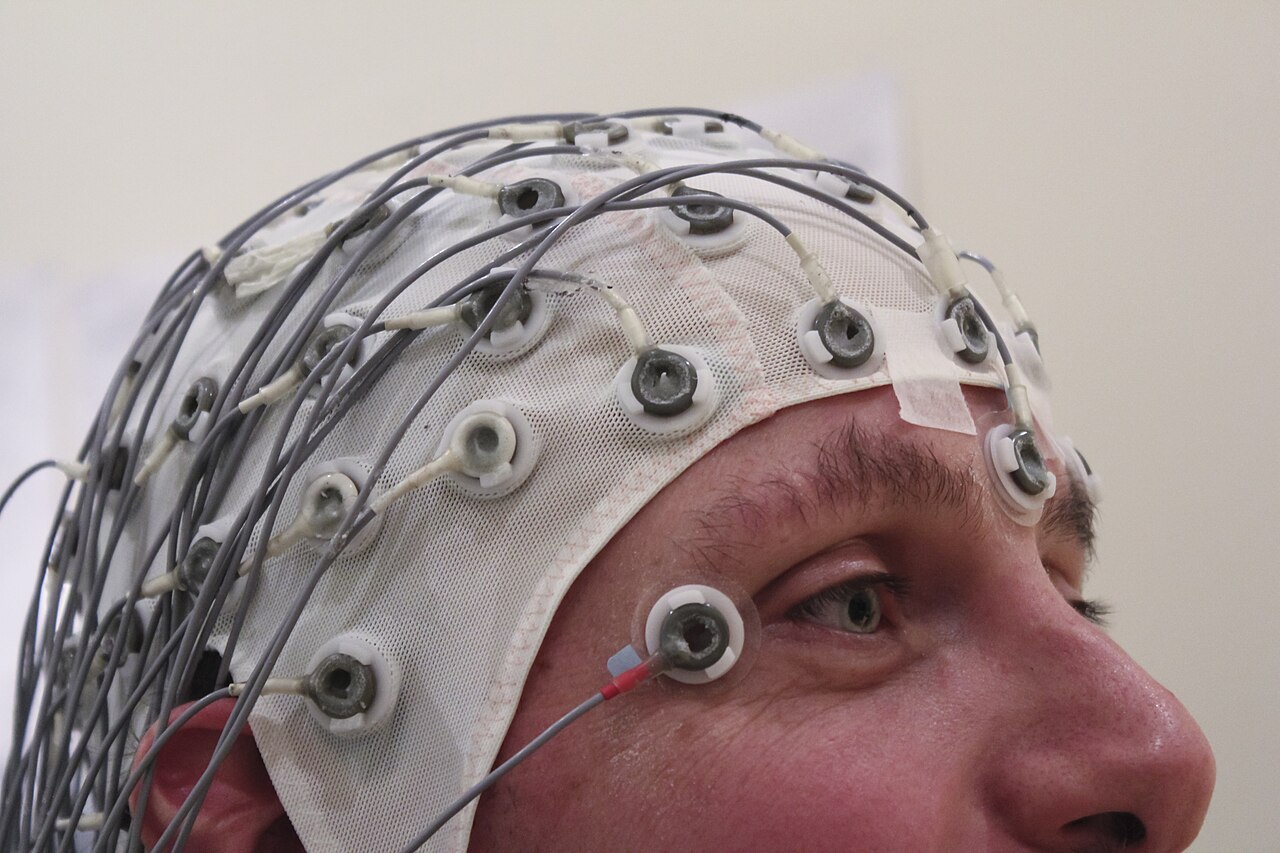
About this picture
An EEG cap holds sensors against the scalp to record the brain’s electrical activity. The readiness potential at the center of the free will debate is measured this way.
In simple lab tasks, averaged brain activity starts to rise before the moment people report deciding to move.Libet and colleagues (Brain, 1983) found the averaged readiness potential began about 350 ms before the reported urge in fully spontaneous series; a 2021 review in Trends in Cognitive Sciences says many replications agree on when people report the urge.
Libet’s experiments proved that the brain makes our decisions before we know about them.The Stanford Encyclopedia of Philosophy says Libet’s reading has come in for severe criticism and neuroscientists are uncertain what the signal means; the 2021 review concludes that the signal fails to support the classic inference that conscious will does nothing, even if the newer models turn out wrong.
The slow buildup before a movement may come from random brain noise, not from a hidden early decision.A model by Schurger, Sitt and Dehaene (PNAS, 2012) reproduced the signal and passed a new test; Maoz and colleagues (eLife, 2019) found it absent before meaningful choices. The 2021 review notes a few studies favor the older reading.
Quantum randomness shows that our choices are free.The Stanford Encyclopedia notes there is no consensus on how to interpret quantum theory, that brain science gives little evidence either way on randomness in our choices, and that pure chance raises a problem of luck rather than control.
Free will can exist even if every event follows from earlier causes and the laws of nature.This is compatibilism, a claim about what free will means. The 2020 PhilPapers Survey found 59.2% of responding philosophers accepting or leaning toward it, 18.8% toward libertarian free will and 11.2% toward no free will.
Nobody knows yet what the readiness potential really reflects. We also don’t know if true randomness plays any part in the brain’s choices. And we don’t know how tests with a finger lift carry over to big life choices.
WHAT WOULD CHANGE THIS ANSWER
Tests that could reliably predict people’s real, thought-out choices long before they felt they had decided would weaken the case for conscious control. But no test alone can settle what free will means. That part of the question is philosophical: it turns on what kind of control matters.
Nobody knows yet whether free will is real. But one popular claim can be checked: that brain research proves your brain decides before you do. The famous experiments behind that claim do not show it. Many researchers now read them in a very different way.
People ask about free will for many reasons. Some worry that science has turned us into machines. Some grew up in faith traditions that teach we are free and responsible for our choices. Some just saw a video saying their brain makes choices without them. All of these are fair reasons to ask.
Here is the core story. In a 1983 study, the scientist Benjamin Libet asked five volunteers to flex a finger or wrist whenever they felt like it. They watched a fast clock and later reported when they first felt the urge. Sensors on the scalp picked up a slow electrical rise, called the readiness potential. It started several hundred milliseconds before the moment people reported. To many, that looked like the brain deciding first.
Later work challenged that reading. In 2012, Aaron Schurger and his team built a model showing that the rise could come from random ups and downs in brain activity that happen to tip over a line. If so, the real decision to move now comes late, close to when people feel the urge. In 2019, another team found the rise before random key presses but not before choices that mattered, such as which charity should get a real donation.
The bigger puzzle is what free will means. Some philosophers say free will fits with a world where physical laws fix everything. Others say it needs a truly open future. Still others say we have no free will at all. Science can inform this debate, but it cannot settle the definitions. That is why we label the headline question an Open question.
THE LONG ANSWER
THE LONG ANSWER · ABOUT 8 MINUTES
You’ve read your 3 free long answers this month.
The short answer, how sure we are, what we don’t know, what would change our mind and every source stay free on every page, for everyone.
All Access members read the long answer: the evidence piece by piece, the strongest objections, and how to check it yourself.
Author’s hypothesis. A reader might wonder whether a book called GOD PLAYS DICE claims that randomness gives us free will. It does not. Ricardo Maldonado, author of GOD PLAYS DICE, uses the title as a metaphor: in the book, “God” is shorthand for the deep laws of nature, and “dice” is shorthand for quantum events, which are random but follow precise rules. The book’s notes say the title is philosophical shorthand, not a claim that one experiment has settled every question about determinism. The book does not offer a theory of free will.
In Chapter 10, the author writes that randomness does not mean chaos: a die can land unpredictably and still obey strict rules. He offers that as a way of picturing the universe, not as an answer to the free will debate.
A slow electrical rise, seen in averaged EEG recordings, that comes before a voluntary movement. What it reflects is still debated.
EEG (electroencephalography)
A way to record the brain’s electrical activity with sensors placed on the scalp.
Determinism
The idea that everything that happens is the result of the laws of nature and the state of the world in the past.
Compatibilism
The view that free will can exist even if determinism is true.
Libertarian free will
The view that we have free will and that it requires determinism to be false. It has nothing to do with political libertarianism.
Hard incompatibilism
A free will skeptic’s view that we lack the free will needed to deeply deserve praise or blame, whether or not determinism is true.
Sources & further reading
(10) · Checked Sep 26, 2026
Time of conscious intention to act in relation to onset of cerebral activity (readiness-potential) ↗Brain (1983), Libet, Gleason, Wright and PearlFive subjects, at least six sessions each; onset of the RP preceded reported intention (W) by at least several hundred ms; in series with type II RPs, by about 350 ms on average (minimum about 150 ms); conclusion that cerebral initiation of a spontaneous, freely voluntary act “can begin unconsciously,” before any recallable awareness of a decision. Abstract read via PubMed (PMID 6640273).
An accumulator model for spontaneous neural activity prior to self-initiated movement ↗PNAS (2012), Schurger, Sitt and DehaeneLeaky stochastic accumulator reproduces the RP; confirmed prediction with unpredictable interruptions (clicks); neural decision to move proposed near −150 ms, coinciding with reported awareness; mean reported urge −150 ms in their data. Full text read on PubMed Central (PMC3479453).
Neural precursors of decisions that matter: an ERP study of deliberate and arbitrary choice ↗eLife (2019), Maoz, Yaffe, Koch and MudrikDonation task with non-profit organizations; RPs found for arbitrary decisions but “strikingly absent” for deliberate ones; lottery design meant each deliberate choice could lead to a real $1,020 donation; 20 participants, data from 18 analyzed. Full text on PubMed Central (PMC6809608).
What Is the Readiness Potential? ↗Trends in Cognitive Sciences (2021), Schurger, Hu, Pak and RoskiesLibet task history (fingers and/or wrist, rotating clock); the veto idea (“free won’t”), which later studies make “seem untenable”; Libet’s “more helpful” point about longer conscious deliberation; fMRI predictions (refs 22 and 28, Soon et al. 2008 and 2013) “only marginally better than a random guess” (Soon et al., Nature Neuroscience 2008, doi:10.1038/nn.2112, abstract: outcomes encoded up to 10 s before awareness); RP built only from epochs ending in movement; a few studies challenge the late-decision view; which model is correct listed as an outstanding question; conclusion that one cannot infer we lack conscious free will from the RP’s timing, and that even if these models are mistaken the RP would still fail to support the classic inference. Author manuscript read on PubMed Central (PMC8192467).
Free Will (Timothy O’Connor and Christopher Franklin) ↗Stanford Encyclopedia of Philosophy (revised 2022)Free will as “a significant kind of control over one’s actions”; Strawson’s argument, “the most radical a priori argument,” that free will is impossible, and replies by Mele (freedom principally a feature of actions) and O’Connor (degrees that grow over time); evidence of unconscious influences; Wegner’s “an illusion”; Libet’s interpretation severely criticized and neuroscientists uncertain what the RP signifies; Spinoza; theists commonly presume humans are free and responsible; theological framework, Edwards (1754), Al-Ghazali, Aquinas, Scotus.
Compatibilism (Michael McKenna and D. Justin Coates) ↗Stanford Encyclopedia of Philosophy (revised 2024)Compatibilism is the thesis that free will is compatible with determinism; determinism described as everything following from the laws of nature and the state of the world in the distant past; classical view (Hobbes: doing what one wills without impediment); reasons-responsive compatibilism.
Incompatibilist (Nondeterministic) Theories of Free Will (Clarke, Capes and Swenson) ↗Stanford Encyclopedia of Philosophy (revised 2021)Incompatibilists: we act freely only if determinism is false; the problem of luck; quantum theory “very well confirmed” but “nothing approaching a consensus” on interpretation; brain science gives “little evidence one way or the other” on indeterminism at the right junctures. Also consulted: SEP “Causal Determinism” (Carl Hoefer, https://plato.stanford.edu/entries/determinism-causal/) on deterministic interpretations of quantum mechanics.
Skepticism About Moral Responsibility (Gregg Caruso) ↗Stanford Encyclopedia of Philosophy (2018)Hard determinism defined and said to have very few defenders today; determinism not refuted by physics; Honderich’s “determinism-where-it-matters”; hard incompatibilism holds we lack basic desert moral responsibility whether reality is deterministic or not.
Philosophers on Philosophy: The 2020 PhilPapers Survey ↗Philosophers’ Imprint (2023), David Bourget and David ChalmersSurvey run Oct. 15 to Nov. 16, 2020; 1,785 of 7,685 targeted philosophers (faculty in BA-granting departments in Australia, Canada, Ireland, New Zealand, the UK and the US, plus English-publishing philosophers elsewhere) completed it; free will: compatibilism 59.2%, libertarianism 18.8%, no free will 11.2%, other 11.4% (accept or lean toward, excluding skips and “insufficiently familiar”).
GOD PLAYS DICE, Volume OneRicardo MaldonadoIntroduction: the title is a metaphor, God is shorthand for the deep laws of nature and dice for quantum events, random but constrained by precise rules. Chapter 10: randomness does not mean chaos; a die can be random and still obey strict rules. Endnotes: the title is philosophical shorthand, not a claim that one experiment has settled every question about determinism, causality or interpretation. The book does not use the phrase “free will.”
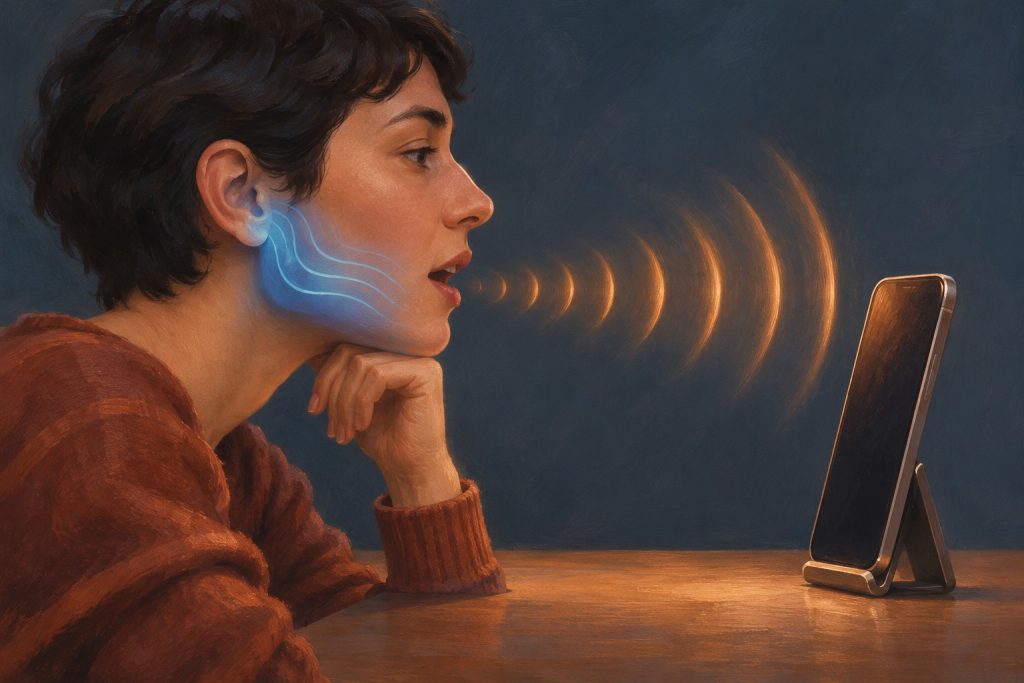
You can recognize every word and still be surprised by the speaker. While you talk, your voice reaches you by two routes.
Established3 min read
THE OCCASIONAL LETTER
Stay curious.
New stories, book updates, and notes from God Plays Dice, delivered when there is something worth sharing.
EMAIL UPDATES ↗
500 DIGITAL COPIES • GIVEAWAY PREVIEW
Be first to know when the 500-copy reader giveaway opens.
Join for the book launch, verified retailer links, and the announcement for a planned giveaway of 500 digital copies. The giveaway is not open yet: dates, eligibility, a dedicated entry form, and Official Rules will be published first.
Privacy · Check your inbox to confirm your subscription. Newsletter signup alone is not a giveaway entry.