
Mind & MortalityAnswer
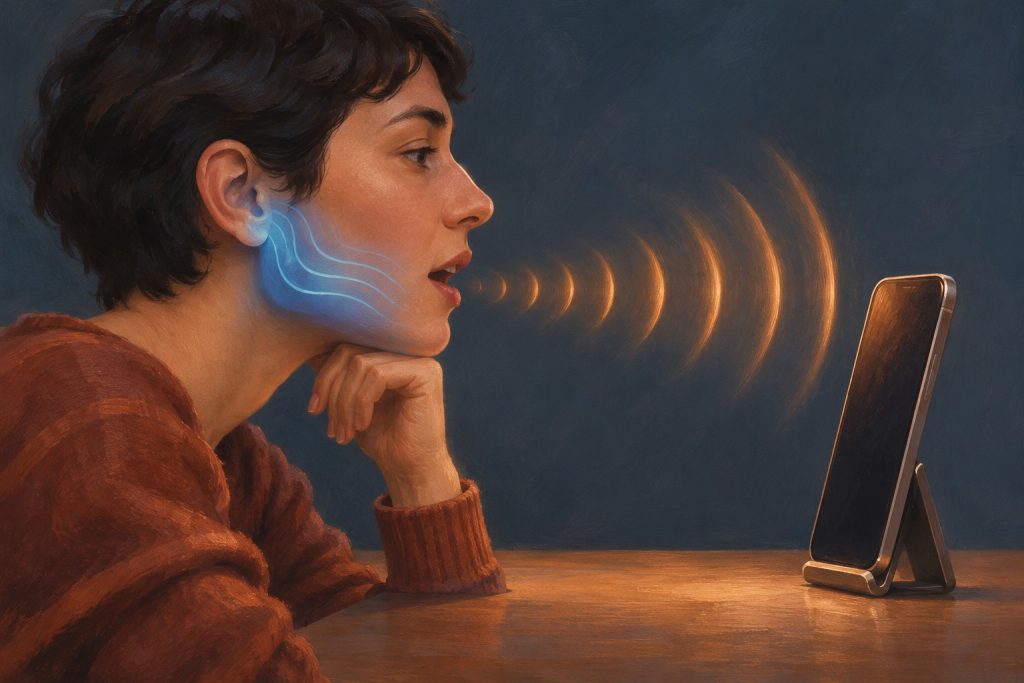
Why Does My Voice Sound Different on a Recording?
You can recognize every word and still be surprised by the speaker. While you talk, your voice reaches you by two routes.
THE QUESTION LIBRARY MIND & MORTALITY
How did language begin, and why do we love stories? Explore emerging sign languages, cultural learning and storytelling’s social uses without claiming a settled origin.
We do not know exactly when or how the first human language arose. Research on emerging sign languages and laboratory learning shows how shared communication can become structured across learners. Stories can carry experiences, social expectations and imagined possibilities. Those uses help explain their appeal, but no single study establishes why storytelling evolved or why every person enjoys it.
WHAT WE DON’T KNOW YET
The timing and pathway of the first language, the balance of biological and cultural changes, and how much different storytelling functions explain its enjoyment across cultures.
WHAT WOULD CHANGE THIS ANSWER
New evidence constraining ancestral communication, and replicated experiments separating storytelling’s causal effects from existing social relationships, would sharpen these explanations.
Language and storytelling are related, but they are not the same puzzle. A language lets people express meanings through shared signs and patterns. A story uses that capacity to follow events: someone wants something, something happens, and we wonder what comes next.
We can study people communicating today. Reconstructing the very first language is harder: none of the studies below observes that prehistoric beginning. They reveal possible processes, not a recording of our ancestors’ first conversation.
THE LONG ANSWER · ABOUT 3 MINUTES
The short answer, how sure we are, what we don’t know, what would change our mind and every source stay free on every page, for everyone.
All Access members read the long answer: the evidence piece by piece, the strongest objections, and how to check it yourself.
Join All Access · $1 a week Or $6 a month
Billed $52 once a year. Cancel anytime in your account.
Until December 4, 11:59 pm Pacific: the Founding rate is $39 a year, and it stays $39 while you stay a member.
Create a free account: 6 long answers a month, email only.
Paying never buys a different answer. Our Paywall Promise
Why Does My Voice Sound Different on a Recording?
When you speak, you hear sound traveling through the air and vibrations traveling through the bones and tissues of your head.
God Plays Dice answers big questions in plain words, with sources and one of six honest labels.
See a mistake? Report a problem. Corrections are made openly.
CONTINUE THE THREAD
Mind & MortalityAnswer
You can recognize every word and still be surprised by the speaker. While you talk, your voice reaches you by two routes.
Mind & MortalityAnswer
Why death can feel frightening: loss, separation, uncertainty and the dying process, with clear limits on psychological explanations.
Mind & MortalityAnswer
Do babies understand more than they can say? See evidence on early word meanings, sound-pattern learning and speech attention—and the limits of infant experiments.
The Architect AI companion · All Access
Labels describe the evidence for a claim, not the people who hold it.
Match my phone uses your device’s light or dark setting.