Do psychic abilities like telepathy or seeing the future hold up when tested?
Scientists have tested telepathy, seeing the future and mind over matter for more than a century; here is what they found, what parapsychologists claim, and what their critics reply.
God Plays Dice Editorial · independently fact-checked · corrections welcomeChecked Sep 28, 20269 min read
THE SHORT ANSWER
Not so far, by the standard of independent labs repeating a result. Parapsychology meta-analyses of ganzfeld telepathy tests report hit rates a few percentage points above the 25% expected by chance. Critics say flaws in how targets were picked and unpublished failures could explain that. When a large, closely watched project repeated a famous “feeling the future” study with 2,115 people, guesses came out right 49.89% of the time, where chance gives 50%. Mind-over-matter tests show at most a tiny effect that unpublished studies could explain.
In a 2005 Gallup poll, 41% of U.S. adults said they believed in ESP, 31% in telepathy and 26% in clairvoyance.
In the ganzfeld telepathy test, a relaxed person tries to pick a hidden target, usually from four choices, so chance alone gives 25% hits.
A 2024 meta-analysis by Tressoldi and Storm pooled 78 ganzfeld studies from 1974 to 2020 and reported a small effect, about 6.8 percentage points above chance.
A 2023 repeat of a “feeling the future” experiment in 10 labs, designed by supporters and critics together, found 49.89% correct guesses where chance is 50%.
A 2006 review of 380 mind-over-machine studies found a very small effect that publication bias could in principle explain.
About this picture
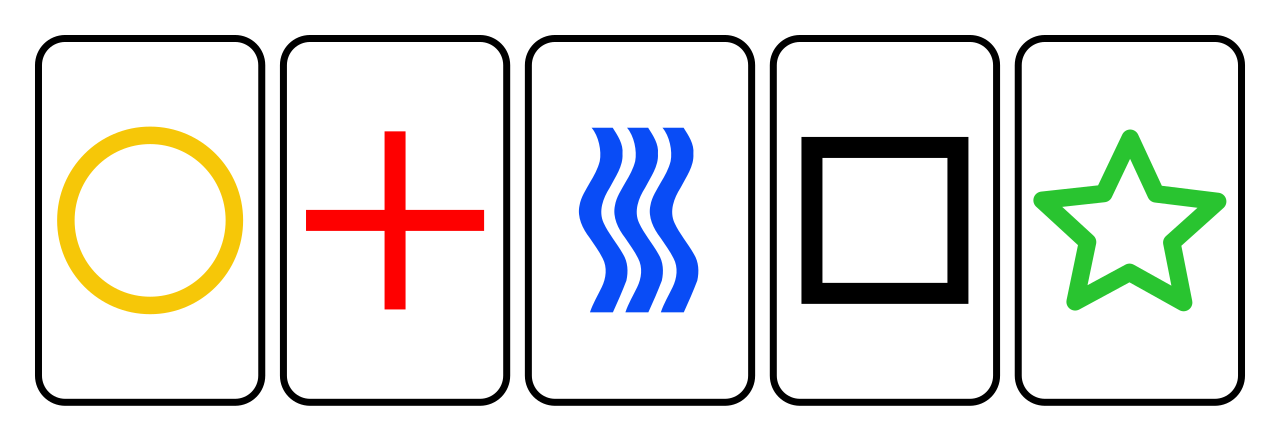
The five symbols of Zener cards, also called ESP cards, designed at Duke University for card-guessing tests. Guessing at random gets about one card in five right.
Pooled ganzfeld studies show hit rates slightly above chance.Storm, Tressoldi and Di Risio (2010) pooled 29 studies and Tressoldi and Storm (2024) pooled 78, both reporting a small effect. Milton and Wiseman (1999) found none in 30 studies, and Hyman (2010) says dropping outliers made the data look more consistent than they are, and Rouder and colleagues (2013) found the evidence far weaker once hand-randomized studies were set aside and omitted studies added.
People can sense the future, as Bem’s 2011 experiments suggested.Three preregistered repeats by Ritchie, Wiseman and French (2012) failed, and the Transparent Psi Project (2023), with 2,115 people in 10 labs, found 49.89% hits where chance is 50%. Bem and colleagues’ 2016 meta-analysis of 90 experiments reports a small effect well beyond chance.
The mind can move objects or steer machines.Bösch and colleagues (2006) pooled 380 random-number-generator studies and found a very small effect that publication bias could in principle produce; Utts’s 1995 review reports that an overall analysis of SRI experiments from 1973 to 1988 found no evidence for psychokinesis.
Dreams that come true show that people can see the future.Utts (1995), whose review concluded psychic functioning was well established, notes that if a few people dream of plane crashes each night, some will do so the night before a major crash; Diaconis and Mosteller (1989) describe the law of truly large numbers.
Nobody knows yet why pooled ganzfeld studies keep showing a small edge over chance. It could be an effect no theory explains, or flaws and missing studies that are hard to see. Both sides have begun to use studies whose plans are fixed in advance, such as the Transparent Psi Project, which supporters and critics designed together.
WHAT WOULD CHANGE THIS ANSWER
Large preregistered studies, run by teams that include skeptics, that beat chance again and again in different labs would change this answer. So would a clear way to tell a real psychic hit from a lucky guess before the answer is known.
Maybe the phone rang and you knew who it was before you looked. Maybe you dreamed about something, and days later it happened. Maybe you felt a sudden worry about someone you love, and later learned they had been in trouble. Moments like these are common. They can feel like proof that the mind reaches beyond the body. So it is fair to ask: do psychic abilities hold up when they are tested?
Many people believe they do. In a 2005 Gallup poll of 1,002 U.S. adults, 41% said they believed in extrasensory perception, or ESP. That means getting information without the usual senses. Another 31% believed in telepathy, contact between minds, and 26% in clairvoyance, the power to know the past and predict the future.
Researchers have tested these claims for more than a century, including card-guessing tests at Duke University that began in 1930. Here is the core picture. Some tests, pooled together, show a small edge over chance. The best known is the ganzfeld test, where a relaxed person tries to pick a hidden picture from four choices. Guessing alone gets 25% right. Parapsychologists, the researchers who study these claims, report hit rates a few points higher. Critics reply that small flaws, plus failed studies that never got published, could add up to an edge that size.
A big recent test went the other way. A team that included both supporters and critics repeated a famous “feeling the future” experiment in 10 labs, with 2,115 people. Their guesses were right 49.89% of the time. Pure chance gives 50%.
So here is the fair answer. Psychic abilities have not held up in the way science asks: in careful studies that other labs can repeat and get the same result. We label the claim Not supported. Why a small edge keeps showing up in some pooled data is still an open question. And the experiences people describe are real to them, which is exactly why they deserve a careful look.
THE LONG ANSWER
THE LONG ANSWER · ABOUT 7 MINUTES
You’ve read your 3 free long answers this month.
The short answer, how sure we are, what we don’t know, what would change our mind and every source stay free on every page, for everyone.
All Access members read the long answer: the evidence piece by piece, the strongest objections, and how to check it yourself.
Getting information without using the known senses. Telepathy, clairvoyance and precognition are forms of ESP.
Psi
The umbrella term parapsychologists use for unexplained transfers of information or energy, such as ESP and psychokinesis.
Ganzfeld
German for “whole field.” A test in which a relaxed receiver, with eyes covered and soft noise in headphones, tries to pick a hidden target from four choices.
Meta-analysis
A study that pools the results of many earlier studies to estimate an overall effect.
Preregistration
Posting a study’s plan and analysis before collecting data, so results cannot shape the method after the fact.
Publication bias
When studies with positive results get published more often than failed ones, so the published record looks stronger than the full picture.
Joseph Banks Rhine (Sally Rhine Feather and Barbara Ensrud) ↗Psi Encyclopedia, Society for Psychical ResearchRhine’s testing began at Duke in 1930; ESP (Zener) cards designed with Karl Zener, 25 cards with star, circle, cross, wavy lines, rectangle (later square), one-in-five chance; Pearce-Pratt series 1933–1934, 558 hits in 1,850 trials vs 370 expected; statistical criticisms from 1935 and requests for more detail on controls; the Institute for Mathematical Studies later approved the mathematics; Rhine credited criticism with helping him improve methods of control; dice tests of psychokinesis began in 1934.
An Assessment of the Evidence for Psychic Functioning (Jessica Utts, 1995) ↗Jessica Utts, University of California, DavisReview of government-sponsored research at SRI International and SAIC; concludes psychic functioning is “well established”; SRI summary finds no evidence for psychokinesis; ganzfeld: Bem and Honorton 106 hits in 329 sessions (32.2%, chance 25%), Amsterdam 37%, Edinburgh 33%, North Carolina 33%; p-values depend on study size; the plane-crash dream example (“if a few people each night happen to dream of plane crashes”).
Meta-analysis of free-response studies, 1992–2008 (Storm, Tressoldi and Di Risio), with comment and reply ↗Psychological Bulletin (2010)29 ganzfeld studies (1997–2008), mean effect size 0.142. Same issue: Hyman, “Meta-analysis that conceals more than it reveals” (https://doi.org/10.1037/a0019676): outliers eliminated, a recipe experiment already failed, no independently replicable evidence after more than a century; Storm et al., “A meta-analysis with nothing to hide” (https://doi.org/10.1037/a0019840). Rouder, Morey and Province (2013, https://doi.org/10.1037/a0029008): Bayes factor about 6 billion to 1, at most 330 to 1 after removing manually randomized studies and adding omitted ones; unpersuasive without a plausible mechanism.
Stage 2 Registered Report: Anomalous perception in a Ganzfeld condition, a meta-analysis of more than 40 years investigation (Tressoldi and Storm) ↗F1000Research (2024)78 studies (113 effect sizes) from 1974 to 2020; overall effect size about .08, which the authors say corresponds to hit rates 6.8 percentage points above chance (95% CI 4.7–8.9; Table 1 gives the mean “hits rate above chance” as .068, a difference in proportions, and notes not all studies used four choices); passed four publication-bias tests; selected participants almost three times the effect; describes the ganzfeld setup (ping-pong ball halves, red light, noise in headphones, sender in a distant room).
Feeling the future: experimental evidence for anomalous retroactive influences on cognition and affect (Bem) ↗Journal of Personality and Social Psychology (2011)9 experiments, more than 1,000 participants, all but one significant; defines psi. Comment by Wagenmakers et al. (https://doi.org/10.1037/a0022790): evidence for psi “weak to nonexistent”. Bem, Tressoldi, Rabeyron and Duggan meta-analysis of 90 experiments from 33 labs in 14 countries (F1000Research, https://doi.org/10.12688/f1000research.7177.2).
Methods for Studying Coincidences (Diaconis and Mosteller) ↗Journal of the American Statistical Association (1989)Abstract only (read via OpenAlex; full text not opened): four principles, including memory and perception, counting close matches as identical, and the law of truly large numbers, under which, with enormous numbers of people and events over time, almost any outrageous event is bound to occur.
What evidence exists for Bigfoot and the Loch Ness monster? Examine tested hairs, the Loch Ness DNA survey, detection limits and what a verified discovery would require.
Can animals sense earthquakes or storms? Separate early-wave detection and observed storm avoidance from reliable prediction, with evidence and limits.
Supported, still debated3 min read
THE OCCASIONAL LETTER
Stay curious.
New stories, book updates, and notes from God Plays Dice, delivered when there is something worth sharing.
EMAIL UPDATES ↗
500 DIGITAL COPIES • GIVEAWAY PREVIEW
Be first to know when the 500-copy reader giveaway opens.
Join for the book launch, verified retailer links, and the announcement for a planned giveaway of 500 digital copies. The giveaway is not open yet: dates, eligibility, a dedicated entry form, and Official Rules will be published first.
Privacy · Check your inbox to confirm your subscription. Newsletter signup alone is not a giveaway entry.