
Mind & MortalityAnswer
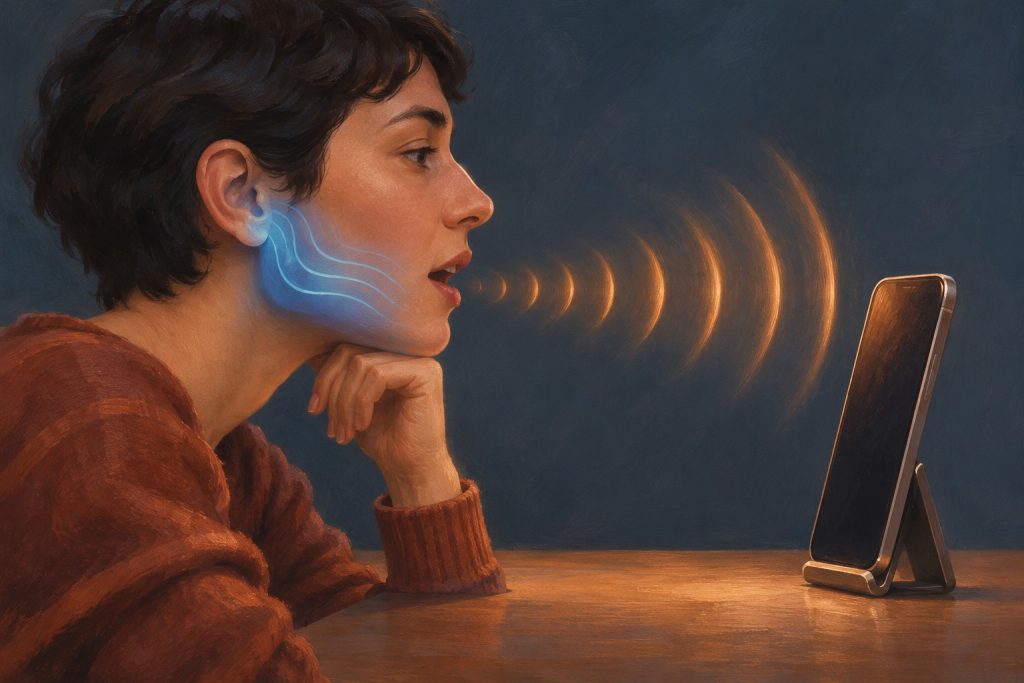
Why Does My Voice Sound Different on a Recording?
You can recognize every word and still be surprised by the speaker. While you talk, your voice reaches you by two routes.
THE QUESTION LIBRARY MIND & MORTALITY
Laughter can signal connection and help social bonding. What experiments suggest about its brain mechanisms—and what they do not establish.
Laughter can express amusement, but it also carries social information and may help people feel connected. Experiments support these roles and suggest a contribution from the brain’s own opioid system. That does not give us one complete explanation for every laugh, or establish that laughter automatically makes people kinder. Its evolutionary history and precise mechanisms remain partly unsettled.
WHAT WE DON’T KNOW YET
We lack a complete account of laughter’s evolutionary history and all of its uses. Preliminary brain-imaging findings and short laboratory interactions do not establish a universal mechanism or lasting social benefit.
WHAT WOULD CHANGE THIS ANSWER
Larger, independently repeated studies using varied participants and well-matched social controls would clarify which mechanisms and effects belong specifically to laughter.
Think of laughter as something to explain at several levels. What triggered it just now? What does it communicate to another person? And what happens in the body? A funny video might answer the first question, while leaving the other two open.
Scientists investigate those questions with different tests. Listening to a recording can reveal whether a laugh carries social information. Watching people together can test whether shared laughter changes how close they feel. Brain imaging addresses a possible mechanism. The findings need not compete: laughter can do more than one thing.
THE LONG ANSWER · ABOUT 2 MINUTES
The short answer, how sure we are, what we don’t know, what would change our mind and every source stay free on every page, for everyone.
All Access members read the long answer: the evidence piece by piece, the strongest objections, and how to check it yourself.
Join All Access · $1 a week Or $6 a month
Billed $52 once a year. Cancel anytime in your account.
Until December 4, 11:59 pm Pacific: the Founding rate is $39 a year, and it stays $39 while you stay a member.
Create a free account: 6 long answers a month, email only.
Paying never buys a different answer. Our Paywall Promise
Why Does My Voice Sound Different on a Recording?
When you speak, you hear sound traveling through the air and vibrations traveling through the bones and tissues of your head.
God Plays Dice answers big questions in plain words, with sources and one of six honest labels.
See a mistake? Report a problem. Corrections are made openly.
CONTINUE THE THREAD
Mind & MortalityAnswer
You can recognize every word and still be surprised by the speaker. While you talk, your voice reaches you by two routes.
Mind & MortalityAnswer
Why death can feel frightening: loss, separation, uncertainty and the dying process, with clear limits on psychological explanations.
Mind & MortalityAnswer
Do babies understand more than they can say? See evidence on early word meanings, sound-pattern learning and speech attention—and the limits of infant experiments.
The Architect AI companion · All Access
Labels describe the evidence for a claim, not the people who hold it.
Match my phone uses your device’s light or dark setting.