OriginsExplainer
Why Do Stars Shine—and Where Did Our Atoms Come From?
A star’s light comes from fusion. Its long history also helps explain the matter that makes planets and people.
ORIGINS EXPLAINER
The hot early universe has strong observational support; the ultimate beginning remains an open question.
The Big Bang is our best tested account of how the observable universe developed from a very hot, dense early state. It is not a filmed explosion, and it does not by itself tell us what caused the universe to exist. The distinction matters: a successful account of the early universe can be powerful without answering every question about an ultimate beginning.
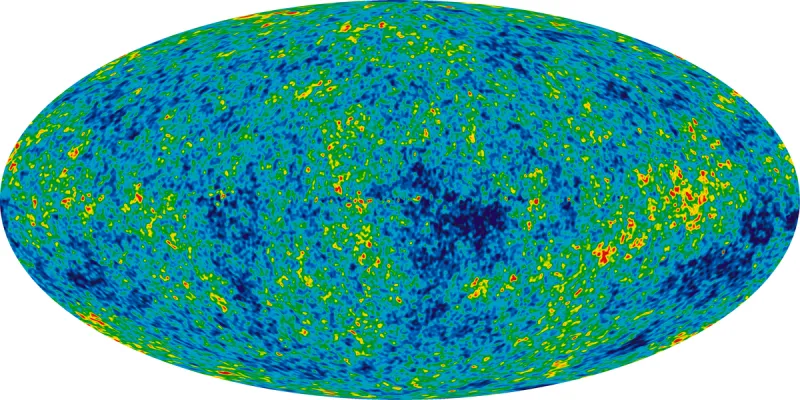
WMAP’s all-sky map shows small temperature variations in the cosmic microwave background, ancient light from the early universe.
What do we actually see? Distant galaxies are generally moving away from one another as space expands. We also detect a faint glow across the sky called the cosmic microwave background. It is light released when the young universe cooled enough for light to travel freely, roughly 380,000 years after the early expansion began. NASA missions including COBE measured this glow in detail. The observations fit the picture of a universe that was once hotter and denser.
Go backward in that picture and ordinary intuition begins to fail. The word “bang” can make us imagine a firecracker exploding into empty space from a single location. That is a misleading picture. The expansion concerns space itself, and observers do not find a center from which all galaxies fly away. The models describe change in the universe; they do not provide a settled account of what, if anything, came before its earliest describable phase.
You may hear the word inflation. It names a proposed episode of extremely rapid expansion in the early universe. Inflation helps explain several patterns astronomers measure, but its physical cause remains unknown. Scientists still test versions of the idea. NASA’s overview says plainly that researchers are unsure what came before inflation or what powered it. That is an honest edge of the model, not a reason to discard the observations it does explain.
Could a telescope settle the “before” question? More sensitive instruments can bring us closer to the young universe and sharpen tests of early-universe ideas. Yet ordinary light cannot show us the Big Bang itself. The cosmic microwave background comes from a later time, after the young universe stopped scattering light in every direction. Any claim about a still earlier event needs a chain of reasoning and predictions that can meet evidence, rather than a dramatic picture alone.
So the useful answer has two parts. The hot early-universe model explains the expansion and ancient light we measure remarkably well. What began that history, whether “before” is a meaningful word at its boundary, and whether a wider physical story exists are still open. A new proposal can join the conversation by saying exactly what it predicts differently and what observation could show it is mistaken.
Did time begin at the Big Bang?Open question
Nobody knows yet. About 13.8 billion years ago the universe was extremely hot and dense, and it has been expanding and cooling ever since; that part is well…
How old is the universe, and how do we know?Established
About 13.8 billion years. The most precise figure, from the European Space Agency’s Planck satellite, is 13.787 billion years, give or take 20 million. Planck…
Author’s hypothesisCosmic origins
Could our hot beginning be the aftermath of something larger?
Next on the path “Where did everything come from?” · step 3 of 7
If the universe is expanding, what is it expanding into?
It need not be expanding into anything.
See this path: Where did everything come from?
God Plays Dice answers big questions in plain words, with sources and one of six honest labels.
CONTINUE THE THREAD
OriginsExplainer
A star’s light comes from fusion. Its long history also helps explain the matter that makes planets and people.
OriginsExplainer
LIGO measured tiny changes in distance and opened another way to study the universe.
OriginsExplainer
From the first atomic nuclei back to a possible burst of inflation, here is what scientists have tested about the first second, and where knowledge runs out.
The Architect AI companion · All Access
Match my phone uses your device’s light or dark setting.