OriginsExplainer
What Happened in the First Second After the Big Bang?
From the first atomic nuclei back to a possible burst of inflation, here is what scientists have tested about the first second, and where knowledge runs out.
THE QUESTION LIBRARY ORIGINS
Scientists have measured the hot early universe in detail, but whether time itself had a first moment is still an open question.
Nobody knows yet. About 13.8 billion years ago the universe was extremely hot and dense, and it has been expanding and cooling ever since; that part is well measured. But Einstein’s theory of gravity breaks down at the very start, so it cannot tell us whether time began there. Some ideas give time a true first moment. Others say the Big Bang was a bounce, or a new chapter of something older. No test has settled it.
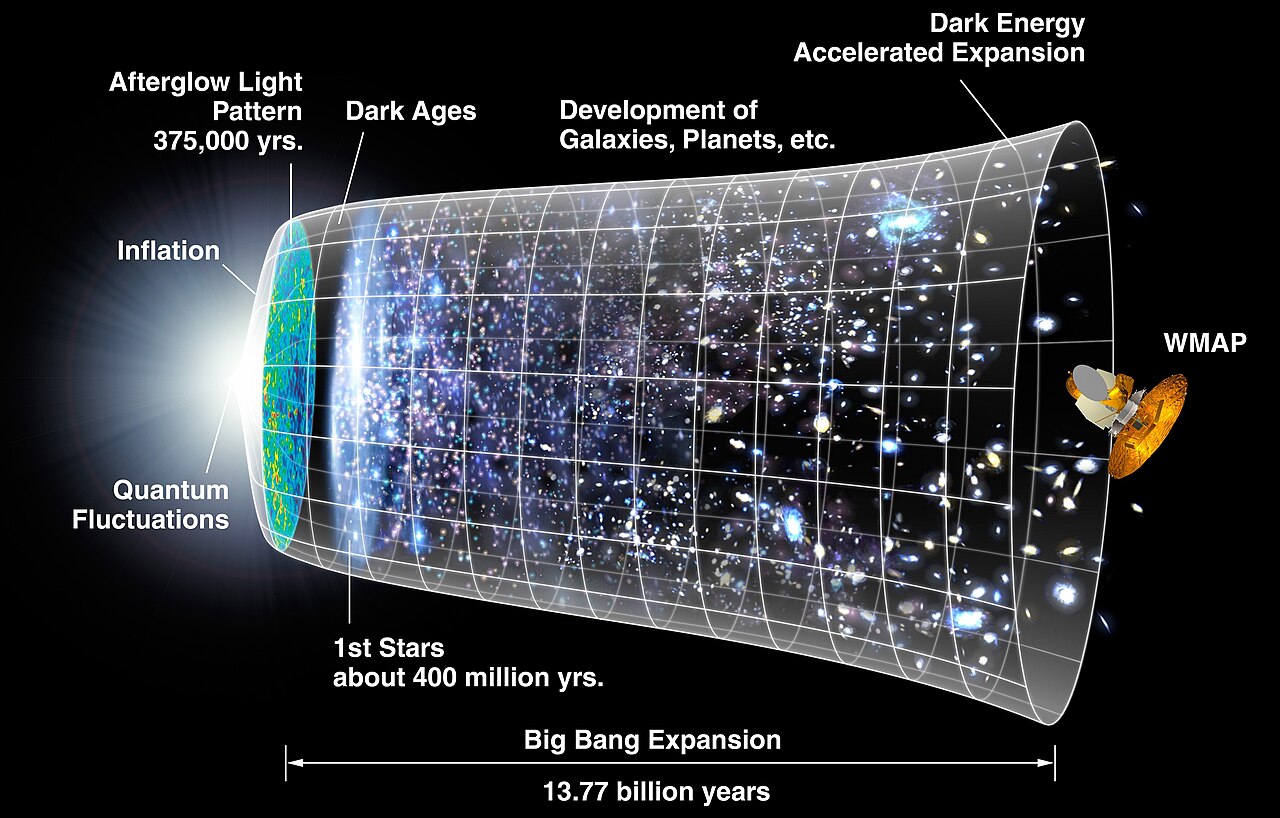
NASA’s timeline of the universe runs from the earliest moment scientists can probe, at left, to today. Its labels use earlier WMAP-era figures; ESA’s Planck later gave about 13.8 billion years. The glow at the far left edge is where this question lives.
WHERE THE EVIDENCE STANDS
WHAT WE DON’T KNOW YET
Nobody knows whether time had a first moment, or whether our hot beginning grew out of something older. Finding out will probably take a tested theory that joins gravity with quantum physics, and no such theory is finished yet.
WHAT WOULD CHANGE THIS ANSWER
A clear signal from before the hot Big Bang would change this answer, especially a pattern in gravitational waves (ripples in space and time) or ancient light that one model predicted in advance and the others did not. A tested theory of quantum gravity that says what happens at “time zero” would change it too.
Nobody knows yet. That is the honest answer, and it is more interesting than it sounds.
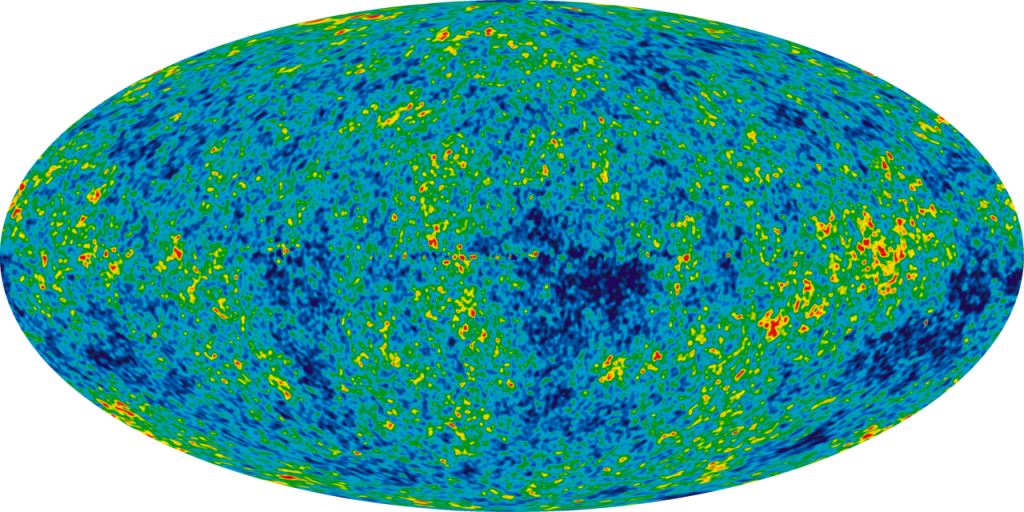
Scientists know a great deal about what came after the start. About 13.8 billion years ago, the universe was extremely hot and packed tight. Since then it has been expanding and cooling. A faint glow left over from that early time still fills the whole sky, and ESA’s Planck spacecraft has mapped it in fine detail. That part of the story is Established.
The trouble comes when you try to rewind to the very first instant. Einstein’s theory of gravity, called general relativity, works beautifully for planets, stars and galaxies. Run its equations backward, though, and they reach a point where density and temperature climb to infinity. Physicists usually read that as a sign that the theory has run out of road. It is not a clear picture of a first moment. To go further, we need a theory that joins gravity with quantum physics, the rules of the very small. Several candidates exist, but none is finished or confirmed.
People ask this question in three ways. Did time begin at the Big Bang? What was there before it? Was the Big Bang an explosion somewhere in space? The last one has a clearer answer: no. It was not a blast at one spot in an empty room. It happened everywhere at once, as space itself began to stretch.
For the first two questions, serious ideas compete. In some, time truly starts. In others, our universe bounced back from an earlier shrinking phase, or is one chapter in a long cycle. Each idea points to different clues we could look for, and none has been confirmed.
If you have lain awake wondering about this, you are in old company. More than 1,500 years ago, the Christian thinker Augustine of Hippo argued that there was no “then” before time began. Modern physics is still working on its own answer.
THE LONG ANSWER · ABOUT 8 MINUTES
The short answer, how sure we are, what we don’t know, what would change our mind and every source stay free on every page, for everyone.
All Access members read the long answer: the evidence piece by piece, the strongest objections, and how to check it yourself.
Join All Access · $1 a week Or $6 a month
Billed $52 once a year. Cancel anytime in your account.
Until December 4, 11:59 pm Pacific: the Founding rate is $39 a year, and it stays $39 while you stay a member.
Create a free account: 6 long answers a month, email only.
Paying never buys a different answer. Our Paywall Promise
Why is it so hard to test ideas about what happened before the hot Big Bang?
We infer earlier history from later traces.
See this path: Where did everything come from?
God Plays Dice answers big questions in plain words, with sources and one of six honest labels.
See a mistake? Report a problem. Corrections are made openly.
CONTINUE THE THREAD
OriginsExplainer
From the first atomic nuclei back to a possible burst of inflation, here is what scientists have tested about the first second, and where knowledge runs out.
OriginsAnswer
An earlier history needs a calculable path to a measurement that separates it from competing explanations.
OriginsAnswer
Several serious ideas in physics allow other universes, so here is what each one says, how scientists have tried to test them, and how a scientific braneworld differs from the multiverse in the movies.
The Architect AI companion · All Access
Labels describe the evidence for a claim, not the people who hold it.
Match my phone uses your device’s light or dark setting.