The Sun has about 5 billion years left, and the universe may fade out over trillions of years, so here is what the evidence says about each possible ending.
God Plays Dice Editorial · independently fact-checked · corrections welcomeChecked Sep 26, 20269 min read
THE SHORT ANSWER
Nobody knows yet. The leading picture is a slow fade: space keeps expanding, stars burn out, and the universe grows colder and darker over trillions of years. This big freeze is what we expect if dark energy, the unknown cause of the speeding-up expansion, stays constant. Recent data hinted that dark energy may be weakening, which could change the ending, but newer results are mixed. Closer to home, NASA says the Sun has about 5 billion years left.
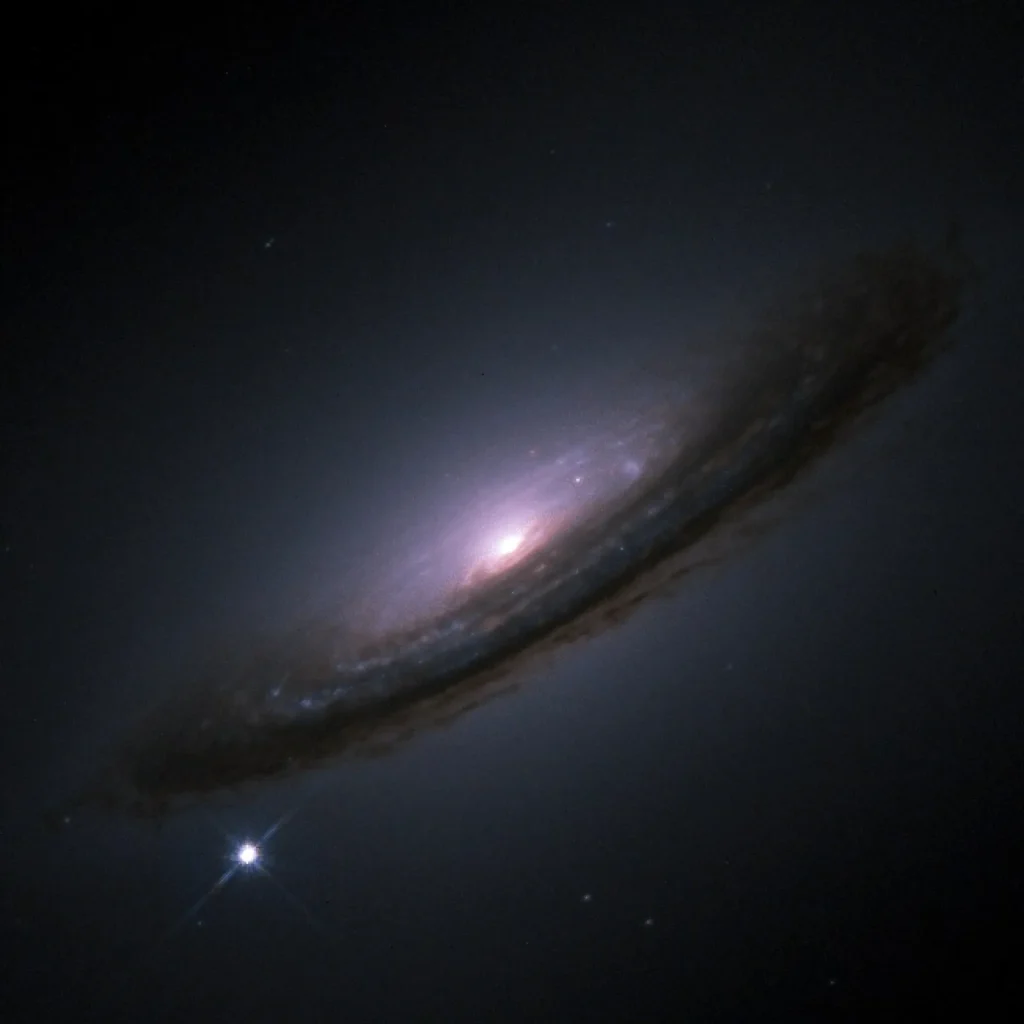
NASA says the Sun will last another 5 billion years or so: it will swell into a red giant and then become a white dwarf.
Dark energy makes up about 70% of the universe and is one of the biggest mysteries in physics.
If dark energy stays constant, galaxies beyond our Local Group will be pushed out of reach in about 100 billion years.
In 2025, the DESI survey reported hints that dark energy may be weakening, short of the 5-sigma standard for a discovery.
Newer checks are mixed: a 2026 supernova reanalysis found only a weak preference, and a July 2026 DESI result agreed with the standard model.
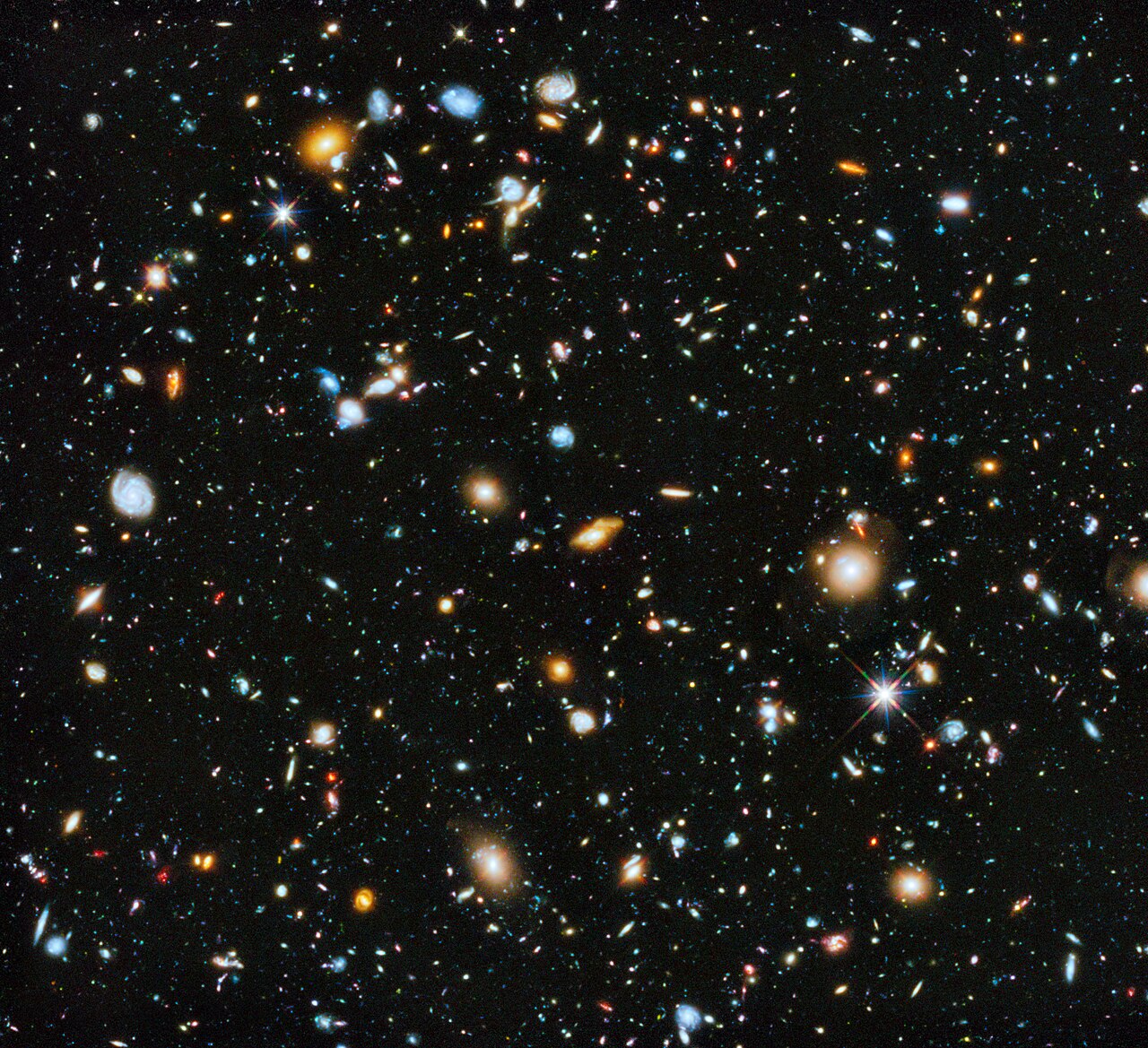
About this picture
The Hubble Ultra Deep Field 2014 image shows about 10,000 galaxies in a tiny patch of sky. If dark energy stays constant, galaxies beyond our own neighborhood will one day be carried out of view.
NASA, ESA, H. Teplitz and M. Rafelski (IPAC/Caltech), A. Koekemoer (STScI), R. Windhorst (Arizona State University) and Z. Levay (STScI), via Wikimedia Commons · Public domain · Image source ↗
WHERE THE EVIDENCE STANDS
How sure are we?
Within the next 5 billion years or so, the Sun will swell into a red giant and then become a white dwarf.NASA’s Sun facts page: the Sun is a little less than halfway through its life, will last another 5 billion years or so, will expand into a red giant that engulfs Mercury and Venus and possibly Earth, and will then become a white dwarf.
The universe will most likely end in a slow big freeze.Expected if dark energy is a cosmological constant (NASA’s WMAP site; Caldwell, Kamionkowski and Weinberg 2003). DESI data alone fit that simple model, but combined data sets hint at change, so the forecast is not settled.
Dark energy is getting weaker over time.DESI 2025: preference of 2.8 to 4.2 sigma, short of 5 sigma. A 2026 supernova reanalysis cut one result from 4.2 to 3.2 sigma, and a July 2026 DESI measurement agreed with the standard model. Full five-year results are expected in 2027.
Dark energy will tear everything apart in a Big Rip.A Big Rip needs phantom dark energy that grows stronger over time (Caldwell, Kamionkowski and Weinberg, Physical Review Letters, 2003). The recent hints point the other way, toward dark energy that may be weakening.
The universe could end in a Big Crunch or through vacuum decay.One 2025 model fit to DES and DESI-era data gives a crunch at a total age of about 33 billion years, with large uncertainty (Luu, Qiu and Tye, JCAP). A 2018 Standard Model calculation gives more than 10^58 years for vacuum decay at 95% confidence, assuming no new physics (Andreassen, Frost and Schwartz).
Nobody knows what dark energy is, or whether it changes over time. We also don’t know whether empty space is truly stable. That depends on physics beyond what has been tested.
WHAT WOULD CHANGE THIS ANSWER
If DESI’s full five-year results, due in 2027, and other surveys show with high confidence that dark energy is weakening, the big freeze would lose its lead. If the hint fades, the slow freeze stays the best bet.
Nobody knows yet how the universe will end, or whether it truly ends at all. But scientists can describe the options, and they can say which one leads for now. The leading picture is not a bang. It is a very slow fade.
People come to this question in many ways. Some meet it in scripture, some in a video about the universe tearing apart, and some while lying awake under the stars. It is one of the oldest questions there is, and it deserves a careful answer.
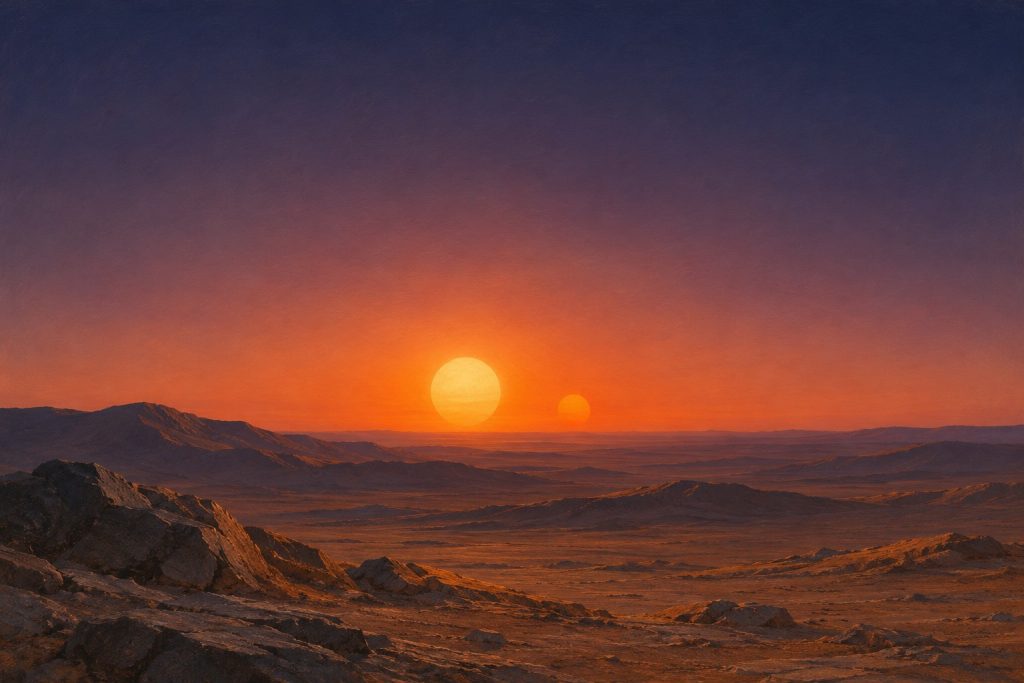
Start close to home. NASA says the Sun is a little less than halfway through its life. Over the next 5 billion years or so, it will swell into a red giant, big enough to swallow Mercury and Venus, and possibly Earth. Then it will shrink into a small, dim star called a white dwarf.
The fate of the whole universe depends on dark energy. That is the name for whatever is making the expansion of space speed up. It makes up about 70% of the universe, and nobody knows what it is. If dark energy stays constant, space keeps expanding forever. Other galaxies drift out of sight. Stars stop forming, burn out and go dark. Over spans of time too long to picture, the universe grows colder and emptier. This ending is called the big freeze, or heat death.
There are other options. Dark energy that grows stronger could rip everything apart. Dark energy that weakens and turns negative could let gravity win, pulling everything back together in a big crunch. Or empty space itself could change state, a process called vacuum decay. In 2025, a huge galaxy survey called DESI found hints that dark energy may be weakening, but newer results are mixed. So we label the headline question an Open question, with the big freeze as the favorite for now.
THE LONG ANSWER
THE LONG ANSWER · ABOUT 7 MINUTES
You’ve read your 3 free long answers this month.
The short answer, how sure we are, what we don’t know, what would change our mind and every source stay free on every page, for everyone.
All Access members read the long answer: the evidence piece by piece, the strongest objections, and how to check it yourself.
The name for whatever is making the expansion of the universe speed up. It makes up about 70% of the universe, and its nature is unknown.
Cosmological constant
The simplest model of dark energy: a steady push built into space that never changes over time.
Big freeze (heat death)
An ending in which space expands forever and the universe grows colder, darker and emptier until almost nothing happens.
Sigma
A measure of how unlikely a result is to be a statistical fluke. Physicists usually want 5 sigma before claiming a discovery.
Red giant and white dwarf
Late stages in the life of a star like the Sun: first it swells up hugely, then it leaves behind a small, dim star that slowly cools.
Vacuum decay
A possible change of empty space to a lower-energy state, starting as a bubble that spreads at the speed of light.
Sources & further reading
(10) · Checked Sep 26, 2026
Our Sun: Facts ↗NASA Science“Like all stars, our Sun will eventually run out of energy”; red giant that will engulf Mercury and Venus, and possibly Earth; “a little less than halfway through its lifetime”; “another 5 billion years or so before it becomes a white dwarf.”
What is the Ultimate Fate of the Universe? (WMAP) ↗NASA Goddard Space Flight Center (page updated Feb. 20, 2024; archived Dec. 3, 2025)Endless expansion vs the Big Crunch; the Big Chill or Big Freeze (endless expansion), as the universe slowly cools as it expands until unable to sustain any life; crunch if density exceeds the critical density; with dark energy the universe will in all likelihood expand forever. The live URL (https://map.gsfc.nasa.gov/universe/uni_fate.html) now redirects to the WMAP overview, so the Internet Archive copy was read.
New DESI Results Strengthen Hints That Dark Energy May Evolve ↗Berkeley Lab News Center (March 19, 2025)Three years of data, nearly 15 million galaxies and quasars; Kitt Peak, Arizona; hints that dark energy’s impact may be weakening; preference of 2.8 to 4.2 sigma, below the 5-sigma discovery threshold; many 3-sigma events have faded with more data; the first-year analysis also hinted at evolving dark energy. Collaboration paper: DESI DR2 Results II, Physical Review D 112, 083515 (2025), https://doi.org/10.1103/tr6y-kpc6 (arXiv:2503.14738), whose abstract also says DESI BAO results alone are well described by flat ΛCDM. First-year paper: JCAP 02 (2025) 021 (arXiv:2404.03002).
DESI Completes Planned 3D Map of the Universe and Continues Exploring ↗Berkeley Lab News Center (April 15, 2026)More than 47 million galaxies and quasars; dark energy makes up about 70% of the universe; first dark energy results from the full five-year survey expected in 2027. Also read: DESI’s July 30, 2026 post on new DR2 Lyman-alpha results (https://www.desi.lbl.gov/2026/07/30/new-desi-dr2-lyman-alpha-results-shed-light-on-dark-energy/): the full-shape result agrees with the standard model, which could mean the hint fades or that a more complex model is needed. Also read: NASA Science, “Dark Energy” (https://science.nasa.gov/dark-energy/): “what exactly is dark energy? The short answer is: We don’t know.”
Phantom Energy: Dark Energy with w<−1 Causes a Cosmic Doomsday ↗Physical Review Letters (2003), Caldwell, Kamionkowski and WeinbergPhantom energy density grows with time; Big Rip tears apart the Milky Way, solar system, Earth and atoms; for w = −3/2 and H0 = 70, the Big Rip is 22 Gyr away; Milky Way destroyed about 60 Myr before, Earth explodes about 30 minutes before; currently bound structures such as the Milky Way remain unaffected if −1 ≤ w < −1/3. Read on arXiv:astro-ph/0302506 (titled “Phantom Energy and Cosmic Doomsday” there).
A Dying Universe: The Long-Term Fate and Evolution of Astrophysical Objects ↗Reviews of Modern Physics (1997), Fred C. Adams and Gregory LaughlinSolar mass loss on the red giant branch can help Earth avoid destruction, amount uncertain; lowest-mass stars burn their hydrogen over about 10^13 years; conventional star formation ends at about 10^14 years, when the galaxy runs out of gas; the Local Group coalesces into one stellar system at about 10^11 to 10^12 years; Black Hole Era to about 10^100 years with Hawking radiation; Dark Era and heat death after that; CMB fades into insignificance after several trillion years. Read on arXiv:astro-ph/9701131.
The Return of a Static Universe and the End of Cosmology ↗General Relativity and Gravitation (2007), Lawrence M. Krauss and Robert J. ScherrerLocal Group stays bound; more distant structures pushed beyond the horizon on a timescale of about 100 billion years; at 100 Gyr the CMB intensity is redshifted by about 12 orders of magnitude; future observers would see a single galaxy (merger product of the Milky Way, Andromeda and other Local Group remnants) in an “island universe” and could not detect the expansion or the CMB; the 100-billion-year figure is cited from earlier work (their ref. 4). Read on arXiv:0704.0221.
Scale-invariant instantons and the complete lifetime of the standard model ↗Physical Review D (2018), Andreassen, Frost and SchwartzPublished abstract: lifetime of our universe 10^139 years; with 95% confidence, more than 10^58 years. Paper: metastable Standard Model vacuum; bubbles expand at the speed of light; the phase diagram assumes no gravity and no physics beyond the Standard Model, and high-scale physics can destabilize or stabilize it. The arXiv v4 text (arXiv:1707.08124) gives 10^161 years and a 95% lower bound of 10^65 years; this page uses only the published lower bound, which both versions satisfy.
The lifespan of our universe ↗Journal of Cosmology and Astroparticle Physics (2025), Luu, Qiu and TyeAxion dark energy plus a negative cosmological constant fit to DES and DESI data; big crunch; best-fit expansion stops about 11 billion years from now; lifespan about 33 billion years; relatively large degeneracy, best fit outside the 1-sigma range of the mean; age of the universe 13.8 billion years. Read on arXiv:2506.24011 (v2).
An everywhere-present field, a fleeting particle and a famous nickname. What did CERN’s experiments actually measure?
Established4 min read
THE OCCASIONAL LETTER
Stay curious.
New stories, book updates, and notes from God Plays Dice, delivered when there is something worth sharing.
EMAIL UPDATES ↗
500 DIGITAL COPIES • GIVEAWAY PREVIEW
Be first to know when the 500-copy reader giveaway opens.
Join for the book launch, verified retailer links, and the announcement for a planned giveaway of 500 digital copies. The giveaway is not open yet: dates, eligibility, a dedicated entry form, and Official Rules will be published first.
Privacy · Check your inbox to confirm your subscription. Newsletter signup alone is not a giveaway entry.