Can quantum entanglement send messages faster than light?
Einstein called it “spooky action at a distance,” and the matching is real, but here is why nobody can use it to send a message faster than light.
What’s rated: “Entanglement can be used to send a message faster than light.”God Plays Dice Editorial · independently fact-checked · corrections welcomeChecked Sep 29, 20268 min read
THE SHORT ANSWER
No. Entanglement makes the results of measurements on two particles match more closely than any built-in instructions could explain, even far apart. But each person sees only random results. The match shows up only when the two lists are compared, and comparing them needs an ordinary signal, like a phone call, that is no faster than light. Physicists have shown that standard quantum theory rules out using entanglement to send faster-than-light messages, and experiments agree.
Einstein called entanglement “spooky action at a distance,” and the 2022 Nobel Prize in Physics honored experiments with entangled photons.
Measured on its own, each entangled particle gives a random result; the match appears only when both sets of results are put side by side.
Physicists showed in 1978, 1980 and 1982 that, in standard quantum theory, this matching cannot be used to send signals faster than light.
Quantum teleportation moves the state of a particle, not a message, and it needs an ordinary signal from sender to receiver.
Entangled photons have been shared between two ground stations 1,203 kilometers apart with the help of a satellite.
About this picture
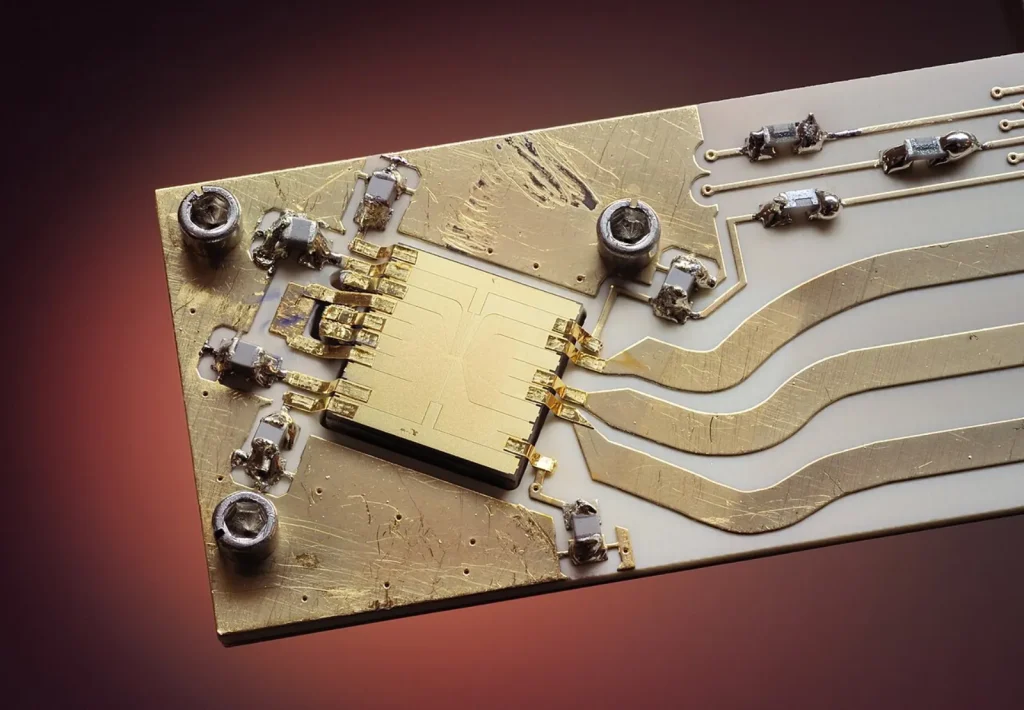
A NIST chip holding a single-photon detector made of superconducting nanowires. Detectors like this can register single particles of light, and NIST used superconducting nanowire detectors in its 2015 test of entanglement.
National Institute of Standards and Technology (NIST), via Wikimedia Commons · Public domain (PD-USGov-NIST) · Image source ↗
WHERE THE EVIDENCE STANDS
How sure are we?
Entanglement can be used to send a message faster than light.The Stanford Encyclopedia of Philosophy cites proofs by Eberhard (1978), Ghirardi, Rimini and Weber (1980) and Page (1982) that quantum correlations cannot be used to signal faster than light; Caltech’s Science Exchange says experiments agree.
Entangled particles match more strongly than any set of built-in instructions could explain.Bell tests from the 1972 experiment by John Clauser and Stuart Freedman onward, honored by the 2022 Nobel Prize, and NIST’s 2015 test that closed all three major loopholes at once.
Some real influence passes instantly between entangled particles.The Stanford Encyclopedia says whether Bell’s theorem clashes with relativity depends on what relativity is taken to require. Salart and colleagues (2008) found that any such hidden influence, if it exists, would have to be at least 10,000 times faster than light under their assumptions.
Entanglement is useful for communication technology, even though it cannot carry a message by itself.The Stanford Encyclopedia describes Ekert’s method for sharing random code keys with entangled photons, which still uses ordinary public messages; the Royal Swedish Academy of Sciences’ popular science background describes entangled photons used as signals in quantum networks.
Physicists still disagree about what entanglement really is. Some think something truly nonlocal happens between the particles, and others read the theory differently. Nobody knows yet how quantum theory and relativity fit together at the deepest level.
WHAT WOULD CHANGE THIS ANSWER
A repeatable experiment in which one person’s choice of measurement changed what a far-away partner sees, before any ordinary signal could arrive, would change this answer. Standard quantum theory forbids that, so the theory itself would need to change.
No. Entanglement cannot send a message faster than light. The link between entangled particles is real, and it is one of the strangest things in physics. But it cannot carry news.
Here is why people ask. Entanglement is a link between particles that have interacted in a special way. Measure one particle, and you instantly know something about the result for its partner, even if the partner is far away. Albert Einstein called this “spooky action at a distance.” If something happens instantly across any distance, it seems as if we should be able to use it to talk to Mars with no delay.
The catch is in what each person actually sees. Picture two scientists, Alice and Bob, far apart, each with one particle from many entangled pairs. Alice measures her particles and writes down her results. They look like coin flips: random. Bob does the same, and his results look random too. Nothing Alice does can change the odds of what Bob sees. The amazing pattern shows up only later, when they put their two lists side by side. To do that, one of them has to send the list by phone, email or radio. Those signals travel no faster than light.
So the matching is instant, but the knowledge is not. Physicists proved this about standard quantum theory in several papers from 1978 to 1982. Experiments have tested entanglement across a lab building, between two villages 18 kilometers apart, and between ground stations more than 1,200 kilometers apart. The matching was always there. A faster-than-light message never was.
That is why we label the idea of entanglement messages Not supported. What entanglement really is, deep down, is still debated. But on the practical question, the answer is clear. You can’t use it to beat light.
THE LONG ANSWER
THE LONG ANSWER · ABOUT 7 MINUTES
You’ve read your 3 free long answers this month.
The short answer, how sure we are, what we don’t know, what would change our mind and every source stay free on every page, for everyone.
All Access members read the long answer: the evidence piece by piece, the strongest objections, and how to check it yourself.
A link between particles that have interacted so that they share one quantum state. Measuring one tells you about the other, even far away.
Hidden variables
Built-in instructions that particles might carry, deciding their results in advance. Bell tests rule out the local kind.
Bell inequality
A limit on how strongly results can match if particles carry built-in instructions. Entangled particles go past this limit.
No-signaling
The rule, proved for standard quantum theory, that quantum correlations cannot be used to send a signal faster than light.
Quantum teleportation
A method that moves the state of one particle onto another far away. It needs an ordinary message too, so it is not faster than light.
No-cloning theorem
The rule, published in 1982, that an unknown quantum state cannot be copied perfectly.
Sources & further reading
(10) · Checked Sep 29, 2026
The Nobel Prize in Physics 2022: Popular science background, How entanglement has become a powerful tool ↗The Royal Swedish Academy of Sciences / NobelPrize.orgEinstein talked about “spooky action at a distance”; Bell inequalities; Clauser and Freedman 1972; EPR 1935; balls analogy (black, white, grey); quantum teleportation first done in 1997 by Zeilinger and colleagues; entanglement between a satellite and a ground station; prize citation. The press release (https://www.nobelprize.org/prizes/physics/2022/press-release/) gives the same citation.
Bell’s Theorem (Stanford Encyclopedia of Philosophy, revised 2024) ↗Stanford Encyclopedia of PhilosophySection 8.2: Eberhard 1978, Ghirardi, Rimini and Weber 1980, and Page 1982 show that, without nonlocal interaction terms, quantum correlations cannot be exploited to signal superluminally; de Broglie-Bohm theory violates parameter independence but does not permit signalling; Bell’s 1964 remark that hidden-variable theories need an instantaneous influence; whether Bell’s theorem shows incompatibility with relativity depends on what relativity requires, and Bell’s own attitude varied.
What Is Entanglement and Why Is It Important? ↗Caltech Science ExchangeFaster-than-light communication between the particles is a common misconception; quantum physics cannot be used to send faster-than-light communications; Thomas Vidick: “There can be correlation without communication.”
How the No-Cloning Theorem Got its Name (Asher Peres, 2002) ↗arXivPeres refereed Nick Herbert’s FLASH paper for Foundations of Physics early in 1981 and recommended publication though he knew it was wrong; Ghirardi recommended rejection; Wheeler contributed the title “A single quantum cannot be cloned”; local quantum operations cannot transmit any information without sending material objects; a nonlinear change to quantum theory would allow it.
NIST Team Proves ‘Spooky Action at a Distance’ is Really Real (2015) ↗National Institute of Standards and TechnologyLoophole-free Bell test; detectors 184 meters apart; measurements finished more than 40 nanoseconds before light-speed communication was possible; light needs 617 nanoseconds; Shalm et al., Phys. Rev. Lett. 115, 250402 (2015).
Salart et al., Testing the speed of ‘spooky action at a distance’, Nature 454, 861 (2008) ↗NatureCrossref confirms title, Nature 454, 861–864 (August 2008), authors Salart, Baas, Branciard, Gisin, Zbinden. Nature abstract: Bell test over more than 24 hours between two villages 18 km apart; if a privileged frame exists in which Earth moves slower than 1/1000 of light speed, any influence would exceed light speed by at least four orders of magnitude; Nature’s editor summary: at least 10,000 times the speed of light under plausible assumptions.
Two particles can share one quantum state, even far apart. Here is what that means, why Einstein distrusted it, and why it still cannot carry a message.
What happened to OPERA's 2011 faster-than-light claim, how relativity is tested, and why successful measurements do not prove every possible prediction.
Established3 min read
THE OCCASIONAL LETTER
Stay curious.
New stories, book updates, and notes from God Plays Dice, delivered when there is something worth sharing.
EMAIL UPDATES ↗
500 DIGITAL COPIES • GIVEAWAY PREVIEW
Be first to know when the 500-copy reader giveaway opens.
Join for the book launch, verified retailer links, and the announcement for a planned giveaway of 500 digital copies. The giveaway is not open yet: dates, eligibility, a dedicated entry form, and Official Rules will be published first.
Privacy · Check your inbox to confirm your subscription. Newsletter signup alone is not a giveaway entry.