Many physicists say life depends on a few numbers of nature falling in narrow ranges, so here is what that means, why 137 is famous, and how design, many universes and luck each try to explain it.
God Plays Dice Editorial · independently fact-checked · corrections welcomeChecked Sep 28, 20269 min read
THE SHORT ANSWER
Many physicists say yes, in a limited sense: life as we know it seems to depend on some numbers of nature falling in narrow ranges. In one 2000 study, changing the strong nuclear force by more than about 0.5% cut the carbon or oxygen made in stars by 30 to 1,000 times. Why the numbers are what they are is still open. A designer, many universes and plain luck are all serious answers, and none has been shown to be right.
A 2000 study in Science found that outside a window of about 0.5% for the strong force and 4% for the electric force, stars make 30 to 1,000 times less carbon or oxygen.
The fine-structure constant, a pure number that sets the strength of electromagnetism, is about 1/137; the 2022 value NIST lists for its inverse is 137.035999177.
No accepted theory yet explains why the constants of nature have the values they do, so physicists measure them.
Light that left a distant quasar when the universe was 0.8 billion years old showed no evidence that this constant has changed over time.
Philosophers still debate whether fine-tuning points to a designer, to many universes, or to nothing that needs explaining.
About this picture
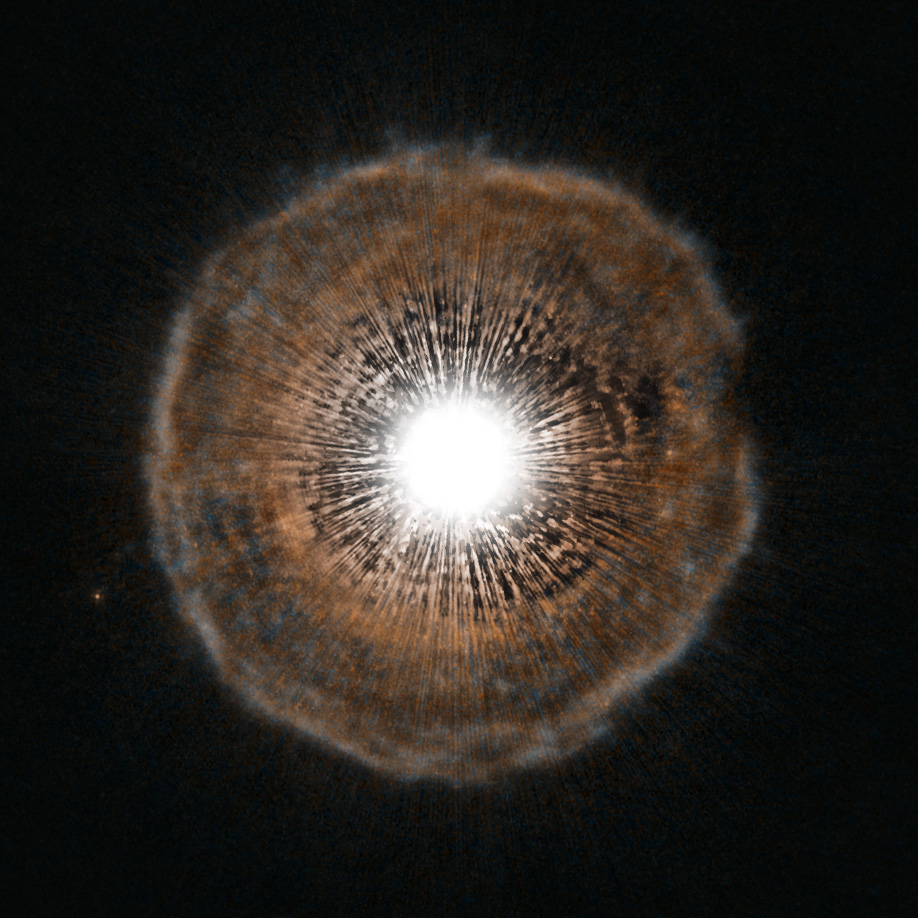
The carbon star U Camelopardalis, seen by the Hubble Space Telescope, inside a shell of gas it blew off as helium around its core began to fuse. Its atmosphere holds more carbon than oxygen.
ESA/Hubble, NASA and H. Olofsson (Onsala Space Observatory), via Wikimedia Commons · CC BY 4.0 · Image source ↗
WHERE THE EVIDENCE STANDS
How sure are we?
Small changes in some constants of nature would make life as we know it impossible.Many physicists hold this view, and studies such as Oberhummer and colleagues (Science, 2000) back specific cases. The Stanford Encyclopedia of Philosophy reports critics: Victor Stenger is extremely critical of fine-tuning claims, and Fred Adams finds the life-friendly ranges quite considerable. Luke Barnes replies that, when many constants are varied at once, the life-permitting range is likely very small.
Physics can explain why the fine-structure constant is about 1/137.No accepted theory predicts its value. Quanta Magazine reports that physicists have more or less given up on explaining where it comes from, and now accept that the constants could be random.
The constants of nature have been shown to differ in other places or at other times.A 2020 study of a very distant quasar found no evidence that the fine-structure constant changed over time. Combined with older data, the team found a marginal preference for change across space, which is not established. The Stanford Encyclopedia says varying-constant ideas seem disfavored by the evidence.
Light traveled faster in the early universe.Andreas Albrecht and João Magueijo explored this idea in 1998 as a way to solve some cosmic puzzles; their paper is a theoretical proposal and reports no observation of it, and no source checked for this page reports one. M. J. Duff argues that a change in the speed of light alone has no operational meaning, because its number depends on our choice of units.
Fine-tuning proves that a designer made the universe.The Stanford Encyclopedia reports careful defenders (Swinburne, Collins, Rota) and careful critics (Sober, Narveson). Whether a designer exists cannot be settled by measuring constants.
Nobody knows yet why the constants have the values they do, or whether a deeper theory will fix them. Nobody knows how to count the odds for numbers that could, in principle, take any value. And nobody knows whether other universes exist.
WHAT WOULD CHANGE THIS ANSWER
A deeper theory that forces the constants to their measured values would weaken the idea that they were tuned. Strong, independent evidence for other universes with different constants would change how we read the tuning. So would firm proof that a constant differs in another part of space.
Many physicists say yes, in a limited sense. Life as we know it seems to depend on a handful of numbers in nature falling inside narrow ranges. That is the scientific part. Why the numbers fall where they do is a different question, and nobody knows the answer yet.
Here is one example. Most of the carbon in our universe is made inside stars. In 2000, three researchers publishing in the journal Science ran the numbers for how stars make carbon. They found that if the strong nuclear force, which holds atomic nuclei together, changed by more than about 0.5%, stars would make 30 to 1,000 times less carbon or oxygen. Life as we know it needs both.
Physicists call results like this fine-tuning. The word does not mean someone did the tuning. The Stanford Encyclopedia of Philosophy compares it to a phone: it only works if its parts are just right. The phone had a designer. For the universe, that is the question people disagree about.
People ask about fine-tuning for many reasons. A believer may see a Creator’s fingerprints. A skeptic may suspect we are fooled by the fact that we are here to look. Someone else just wonders why nature has these numbers and not others. All of these are fair questions.
There are four main answers. Some see a designer. Some think there are many universes with different numbers, and we live in one that happens to allow life. Some say it is luck, and that we could only ever find ourselves in a universe that allows observers. And some expect a deeper theory to explain the numbers one day. Each answer has careful defenders and a strong objection. This page walks through them fairly.
THE LONG ANSWER
THE LONG ANSWER · ABOUT 8 MINUTES
You’ve read your 3 free long answers this month.
The short answer, how sure we are, what we don’t know, what would change our mind and every source stay free on every page, for everyone.
All Access members read the long answer: the evidence piece by piece, the strongest objections, and how to check it yourself.
A number in the laws of physics that has to be measured, such as the strength of gravity or the fine-structure constant.
Fine-structure constant
A pure number, about 1/137, that sets how strongly light and electric charges interact.
Fine-tuning
When a result depends sensitively on a number falling in a narrow range. The word does not by itself imply a tuner.
Weak anthropic principle
Brandon Carter’s point that we can only observe conditions that allow observers to exist.
Multiverse
A proposed vast collection of universes, possibly with different laws or constants.
Pure number
A number with no units, like the fine-structure constant. It stays the same whether you measure in meters or miles.
Sources & further reading
(10) · Checked Sep 28, 2026
Fine-Tuning (Simon Friederich) ↗Stanford Encyclopedia of Philosophy (substantive revision 26 February 2026)Phone analogy (a designer is not required for fine-tuning); fine-tuning for life is the view of many physicists; cases: gravity, strong force (about 50%; carbon and oxygen much narrower, citing Oberhummer et al. 2000), weak force (factor of about 10), vacuum energy (10^50 to 10^123; only a few orders larger allow galaxies); electromagnetism vs gravity on an electron/proton pair about 10^40; Stenger, Barnes (life-permitting range likely very small) and Adams (range quite considerable; could have been more life-friendly); life in general, not only humans; four reactions; design as strongest teleological version; Swinburne, Collins, Rota; Sober (judgments based on human intelligence) and Narveson (bodiless designer); Manson 2020; Carter’s anthropic principles; Leslie’s firing squad with Weisberg and Kotzen; Gould and coin tosses; Leslie on candidate explanations; Susskind, Greene, Tegmark; Hacking’s inverse gambler’s fallacy (1987) and McGrath’s reply; Einstein’s hope for determined constants; string theory vacua; inflation and flatness, not universally recognized; Donoghue on no clear pattern; varying-constant ideas seem disfavoured (Uzan 2011); multiverse extremely difficult to test.
Stellar Production Rates of Carbon and Its Abundance in the Universe ↗Science 289: 88–90 (2000), H. Oberhummer, A. Csótó and H. SchlattlAbstract: outside a narrow window of 0.5% (strong force) and 4% (Coulomb force), stellar production of carbon or oxygen drops by factors of 30 to 1,000. Abstract read from arXiv astro-ph/0007178; bibliographic details from Crossref. Same figures as /library/arguments-for-god/.
Current advances: The fine-structure constant and quantum Hall effect ↗NISTAlpha is dimensionless, very nearly 1/137; measures the strength of the electromagnetic force; introduced by Sommerfeld in 1916; at the W-boson mass it is about 1/128, so “the famous number 1/137 is not unique or especially fundamental”; c exact since the 1983 redefinition of the meter.
Physicists Nail Down the ‘Magic Number’ That Shapes the Universe ↗Quanta Magazine (2 December 2020)Alpha has no units, close to 1/137; Feynman: “a magic number that comes to us with no understanding”; Dirac on its origin as “the most fundamental unsolved problem of physics”; physicists have more or less given up on where its value comes from and acknowledge the constants could be random; precise measurements test the Standard Model; c’s numerical value depends on units.
Four direct measurements of the fine-structure constant 13 billion years ago ↗Science Advances 6 (2020), M. R. Wilczynska et al.Quasar J1120+0641 at redshift 7.085; universe 0.8 billion years old; no evidence for a temporal change in alpha; combined with earlier data, spatial variation “marginally preferred” at 3.7 sigma (reported on this page as not established). Author list and abstract read from arXiv 2003.07627 (first author Michael R. Wilczynska); journal details from Crossref.
Varying Constants, Gravitation and Cosmology (Jean-Philippe Uzan) ↗Living Reviews in Relativity 14 (2011)Abstract (arXiv 1009.5514): constraints from atomic clocks, the Oklo phenomenon, Solar System observations, meteorite dating, quasar absorption spectra, stellar physics, pulsar timing, the CMB and big bang nucleosynthesis; discussion of apparent fine-tuning. Journal details from Crossref.
A time varying speed of light as a solution to cosmological puzzles ↗Physical Review D 59, 043516 (1999), A. Albrecht and J. MagueijoAbstract (arXiv astro-ph/9811018, submitted 2 November 1998): cosmological implications of light travelling faster in the early universe; shows how the horizon, flatness and cosmological constant problems may be solved. Theory only; no observation reported.
Comment on time-variation of fundamental constants (M. J. Duff) ↗arXiv (2002, revised 2016)Abstract: variation of dimensionless constants such as alpha is a legitimate subject of enquiry; variation of dimensional constants such as c has no operational meaning; Appendix A answers criticisms by P. Davies and two Nature referees; Appendix B responds to remarks by Magueijo and T. Davis.
Extra dimensions, gravitons, and tiny black holes ↗CERNA small fridge magnet creates an electromagnetic force greater than the gravitational pull of the Earth; why gravity is so much weaker than the other forces.
Several serious ideas in physics allow other universes, so here is what each one says, how scientists have tried to test them, and how a scientific braneworld differs from the multiverse in the movies.
Cosmic expansion means distances between faraway galaxies grow; it does not require a wall, an edge, or a room beyond space.
Established7 min read
THE OCCASIONAL LETTER
Stay curious.
New stories, book updates, and notes from God Plays Dice, delivered when there is something worth sharing.
EMAIL UPDATES ↗
500 DIGITAL COPIES • GIVEAWAY PREVIEW
Be first to know when the 500-copy reader giveaway opens.
Join for the book launch, verified retailer links, and the announcement for a planned giveaway of 500 digital copies. The giveaway is not open yet: dates, eligibility, a dedicated entry form, and Official Rules will be published first.
Privacy · Check your inbox to confirm your subscription. Newsletter signup alone is not a giveaway entry.