Can crystals or energy healing work? What happens when they are tested?
Healers describe an energy carried by stones and guided by hands; here is what happened when that energy was put to a fair test, and why the calm people feel is real.
God Plays Dice Editorial · independently fact-checked · corrections welcomeChecked Sep 30, 202611 min read
THE SHORT ANSWER
Not in the way their energy claims describe, as far as fair tests show. In two studies, people’s tingles and other sensations were no different when they held a glass copy instead of real quartz. In a blinded test, therapeutic touch practitioners trying to sense a hidden hand were right 44% of the time, where guessing gives 50%. No one has measured the energy field, or aura, that healers describe. Still, the calm people can feel after a session is real, and caring attention and touch can help explain it.
In two studies at Goldsmiths, University of London, with 80 volunteers each, sensations were the same with real quartz or a glass copy; the studies were presented at conferences but never published in a journal.
In a test published in JAMA in 1998, 21 therapeutic touch practitioners found a hidden hand in 123 of 280 tries, or 44%, where guessing gives 50%.
In its 2018 fact sheet, the U.S. National Center for Complementary and Integrative Health says Reiki hasn’t been clearly shown to work for any health purpose and no scientific evidence supports its energy field.
In a 2008 trial with 262 adults with irritable bowel syndrome, 62% reported adequate relief after a fake treatment given with warmth and attention, compared with 28% on a waiting list.
A 2024 review of 137 studies found that touch eased pain, anxiety and depression in adults, though such studies cannot be blinded, since people know when they are touched.
About this picture
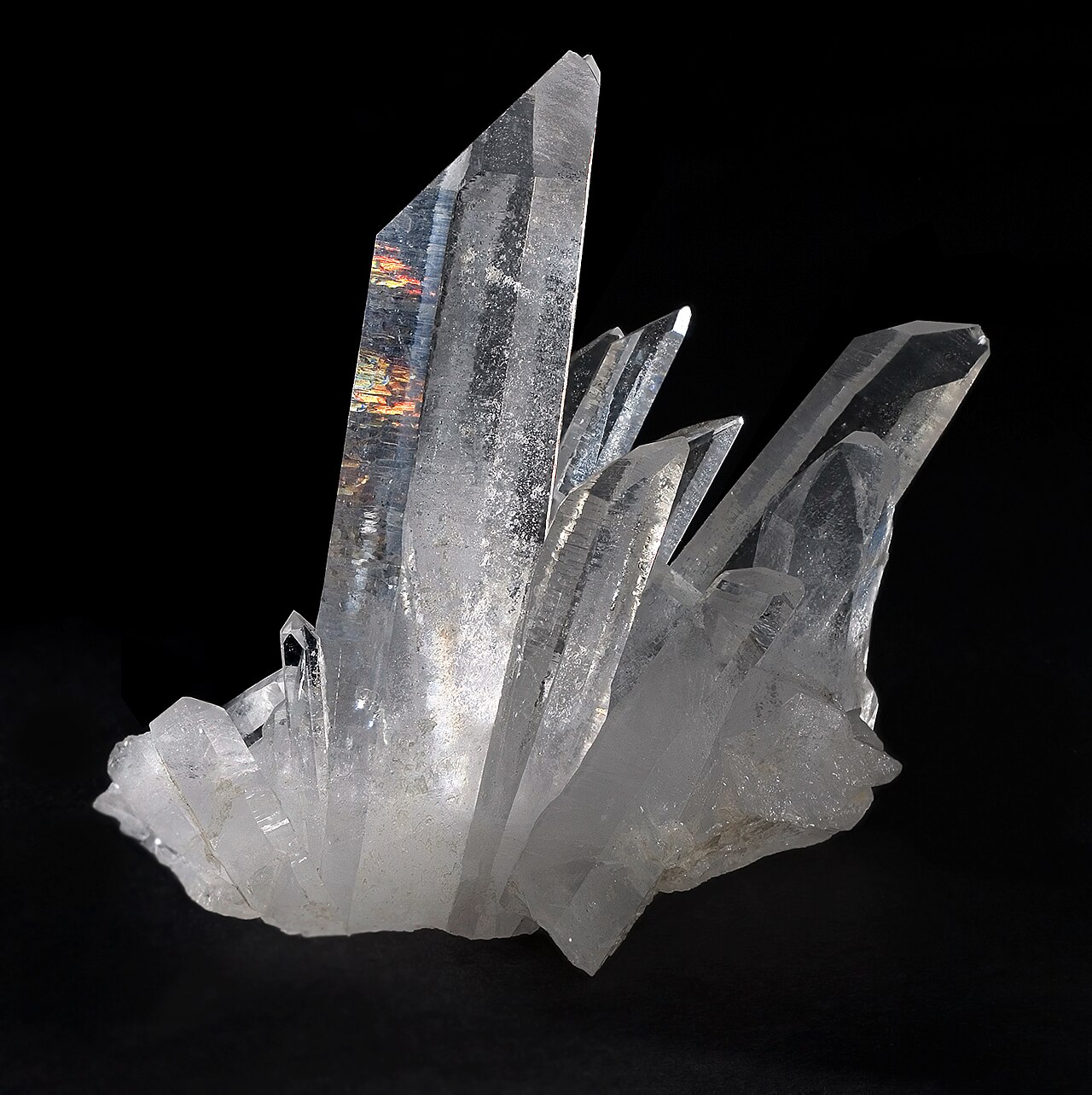
Clear quartz from Tibet. Squeezing or bending quartz makes an electric field, which is what lets quartz keep time in the circuits of watches and clocks. In two studies, though, people reported the same sensations holding real quartz or a glass copy.
Crystals give off an energy that people can feel.Two Goldsmiths studies of 80 volunteers each, presented at conferences in 1999 and 2001: reported sensations were the same with real quartz and glass copies, and tracked paranormal belief and, in the second study, suggestibility. Chris French, who ran them, says they were never published in a peer-reviewed journal.
Healers can sense a human energy field, or aura, around the body.Rosa and colleagues, JAMA 1998: 21 practitioners were right in 123 of 280 tries (44%), close to guessing; a 2003 reanalysis disputed the design, and we found no larger blinded test since. NCCIH: no scientific evidence for the energy field behind Reiki. Science, 1976: most changes in the glow of Kirlian photos of living subjects can be explained by moisture.
Reiki from a trained practitioner eases stress, anxiety or depression more than an imitation (sham) session.A 2022 review of 14 trials with imitation (sham) sessions found Reiki did better for some symptoms, especially at clinical levels, but called the findings inconclusive; in most trials the real practitioner knew which session was real. Cochrane (2015) found too little evidence to say; in a 2008 trial with 100 adults with fibromyalgia, a Reiki master did no better than an actor.
A calm session with warmth, attention and gentle touch can help people feel better.Kaptchuk and colleagues, BMJ 2008: warmth and attention raised adequate relief from 44% to 62%. Kelley and colleagues, 2014: across 13 trials, the patient-clinician relationship had a small but statistically significant effect on health. Packheiser and colleagues, 2024: touch eased pain, anxiety and depression across 137 studies, though small studies may inflate the effect.
Reiki is guided by a spiritual source, as its teachers describe it.The International Center for Reiki Training says the word joins rei, “God’s Wisdom or the Higher Power,” and ki, “life force energy.” Tests can check whether real Reiki beats a sham; they cannot test whether a higher power is at work.
Nobody knows yet whether Reiki eases stress, anxiety or depression more than a convincing imitation session, because the trials are few, small and mixed. The two crystal studies were never published in a peer-reviewed journal, and the psychologist who ran them wrote in 2021 that, as far as he could see, crystals’ healing claims had never been tested.
WHAT WOULD CHANGE THIS ANSWER
Repeated blinded tests in which practitioners reliably sensed an energy field, or in which real crystals or real Reiki beat convincing imitations in independent labs, would change this answer. So would an instrument that could measure the energy these practices describe.
Not in the way their energy claims describe, as far as fair tests show. When researchers tested the energy itself, using glass copies of crystals or hidden hands, it did not show up. But people can feel calmer after a session, and that calm is real. Science can say a lot about where it comes from.
These practices matter to many people. In a 2018 Pew Research Center report, four in ten U.S. adults said they believe spiritual energy can be found in physical objects, such as mountains or trees. Reiki teachers say a session brings relaxation and feelings of peace. So it is fair to ask what these practices do, and to ask with respect.
Practitioners explain what happens in terms of energy. Crystal healers say different stones carry different energies. Reiki teachers describe an unseen “life force energy” that flows through us, and they give Reiki by laying on hands. Therapeutic touch practitioners say a person is an energy field that reaches past the skin. Some healers call this field the aura.
Some of these claims can be put to a fair test, and a few have been. In two studies at Goldsmiths, University of London, volunteers held either real quartz or a glass copy. Their reports of tingling and other sensations were the same either way. In a test published in 1998, 21 therapeutic touch practitioners tried to sense which of their hands was near a hidden hand. They were right 44% of the time. Guessing gives 50%.
So why do people feel better? Warmth, attention, ritual and gentle touch can ease pain, anxiety and other symptoms, and studies can measure that. It is a real effect, not a trick to wave away. What tests have not shown is a special energy behind it: no one has measured the energy itself, and trials of real versus imitation Reiki are few and mixed. You are welcome here, whatever you practice.
THE LONG ANSWER
THE LONG ANSWER · ABOUT 9 MINUTES
You’ve read your 3 free long answers this month.
The short answer, how sure we are, what we don’t know, what would change our mind and every source stay free on every page, for everyone.
All Access members read the long answer: the evidence piece by piece, the strongest objections, and how to check it yourself.
Improvement that comes from the experience of being treated, such as expectation, ritual and a caring practitioner, rather than from a specific ingredient or force.
Blinded test
A test in which people do not know which option they got, such as a real crystal or a glass copy, so their expectations cannot sway the result. In a double-blind test, the people running it do not know either.
Sham treatment
A fake version of a treatment made to look and feel like the real one, so researchers can see whether the real one adds anything.
Piezoelectric
Describes a material, such as quartz, that makes an electric field when squeezed or bent and changes shape when an electric field is applied.
Human energy field (aura)
The field of energy that many energy healers say surrounds the body and reaches past the skin. Blinded tests have not found evidence that it exists.
Kirlian photography
A high-voltage photo method that makes a glowing outline appear around an object on the film. The glow is electrified air, and a 1976 study found that most changes in it around living things can be explained by moisture.
Sources & further reading
(10) · Checked Sep 30, 2026
Romance in the stones? The power of crystals vs the power of suggestion (Chris French) ↗The Skeptic (UK), 21 April 2021The researcher’s own account of both crystal studies, carried out with two final-year students. Study 1 with Lynn Williams, Sixth European Congress of Psychology, Rome, July 1999: 80 volunteers relaxed five minutes holding a crystal; half primed by a brief Introduction to Crystals; six mildly anomalous sensations; the vast majority reported at least one; scores correlated with paranormal belief; primed group scored higher; no difference between genuine quartz and a glass fake identical in appearance. Study 2, data collected by Hayley O’Donnell, improved double-blind method, BPS Centenary Annual Conference, Glasgow, March 2001: 80 new volunteers; priming made no difference this time; scores correlated with paranormal belief and hypnotic susceptibility (a measure of suggestibility); real vs fake had no effect. French regrets not publishing in a peer-reviewed journal; the results were only ever formally presented at conferences; no one has ever been able to measure the ‘subtle energies’ scientifically; as far as he can see, crystals’ alleged healing properties have never been put to the empirical test; the fakes were expertly made glass. Author bio: Professor Emeritus, Department of Psychology, Goldsmiths. Also: WHYY, The Pulse, Steven Jackson, “Why healing crystals might make some people feel better,” 28 May 2015 (https://whyy.org/segments/why-healing-crystals-might-make-some-people-feel-better/): French, then head of the Anomalistic Psychology Research Unit at Goldsmiths, on real vs glass crystals, with participants told to expect warmth, tingling and vibrations.
A Close Look at Therapeutic Touch (Linda Rosa, Emily Rosa, Larry Sarner, Stephen Barrett) ↗JAMA 279 (1998): 1005–1010PubMed abstract (PMID 9533499) and full text (copy at https://www.dcscience.net/Rosa-1998-JAMA.pdf): 21 practitioners with 1 to 27 years of experience; coin flip; screen and towel; experimenter’s hand 8 to 10 cm above the target; 123 of 280 correct (44%), chance 50%; 1996 series 70 of 150 (47%); Emily Rosa designed the experiment, was 9 years old at the first series, fourth-grade science-fair project; 1997 series at the request of a PBS television producer, videotaped, 53 of 130 (41%), subjects first allowed to feel the investigator’s field and choose her hand; pass mark 8 of 10, with 8 of 10 by chance put at 45 of 1,024 (P = .04); one subject scored 8, then 6 on retest; hands-too-hot complaint made after results were known; 2-of-3 detection would be missed with probability below .05; earlier TT studies, mostly nursing doctoral dissertations, reported relaxation, headache relief and wound healing, with methods seriously questioned; no other objective study with more than a few practitioners known to the authors; author affiliations: Questionable Nurse Practices Task Force, National Council Against Health Fraud (L. Rosa), National Therapeutic Touch Study Group (Sarner), Quackwatch (Barrett); PubMed lists letters in reply (JAMA, 9 December 1998) with an author reply. Critique: Cox, “A nurse-statistician reanalyzes data from the Rosa therapeutic touch study,” Alternative Therapies in Health and Medicine 9 (2003): 58–64, PMID 12564352 (abstract: inappropriate design and analysis, incorrect statistical assumptions; questions the experiment’s capability to validate an existing skill).
Reiki (fact sheet) ↗National Center for Complementary and Integrative Health (NIH), last updated December 2018Practitioners place hands lightly on or just above a person to direct energy; Reiki hasn’t been clearly shown to be effective for any health-related purpose; most research not of high quality, results inconsistent; no scientific evidence supporting the existence of the energy field; no harmful effects shown. Also: Joyce and Herbison, “Reiki for depression and anxiety,” Cochrane Database of Systematic Reviews 2015, doi:10.1002/14651858.CD006833.pub2 (searches to November 2014; three studies; data too sparse; insufficient evidence to say whether Reiki is useful; first author declared as a Reiki teacher not practicing during the review); Lee, Pittler and Ernst, International Journal of Clinical Practice 62 (2008), doi:10.1111/j.1742-1241.2008.01729.x (nine randomized trials; evidence insufficient; small, flawed trials).
Does Reiki Benefit Mental Health Symptoms Above Placebo? (Zadro and Stapleton) ↗Frontiers in Psychology 13 (2022): 897312PubMed abstract (PMID 35911042) and full text (PMC9326483): systematic review of 14 randomized placebo-controlled trials; Reiki showed a greater effect than placebo for some mental health symptoms; GRADE evidence high for clinically relevant stress and depression; small number of studies in each area, so findings inconclusive; most studies at some risk of bias. In most trials an untrained person mimicked the hand positions and participants, not practitioners, were blinded; two trials controlled for practitioner expectations (Erdogan and Cinar 2016, significant benefit for depression; Shiflett and colleagues 2002, no significant effect). The authors call unconvincing Hamilton’s (2021) argument that the effects come from practitioner expectations and the relationship. Also: Assefi and colleagues, “Reiki for the treatment of fibromyalgia,” Journal of Alternative and Complementary Medicine 14 (2008): 1115–1122, doi:10.1089/acm.2008.0068 (PMID 18991519; 100 adults; Reiki master or actor, touch or distant, twice weekly for 8 weeks; neither Reiki nor touch had any effect on pain or secondary outcomes; outcomes nearly identical across the four groups).
What is Reiki? and What is the history of Reiki? ↗International Center for Reiki TrainingInside source. “A Japanese technique for stress reduction and relaxation that also promotes healing”; laying on hands; unseen life force energy; relaxation and feelings of peace, security and wellbeing; “effective in helping virtually every known illness and malady”; works in conjunction with other medical or therapeutic techniques; Rei = “God’s Wisdom or the Higher Power,” Ki = “life force energy”; “spiritually guided life force energy”; works whether you believe in it or not. History page (https://www.reiki.org/faqs/what-history-reiki): Usui’s mystical experience on Kurama yama in March 1922; Usui Reiki became the predominant form practiced throughout the world.
What is Therapeutic Touch? (home page) ↗Therapeutic Touch International AssociationInside source. TT “is based on the idea that human beings are energy in the form of a field”; the field extends beyond the skin; hands generally held 2 to 6 inches from the skin with sweeping motions “as if they are smoothing or rebalancing your energy field”; developed by Dolores Krieger, PhD, RN, and Dora Kunz, taught from the early 1970s to Krieger’s graduate nursing students at New York University. The live page shows a bot check to scripted requests, so its text was read from the Internet Archive copy of 4 January 2026. Other inside sources: Barbara Brennan School of Healing home page (https://www.barbarabrennan.com/; over four decades training practitioners in energy healing; “Learn how the aura and chakras reflect physical, emotional, and relational experience”; “Free Events & Community Gatherings,” including an online BBSH Global Healing Meditation); Hibiscus Moon, “The Hidden Science that Makes Your Quartz So Powerful” (https://hibiscusmoon.com/power-of-quartz/; first published 2015, updated 2020, per page metadata; “Piezoelectric crystals are highly beneficial to our energy fields”; Certified Crystal Healer Course); WHYY, The Pulse, 28 May 2015 (long-time Crystal Room employee in Mt. Shasta on rose quartz and black tourmaline; no amount of data will change the way she feels about crystals, “Because I feel energy”). The Rosa paper (above) is the source for chakras as sites where healers inspired by India describe energy flowing in and out.
Components of placebo effect: randomised controlled trial in patients with irritable bowel syndrome (Kaptchuk and colleagues) ↗BMJ 336 (2008): 999–1003PubMed abstract (PMID 18390493) and full text (PMC2364862): 262 adults; waiting list vs placebo acupuncture alone vs placebo acupuncture with warmth, attention and confidence; adequate relief at three weeks 28%, 44%, 62%; the patient-practitioner relationship was the most robust component; outcomes were self-reported. Also: Kelley and colleagues, “The influence of the patient-clinician relationship on healthcare outcomes,” PLoS ONE 9 (2014): e94207, doi:10.1371/journal.pone.0094207 (13 randomized trials; overall effect small, d = .11, but statistically significant, p = .02); Hróbjartsson and Gøtzsche, “Placebo interventions for all clinical conditions,” Cochrane 2010, doi:10.1002/14651858.CD003974.pub3 (no important clinical effects in general; in some settings can influence patient-reported outcomes, especially pain and nausea; hard to separate from biased reporting); Packheiser and colleagues, Nature Human Behaviour 8 (2024): 1088–1107, doi:10.1038/s41562-024-01841-8 (137 studies in the meta-analysis; touch vs no touch reduced pain, depression and anxiety in adults; blinding impossible; small-study bias means effects might be overestimated).
Image modulation in corona discharge photography (Pehek, Kyler and Faust) ↗Science 194 (1976): 263–270PubMed abstract (PMID 968480): Kirlian images are principally a record of corona activity; most variations in images of a living subject in contact with the film “can be accounted for by the presence of moisture.” Also: Christopher S. Baird, Associate Professor of Physics, West Texas A&M University, “Do Kirlian photographs show the soul of an organism?” (https://www.wtamu.edu/~cbaird/sq/2016/02/10/do-kirlian-photographs-show-the-soul-of-an-organism/; claims that the patterns show an aura; the glow is gas (corona) discharge, the process in neon signs; nails and pennies can emit it); Milán and colleagues, “Auras in mysticism and synaesthesia: a comparison,” Consciousness and Cognition 21 (2012): 258–268, doi:10.1016/j.concog.2011.11.010 (PMID 22197149; four synaesthetes who experience colours in response to faces and figures; the proposal that aura perception is a form of synaesthesia; the two found phenomenologically and behaviourally dissimilar); NHLBI, Heart Tests (https://www.nhlbi.nih.gov/health/heart-tests): an EKG records the heart’s electrical activity through sticky patches called electrodes.
A Walk Through Time: A Revolution in Timekeeping (quartz clocks) ↗National Institute of Standards and Technology (NIST)Quartz clock operation is based on the piezoelectric property: apply an electric field and the crystal changes shape; squeeze or bend it and it generates an electric field; in a suitable electronic circuit it vibrates and gives a signal of relatively constant frequency for clocks and watches.
ACHO Code of Conduct and Ethics (revised February 2024) ↗Affiliation of Crystal Healing Organisations (UK)Inside source; the PDF is linked from the ACHO Documents page as “ACHO Code of Conduct 2024” (Google Drive file) and says “Revised and updated February 2024.” Practitioners must never claim to cure or to treat specific medical conditions; “Crystal Therapy must not be offered as an alternative to orthodox medicine, but as complementary”; clients with a medical condition who have not seen a doctor must be advised to do so. ACHO formed in 1988 by a group of crystal healing schools (home page). Related evidence: Johnson and colleagues, “Use of Alternative Medicine for Cancer and Its Impact on Survival,” Journal of the National Cancer Institute 110 (2018): 121–124, doi:10.1093/jnci/djx145 (PMID 28922780; 281 patients with nonmetastatic breast, prostate, lung or colorectal cancer who chose alternative medicine as sole treatment; after 2:1 matching, hazard ratio for death 2.50; the authors call such use for curable cancer associated with greater risk of death). Context for the opening: Pew Research Center, 1 October 2018 (https://www.pewresearch.org/short-reads/2018/10/01/new-age-beliefs-common-among-both-religious-and-nonreligious-americans/): four in ten U.S. adults believe spiritual energy can be found in physical objects like mountains or trees.
What evidence exists for Bigfoot and the Loch Ness monster? Examine tested hairs, the Loch Ness DNA survey, detection limits and what a verified discovery would require.
Can animals sense earthquakes or storms? Separate early-wave detection and observed storm avoidance from reliable prediction, with evidence and limits.
Supported, still debated3 min read
THE OCCASIONAL LETTER
Stay curious.
New stories, book updates, and notes from God Plays Dice, delivered when there is something worth sharing.
EMAIL UPDATES ↗
500 DIGITAL COPIES • GIVEAWAY PREVIEW
Be first to know when the 500-copy reader giveaway opens.
Join for the book launch, verified retailer links, and the announcement for a planned giveaway of 500 digital copies. The giveaway is not open yet: dates, eligibility, a dedicated entry form, and Official Rules will be published first.
Privacy · Check your inbox to confirm your subscription. Newsletter signup alone is not a giveaway entry.