What does quantum physics really say about consciousness and healing?
The wonder is earned and the physics really is strange, so here is what experiments show, what they do not, and where the open questions about the mind actually are.
God Plays Dice Editorial · independently fact-checked · corrections welcomeChecked Sep 29, 20269 min read
THE SHORT ANSWER
Standard quantum physics does not say that your mind creates reality, and it does not show that “quantum” products heal. The physics is real and strange: tiny particles can be in blends of states and can be entangled. But the “observer” in quantum physics means a measuring interaction, not a human mind, and entanglement cannot send messages faster than light. Whether quantum effects help produce consciousness is an open question, and a much-debated proposal, Orch OR, is unconfirmed.
In quantum physics, an “observation” is a measurement by a device or the surroundings, and Caltech calls the word misleading because it suggests a mind.
Entangled particles give linked results, but entanglement cannot be used to send messages faster than light.
In 2000, Max Tegmark calculated that quantum states in the brain would fade in less than a trillionth of a second; supporters of Orch OR dispute his model.
A test reported in 2020 ruled out the natural, “parameter-free” version of the Diósi–Penrose collapse idea that Orch OR builds on.
In 2021, Dutch tests found that ten products, among them a “Quantum Pendant,” gave off low levels of radiation, and sellers were told to stop selling them.
About this picture
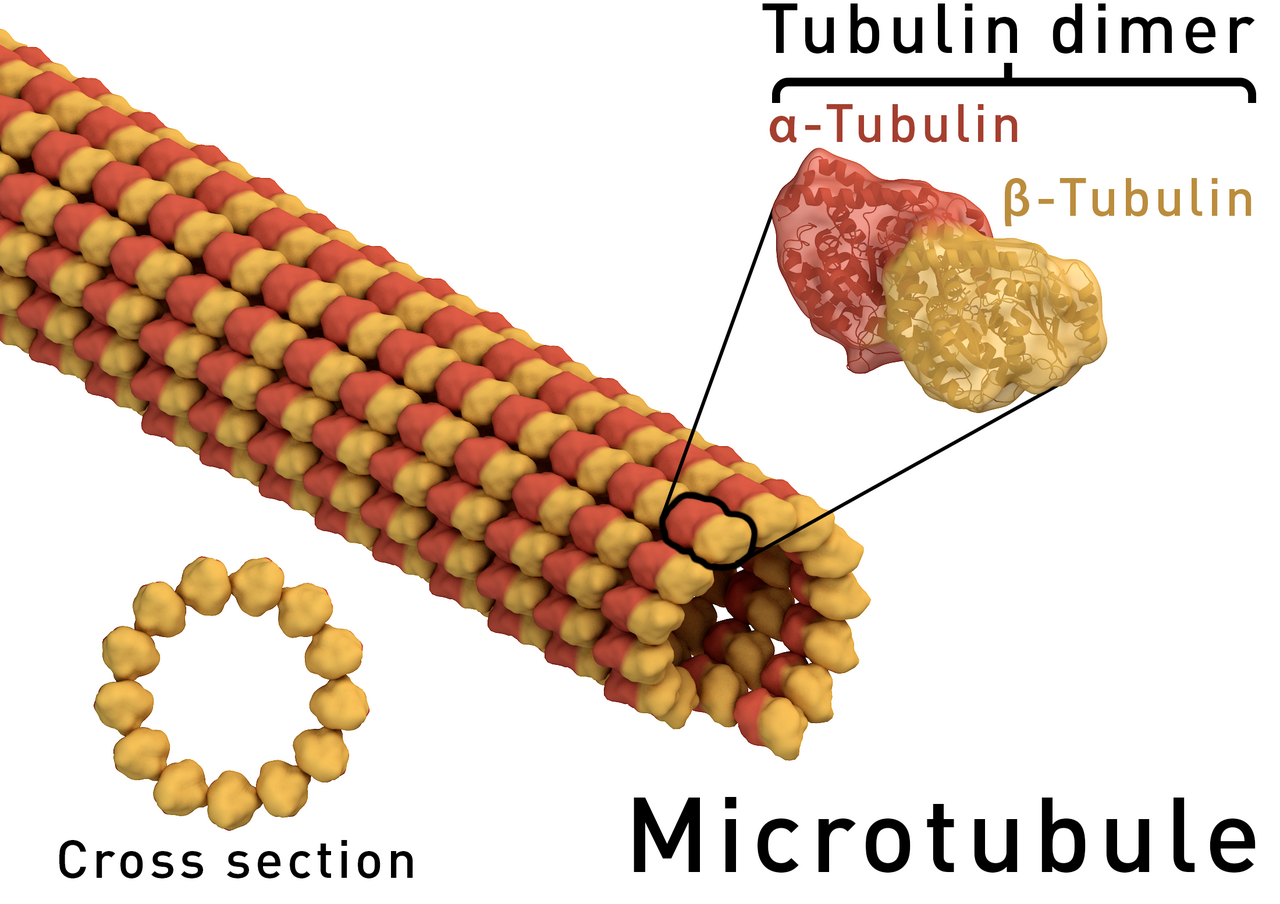
A microtubule, one of the tiny protein tubes inside cells, built from pairs of alpha- and beta-tubulin. The Orch OR proposal places quantum events in the microtubules of brain cells; that idea is still unconfirmed.
Tiny particles can be in superposition and can be entangled.Caltech Science Exchange: superposition describes an object as a combination of possible states; entanglement “passes test after test”; work by Bell in the 1960s and experiments by Clauser and others from the 1970s ruled out local hidden-variable theories.
In quantum physics, a conscious observer is what makes a particle take a definite state.Caltech: the term “observation” is misleading because it suggests consciousness is involved; measurement, an interaction with the environment including the device, better describes it. Stanford Encyclopedia of Philosophy: adding the observer’s mental state is unorthodox in standard quantum physics and “highly speculative from a contemporary perspective.”
Entanglement can carry messages or signals instantly across any distance.Caltech: experiments show entangled particles are not communicating faster than light, and quantum physics cannot be used to send faster-than-light communications; “There can be correlation without communication” (Thomas Vidick).
Products sold with “quantum energy” claims heal the body through quantum effects.U.S. Nuclear Regulatory Commission: many products advertised as emitting negative ions, scalar energy, quantum energy or quantum science contain radioactive material (tested products held uranium, thorium or radium); they are not licensed, and the NRC “cannot say whether these products work as advertised.” Dutch ANVS (Dec. 2021): ten such products emit low levels of ionizing radiation, and Dutch law prohibits their sale. None of the sources on this page reports a controlled trial showing a quantum healing effect.
Quantum events in brain microtubules produce consciousness, as the Orch OR proposal says.Hameroff and Penrose (2014) review the proposal. Tegmark (2000) calculated decoherence times of 10⁻¹³ to 10⁻²⁰ s; Hagan et al. (2002) replied with 10⁻⁵ to 10⁻⁴ s. Donadi et al. (2020) ruled out the parameter-free Diósi–Penrose model. Khan et al. (2024) found that a microtubule-stabilizing drug delayed anesthetic-induced unconsciousness in rats; the authors say quantum models predict this and that it may also fit classical models. The Stanford Encyclopedia calls Orch OR the most speculative of the quantum-brain approaches it discusses but says it “should neither be too quickly celebrated nor offhandedly dismissed.”
Physicists still debate what measurement really is, and nobody knows yet how the brain produces conscious experience. Whether quantum effects play any special role in the brain is still being tested.
WHAT WOULD CHANGE THIS ANSWER
A repeatable, well-controlled experiment in which a person’s intention alone changed quantum measurement results would change this answer. So would fair trials showing healing that only quantum physics can explain. Clear evidence of long-lived quantum states tied to awareness in the brain would strengthen the case for Orch OR.
Standard quantum physics does not say that your mind creates reality, and it does not show that “quantum” products heal. But the wonder people feel about quantum physics is earned. The physics really is strange, and experts still debate parts of what it means.
Quantum physics is the study of matter and energy at the most basic level. The word quantum comes from Latin and means “how much.” Its discoveries gave us lasers and transistors. Three of its ideas matter most for this question. Superposition means a tiny object, such as an electron, is described as a blend of several possible states at once. Entanglement means two particles can be linked, so that measuring one tells you something about the other, even far away. Measurement is when a blend gives way to one definite result.
Here is where the story often goes wrong. Early physicists were puzzled that simply observing an experiment influenced the outcome. The word “observing” made it sound as if a watching mind changed reality. Caltech’s science explainer says the word is misleading. “Measurement” describes it better: a change in outcome can come from the interaction between the particle and its surroundings, including the measuring device. And entanglement cannot be used to send messages faster than light.
Could quantum effects still help explain consciousness? Some scientists have proposed that they could. One much-debated proposal, called Orch OR, comes from Roger Penrose and Stuart Hameroff. It says moments of awareness arise from quantum events inside microtubules, tiny protein tubes in brain cells. A critic calculated that the warm, wet brain would erase such quantum states in less than a trillionth of a second. Supporters dispute that math. So Orch OR is a real scientific hypothesis, but it is unconfirmed.
As for healing, some products sold with “quantum energy” claims turned out to contain radioactive material. A U.S. regulator says it cannot say whether they work as advertised. People who buy them are looking for health, and they deserve better information.
THE LONG ANSWER
THE LONG ANSWER · ABOUT 7 MINUTES
You’ve read your 3 free long answers this month.
The short answer, how sure we are, what we don’t know, what would change our mind and every source stay free on every page, for everyone.
All Access members read the long answer: the evidence piece by piece, the strongest objections, and how to check it yourself.
Describing a tiny object as a combination of several possible states at once. A measurement gives one result, with chances set by the math.
Measurement
In quantum physics, an interaction between a particle and its surroundings, such as a detector, that gives a definite result. Standard physics does not require a watching mind for it.
Entanglement
A link between particles that makes them act as one system, so learning about one tells you about the other, even far apart. It cannot carry messages faster than light.
Decoherence
The loss of quantum interference when a system interacts with its environment. It is at the center of the debate over quantum effects in the warm brain.
Orch OR
“Orchestrated objective reduction,” the proposal by Roger Penrose and Stuart Hameroff that consciousness arises from quantum events in brain microtubules. It is unconfirmed.
Microtubule
A long, hollow protein tube, about 25 nanometers across, built from tubulin. Microtubules help move materials inside nerve cells and other cells.
Sources & further reading
(10) · Checked Sep 29, 2026
What Is Quantum Physics? and What Is Entanglement and Why Is It Important? ↗Caltech Science Exchange (reviewed by Caltech faculty)Quantum physics page: study of matter and energy at the most fundamental level; late 1800s and early 1900s; quanta and photons; “quantum” has Latin roots and means “how much”; lasers and transistors; superposition, pond-ripple analogy, wave functions give likelihoods; mathematics essential because concepts are “difficult if not impossible for us to visualize”; quantum phenomena act on every scale; “observation” misleading, “suggesting that consciousness is involved,” “measurement” better describes it, interaction with the external environment including the device; a full understanding of measurement still needed; collapse “more accurately, decohere.” Entanglement page (https://scienceexchange.caltech.edu/topics/quantum-science-explained/entanglement): Einstein in the 1930s, Bell in the 1960s, Clauser and others from the 1970s ruled out local hidden-variable theories; no faster-than-light communication; “passes test after test”; Thomas Vidick, described on the page as a professor of computing and mathematical sciences at Caltech: “There can be correlation without communication”; entangled objects “can be thought of as a single system.”
Quantum Approaches to Consciousness (Harald Atmanspacher) ↗Stanford Encyclopedia of Philosophy (substantive revision May 13, 2024)Most quantum-brain approaches speculative; von Neumann (1930s), Wigner (1967), Stapp; including observers’ mental states unorthodox, “highly speculative from a contemporary perspective”; Penrose: objective reduction needs quantum gravity; Hameroff’s anaesthesiology background; microtubuli “usually constructed of 13 longitudinal α and β-tubulin dimers” with an outside diameter of about 25 nm, essential for transport within neurons (as well as other cells); Tegmark (2000) vs Hagan et al. (2002); recoherence studies (entanglement in hot, noisy systems under particular circumstances); Tegmark’s criticism called “influential”; Orch OR “the most speculative example among the quantum brain approaches discussed,” it “initiated important empirical work on the function of anesthetics and the operation of microtubuli”; Hameroff suggested microtubules “as an option for where reductions of quantum states can take place”; the scenario has “stirred up heated debate”; “should neither be too quickly celebrated nor offhandedly dismissed.”
The Role of Decoherence in Quantum Mechanics (Guido Bacciagaluppi) ↗Stanford Encyclopedia of Philosophy (substantive revision Jan. 23, 2025)Decoherence: interactions between a system and its environment that lead to suppression of interference; decoherence as such does not provide a solution to the measurement problem unless combined with a foundational approach; mentions the Hameroff–Penrose proposal.
Importance of quantum decoherence in brain processes (Max Tegmark) ↗Physical Review E 61:4194–4206 (2000)arXiv abstract (quant-ph/9907009): decoherence timescales ~10⁻¹³–10⁻²⁰ s vs relevant dynamical timescales ~0.001–0.1 s; brain degrees of freedom tied to cognition should be treated as classical; disagrees with Penrose and others.
Consciousness in the universe: a review of the ‘Orch OR’ theory (Hameroff and Penrose) ↗Physics of Life Reviews 11(1):39–78 (2014)Abstract (PubMed 24070914): proposed in the mid-1990s; orchestrated coherent quantum processes in microtubules within brain neurons; terminate by the Diósi–Penrose scheme of objective reduction; taken to result in moments of conscious awareness and/or choice. Affiliations: University of Arizona (Hameroff), University of Oxford (Penrose).
Underground test of gravity-related wave function collapse (Donadi et al.) ↗Nature Physics 17:74–78 (2021; published online Sept. 7, 2020)arXiv abstract (2111.13490): Roger Penrose’s proposal, formula similar to Lajos Diósi’s; dedicated experiment at the Gran Sasso underground laboratory; lower bound on the effective size of the mass density; “rules out the natural parameter-free version of the Diósi-Penrose model.” Diósi is a co-author (Crossref).
Microtubule-Stabilizer Epothilone B Delays Anesthetic-Induced Unconsciousness in Rats (Khan et al.) ↗eNeuro 11(8) (2024)Abstract (PubMed 39147581): Wellesley College; male rats given epothilone B took on average 69 s longer to lose the righting reflex under 4% isoflurane; the finding “is predicted by models that posit consciousness as a property of a quantum physical state of neural MTs.” Full text (PMC11363512): the results are “potentially consistent with classical models of consciousness” but are called a more stringent test of the microtubule-based models.
Negative Ion Products Containing Radioactive Material ↗U.S. Nuclear Regulatory Commission (fact sheet dated October 2024)Advertised for well over a decade as emitting negative ions, scalar energy, quantum energy or quantum science; wrist bands and pendants to pillows and mattresses; advertised “benefits” include enhanced blood circulation, protection of DNA from damage, strengthened “biofield”; “Many of these products contain radioactive material”; agencies and universities (NRC, FDA, ARPANSA, the Dutch RIVM and others) found measurable quantities of uranium, thorium or radium; whole-body dose likely low, continuous wear can raise skin dose; some products contain no radioactive material; not licensed by the NRC or any state; “We cannot say whether these products work as advertised”; anyone with health concerns should talk to their doctor; ten items analyzed by the Dutch RIVM exceeded Dutch safety limits. Fact sheet dated October 2024; on Sept. 28, 2026 this address redirected (HTTP 301) to the NRC’s new address for the same fact sheet, https://www.nrc.gov/regulations-legislation/fact-sheets-brochures/negative-ion-products-containing-radioactive-material.
Do you have a ‘Quantum Pendant’ anti-5G pendant or a ‘negative ion’ jewellery item or sleep mask? If so, store it away safely ↗Authority for Nuclear Safety and Radiation Protection (ANVS), Netherlands (Dec. 16, 2021)News item of 16-12-2021: study commissioned by the ANVS and carried out by the RIVM found that the listed products emit ionizing radiation; the level measured is low and the risk of health problems is low, but long-term harm from continuous wear cannot be ruled out; the ANVS knows of ten such products, including the Quantum Pendant; owners advised to stop wearing them and store them safely; Dutch law prohibits their sale, and sellers were told to stop selling them immediately.
Two particles can share one quantum state, even far apart. Here is what that means, why Einstein distrusted it, and why it still cannot carry a message.
What past-life memory research investigates, what reported matches can show, and why case studies do not by themselves establish reincarnation.
Not supported3 min read
THE OCCASIONAL LETTER
Stay curious.
New stories, book updates, and notes from God Plays Dice, delivered when there is something worth sharing.
EMAIL UPDATES ↗
500 DIGITAL COPIES • GIVEAWAY PREVIEW
Be first to know when the 500-copy reader giveaway opens.
Join for the book launch, verified retailer links, and the announcement for a planned giveaway of 500 digital copies. The giveaway is not open yet: dates, eligibility, a dedicated entry form, and Official Rules will be published first.
Privacy · Check your inbox to confirm your subscription. Newsletter signup alone is not a giveaway entry.