The UniverseAnswer
Can a Planet Orbit Two Stars?
Two stars can circle each other while a planet travels around them both. Astronomers confirmed it by watching the moving stars dim.
THE QUESTION LIBRARY THE UNIVERSE
Mathematical reasoning and successful predictions are real achievements; their ultimate meaning is debated.
Nobody knows yet whether numbers and other math objects exist without minds. People create symbols, definitions and rules for reasoning. They also find consequences that they cannot freely change once the rules are fixed. Math helps scientists make claims that observations can test. That success does not settle whether numbers exist beyond thought. The invented-or-discovered question is philosophical; whether a physical model fits nature is testable. Infinity in mathematics does not by itself establish an infinite physical universe.
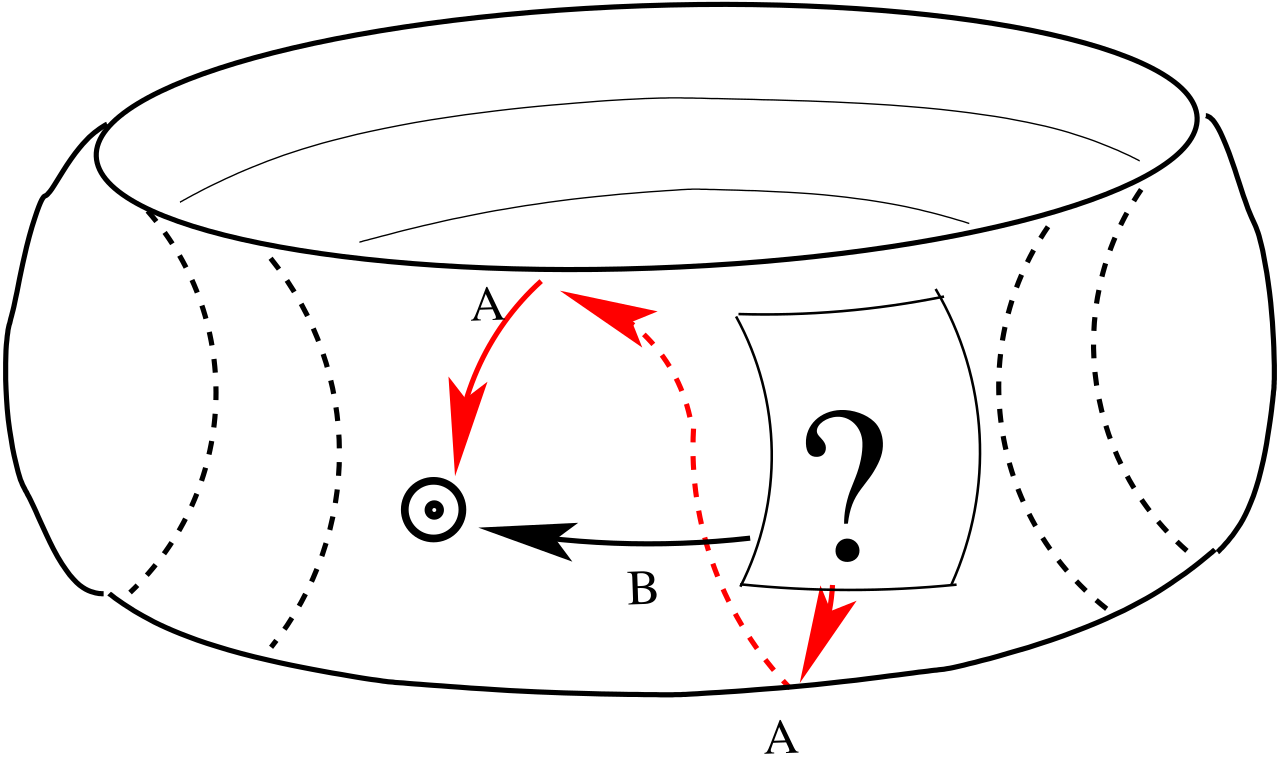
A mathematical illustration of a finite surface without an edge. Such models help clarify possibilities; a drawing alone cannot establish the shape or size of the physical universe.
WHERE THE EVIDENCE STANDS
WHAT WE DON’T KNOW YET
There is no agreed final account of why math works so well in physics or what numbers are. We also do not know whether nature contains actual infinities.
WHAT WOULD CHANGE THIS ANSWER
New observations could favor one physical model over another. A stronger argument could change how we view numbers and other math objects. One successful equation would not settle this on its own.
Nobody knows yet whether numbers and other mathematical objects exist independently of minds. There are serious views on more than one side. It also mixes several issues that are easier to understand when kept apart: the language people create, the results they work out, and the patterns they find in nature.
People choose symbols and definitions. We can write a number in different ways while still talking about the same count. But once we fix what we mean and which rules we use, an answer is not freely up to us. A valid argument has to follow those rules. This helps explain why doing mathematics can feel like invention and discovery at once.
That practical observation does not settle what mathematics ultimately is. Some thinkers hold that numbers and other math objects exist without us. Others seek an account that needs no separate realm of numbers. Still others focus on structures, the relations between things. These views need arguments. Listing them does not decide which is right.
Science asks a further question. Does a mathematical model fit the world? A model is a way to describe selected features and make predictions. Even elegant equations must face observations. When a signal matches a predicted pattern, it supports that physical account. It does not settle every claim about what the math inside it means.
Infinity makes the boundary clear. Mathematics can describe a collection with no final member. Whether the physical universe is infinite is another matter. An endless sequence on paper is not a survey of endless space.
You can keep the wonder without forcing a verdict. Mathematics gives us powerful ways to reason. Science tests their use in nature. Philosophy asks what the results mean and what kinds of things, if any, stand behind them.
THE LONG ANSWER · ABOUT 6 MINUTES
The short answer, how sure we are, what we don’t know, what would change our mind and every source stay free on every page, for everyone.
All Access members read the long answer: the evidence piece by piece, the strongest objections, and how to check it yourself.
Join All Access · $1 a week Or $6 a month
Billed $52 once a year. Cancel anytime in your account.
Until December 4, 11:59 pm Pacific: the Founding rate is $39 a year, and it stays $39 while you stay a member.
Create a free account: 6 long answers a month, email only.
Paying never buys a different answer. Our Paywall Promise
Nobody knows yet.
God Plays Dice answers big questions in plain words, with sources and one of six honest labels.
See a mistake? Report a problem. Corrections are made openly.
CONTINUE THE THREAD
The UniverseAnswer
Two stars can circle each other while a planet travels around them both. Astronomers confirmed it by watching the moving stars dim.
The UniverseAnswer
An everywhere-present field, a fleeting particle and a famous nickname. What did CERN’s experiments actually measure?
The UniverseAnswer
Why the matter surplus remains unexplained, what Sakharov's conditions require, and how sphalerons and proposed neutrino mechanisms might connect.
The Architect AI companion · All Access
Labels describe the evidence for a claim, not the people who hold it.
Match my phone uses your device’s light or dark setting.