The UniverseAnswer
Can a Planet Orbit Two Stars?
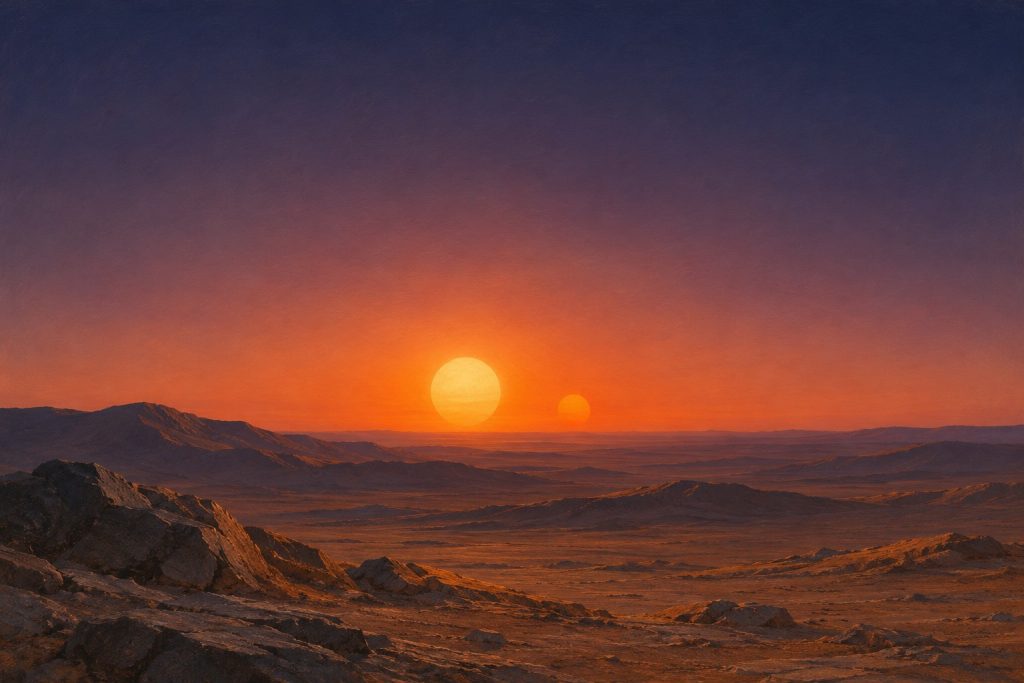
Two stars can circle each other while a planet travels around them both. Astronomers confirmed it by watching the moving stars dim.
THE QUESTION LIBRARY THE UNIVERSE
What gravitational-wave echoes might reveal about black-hole boundaries, why quantum structure is unconfirmed, and what a convincing detection needs.
Possibly, but a proposed departure needs a measurable prediction and reliable evidence. Some compact-object models predict delayed gravitational-wave echoes. An unusual signal would need careful checks and comparisons before it could identify a new physical mechanism. The answer depends on what observations support, rather than on how striking an idea sounds.
WHAT WE DON’T KNOW YET
Whether horizons have observable quantum structure remains unresolved. Negative searches constrain particular signals; they cannot exclude every alternative.
WHAT WOULD CHANGE THIS ANSWER
A robust signal with the predicted timing and waveform, surviving independent noise and modeling checks and discriminating among specific alternative explanations.
Possibly, but a proposed departure needs a measurable prediction and reliable evidence. Some compact-object models predict delayed gravitational-wave echoes. An unusual signal would need careful checks and comparisons before it could identify a new physical mechanism. The answer depends on what observations support, rather than on how striking an idea sounds.
Free long answer 3 of 3 this month.
The event horizon is a boundary beyond which light cannot escape; it is not a visible solid skin. NASA distinguishes the horizon from light emitted by surrounding material. Asking whether the edge differs from Einstein's model means asking whether a measurable property departs from the standard description. It does not mean looking for a crack in a photographed surface. NASA: horizon and surrounding matter.
Some compact-object models replace the usual black-hole boundary conditions with a partially reflecting region. Returning disturbances can produce weaker delayed pulses. Mark and colleagues studied this using a simplified wave field as a proxy, not an observed reflective horizon. Original echo model.
Different assumptions predict different pulse patterns. A reflection would not uniquely identify quantum gravity. To see why, imagine two explanations that both predict a delayed pulse: observing the delay alone cannot decide between them. Researchers need some further measurable difference. This is a logical requirement for interpreting evidence, rather than another detector result.
The March 2026 GWTC-4.0 remnant preprint found no post-merger echoes in its analyzed events, using four echo tests. That constrains searched signals, not every model or arbitrarily faint effect. Original remnant analysis.
Its combined ringdown deviation varied with the finite sample and weakened after including GW250114; no strong relativity violation was established. An interesting result's stability matters. Adding observations is a useful check precisely because a proposed explanation should keep working when the evidence grows.
Earlier echo claims prompted direct scrutiny. In a 2016 response, Ashton and colleagues identified shortcomings in a proposed signal's analysis and significance estimates, concluding that it did not establish Planck-scale horizon structure. The lesson is to examine how a search estimates ordinary noise and how its choices affect the apparent evidence. A promising pattern must survive those checks. Original methodological response.
A practical question is whether an analysis could find a similarly impressive pattern when its input contains only ordinary noise. Another is whether different analysts obtain the same feature without adjusting their choices to match the original claim. Those checks help turn an attractive plot into an assessable result.
The reviewed searches do not establish quantum horizon structure. Whether such structure is observable remains open. A robust, repeatable signal matching a clearly stated alternative and surviving independent noise and modeling checks would change the evidence. Continue with black-hole basics and their limits and what counts as scientific support.
THREE THINGS TO REMEMBER
God Plays Dice answers big questions in plain words, with sources and one of six honest labels.
See a mistake? Report a problem. Corrections are made openly.
CONTINUE THE THREAD
The UniverseAnswer
Two stars can circle each other while a planet travels around them both. Astronomers confirmed it by watching the moving stars dim.
The UniverseAnswer
An everywhere-present field, a fleeting particle and a famous nickname. What did CERN’s experiments actually measure?
The UniverseAnswer
Why the matter surplus remains unexplained, what Sakharov's conditions require, and how sphalerons and proposed neutrino mechanisms might connect.
The Architect AI companion · All Access
Labels describe the evidence for a claim, not the people who hold it.
Match my phone uses your device’s light or dark setting.