Proof belongs to mathematics and logic, while science builds strong, testable confidence from evidence, and that difference is a strength, not a weakness.
God Plays Dice Editorial · independently fact-checked · corrections welcomeChecked Sep 30, 202610 min read
THE SHORT ANSWER
No, not in the strict sense. Proof belongs to mathematics and logic, where a conclusion follows from starting rules. Science works with evidence. It tests ideas against the world, checks how often chance alone would give such a result, and asks others to repeat the work. The best-tested ideas, like atoms or the Earth orbiting the Sun, are extremely reliable. But even strong theories stay open to refinement if new evidence calls for it.
In math, a proof uses logic to show a statement must be true, like Andrew Wiles’s 1995 proof of Fermat’s Last Theorem.
In science, a theory is a broad explanation backed by a vast body of evidence, not a hunch.
Particle physicists often require five sigma to call a result a discovery: noise alone would give a result at least that strong only about once in 3.5 million tries.
When 100 psychology studies were repeated, 97% of the originals but only 36% of the repeats had statistically significant results.
The U.S. National Academies say science aims for refined degrees of confidence, rather than complete certainty.
About this picture
A living coelacanth, photographed 69 metres down off Pumula on South Africa’s KwaZulu-Natal South Coast on 22 November 2019. Until 1938, scientists accepted that these fish had died out about 80 million years ago.
Bruce A.S. Henderson, from Fraser et al., South African Journal of Science (2020), via Wikimedia Commons · CC BY 4.0 · Image source ↗
WHERE THE EVIDENCE STANDS
How sure are we?
Science can prove an idea true once and for all.Understanding Science (UC Museum of Paleontology) says real, absolute proof is not particularly scientific; the National Academies say science aims for refined degrees of confidence rather than complete certainty.
The best-tested scientific theories are extremely reliable, even though they stay open to revision.The National Academies say theories such as heliocentrism, cell theory, atomic theory and plate tectonics are unlikely to be substantially changed by new evidence, yet all theories are subject to refinement.
In science, a theory is only an untested guess.The National Academies define a scientific theory as a comprehensive explanation supported by a vast body of evidence; Understanding Science notes that hypotheses, theories and laws differ in breadth, not in level of support.
Falsifiability, by itself, can tell science from non-science.The Stanford Encyclopedia of Philosophy reports that Popper finally accepted this cannot be done by falsifiability alone, and describes Lakatos’s Neptune critique; Understanding Science calls falsification an incomplete picture.
In particle physics, a new effect is often called a discovery only at five sigma or more.The Particle Data Group’s statistics review says an effect often qualifies as a discovery at five sigma (p = 2.87 × 10⁻⁷); CERN’s 2012 Higgs announcement reported signals at about five sigma.
Philosophers still disagree about the general rule that separates science from non-science, even when they agree on many specific cases. Nobody can say in advance which of today’s theories will need refining next, or by how much.
WHAT WOULD CHANGE THIS ANSWER
The basic answer would change only if someone found a way to rule out every future surprise in nature, and no such method exists. Smaller parts could change as philosophers and statisticians refine how they describe good evidence.
No, not in the strict sense of the word. Proof belongs to mathematics and logic. Science works with evidence. That can sound like a weakness, but it is a big part of why science keeps getting better.
People ask this for good reasons. A headline says scientists have proved something, and later another headline seems to say the opposite. A relative calls evolution “just a theory.” A video argues that since science can’t prove everything, any idea is as good as any other. These are fair things to wonder about.
Here is the core picture. In mathematics, a proof starts from agreed rules and uses logic to show that a statement must follow. In 1995, the mathematician Andrew Wiles published a proof of Fermat’s Last Theorem, a claim about whole numbers first stated in the 1600s. His proof covers every case at once, which no amount of checking examples could ever do.
Science is different, because its claims are about the real world. As a matter of logic, no pile of observations can show that a general law holds everywhere and always. In principle, one solid counterexample can show that it fails, though in practice scientists first check whether something else went wrong. So scientists talk about evidence and confidence. The U.S. National Academies put it this way: science aims for refined degrees of confidence, rather than complete certainty.
That does not make science a guess. Some ideas are backed by so much evidence that no new finding is likely to overturn them: the Earth goes around the Sun, living things are made of cells, and matter is made of atoms. Engineers use well-tested science to design airplanes, and the airplanes fly. Even these ideas stay open to refinement. That openness is part of why they can be trusted.
THE LONG ANSWER
THE LONG ANSWER · ABOUT 8 MINUTES
You’ve read your 3 free long answers this month.
The short answer, how sure we are, what we don’t know, what would change our mind and every source stay free on every page, for everyone.
All Access members read the long answer: the evidence piece by piece, the strongest objections, and how to check it yourself.
Author’s hypothesis. Ricardo Maldonado, author of GOD PLAYS DICE, applies these rules to his own idea. His HD-Blast proposal asks whether our hot beginning could be the aftermath of a burst of energy in a space with more dimensions. The book’s glossary calls a falsifiable idea one that specific evidence could show to be wrong, and says that in science this is the entrance requirement. It keeps a written list of results that would rule the idea out, and Chapter 11 states the rule plainly: “If an idea cannot be wrong, it cannot be science.”
The book also applies the sigma lesson to itself. Its glossary says five sigma is a conventional discovery bar in some fields, and that the book’s own exploratory statistical screens are not sigma-level results. On the Research Notebook, the idea’s benchmark curve for a slow hum of gravitational waves is listed as frozen and waiting for later, independent pulsar-timing data. No test of that curve against such data has been published. The test ledger lists its dated public predictions and the results that would weaken it.
In mathematics and logic, a chain of reasoning that shows a statement must follow from agreed starting rules. Science does not produce proofs in this sense.
Hypothesis
A tentative explanation that can be tested. It must be stated in a way that allows it to be rejected.
Scientific theory
A comprehensive explanation of some part of nature that is supported by a vast body of evidence, such as cell theory or plate tectonics.
Scientific law
A compact description of a pattern in data, such as the ideal gas law. Laws describe what we expect to happen and can have exceptions.
Falsifiable
Able to clash with some possible observation, so that evidence could show the idea is wrong. Scientists often mean simply “testable.”
Sigma (σ)
A way of saying how unlikely a result would be if only random noise were at work. Five sigma, about 1 in 3.5 million, is a common discovery bar in particle physics.
Sources & further reading
(10) · Checked Sep 30, 2026
Correcting misconceptions (and: Science aims to explain and understand) ↗Understanding Science, University of California Museum of Paleontology‘Science proves ideas’ misconception: real, absolute proof is not particularly scientific; hypotheses, theories and laws differ in breadth, not level of support (apples, oranges and kumquats); law glossary and the ideal gas law; falsification an incomplete picture, scientists usually mean ‘testable’; news coverage highlights disagreements, cutting-edge change is normal and healthy. Companion page (https://undsci.berkeley.edu/understanding-science-101/what-is-science/science-aims-to-explain-and-understand/): coelacanths accepted as extinct about 80 million years ago until a live one was found off South Africa in 1938; airplanes as an example of reliable knowledge.
Reproducibility and Replicability in Science (2019), Chapter 2 and Summary ↗National Academies of Sciences, Engineering, and Medicine‘Science aims for refined degrees of confidence, rather than complete certainty’; uncertainty inherent in all scientific knowledge; new knowledge that displaces or reframes older knowledge ‘should not be interpreted as a weakness in science’; 1989 cold fusion claim by Fleischmann and Pons and the replication attempts; Bayesian example (1% prior and p ≤ 0.01 gives about one in eight correct; 25% prior gives more than four of five). Summary (https://www.nationalacademies.org/read/25303/chapter/3): definitions of reproducibility and replicability; helpful and unhelpful sources of non-replicability.
Evolution Resources: definitions and ‘Is evolution a theory or a fact?’ ↗National Academies of Sciences, Engineering, and MedicineEveryday vs scientific meaning of theory; theory as a comprehensive explanation supported by a vast body of evidence; heliocentric, cell, atomic and plate-tectonic theories unlikely to be substantially altered; hypothesis must be posed so it can be rejected; ‘fact’ in science; evolution both theory and fact; theory of gravity tested near neutron stars and black holes, expanded by general relativity.
Karl Popper (Stephen Thornton) ↗Stanford Encyclopedia of Philosophy (revised 2026)Falsifiability as Popper’s demarcation criterion; risky predictions, Einstein’s light deflection and Eddington’s 1919 experiments; asymmetry between verification and falsification; conservation of energy as ‘there is no perpetual motion machine’; Lakatos on Uranus, Adams, Leverrier (Le Verrier), Galle and Neptune; theories protected by auxiliary hypotheses; Popper’s final position that falsifiability alone cannot discriminate science from non-science.
Science and Pseudo-Science (Sven Ove Hansson) ↗Stanford Encyclopedia of Philosophy (revised 2025)Popper’s falsifiability criterion criticized both for excluding legitimate science and for admitting some pseudosciences; Kuhn’s puzzle-solving alternative; ‘virtual unanimity’ on how to classify particular cases ‘in spite of almost complete disagreement on the general criteria’ (section 8, Unity in diversity).
Review of Particle Physics: 40. Statistics (G. Cowan and L. Lista, revised June 2025) ↗Particle Data Group (S. Navas et al., Phys. Rev. D 110, 030001, 2024, and 2025 update)‘Often in particle physics the level of significance where an effect is said to qualify as a discovery is Z = 5, i.e., a 5σ effect, corresponding to a p-value of 2.87×10⁻⁷’; degree of belief also depends on plausibility, confidence in the model and the look-elsewhere effect. (1/2.87×10⁻⁷ ≈ 3.5 million.)
CERN experiments observe particle consistent with long-sought Higgs boson ↗CERN (4 July 2012; Internet Archive copy of 15 April 2026)ATLAS and CMS each observe a new particle in the mass region around 125–126 GeV; “at the level of 5 sigma” (Gianotti) and “the 5 sigma signal” (Incandela); results labelled preliminary; “a particle consistent with the Higgs boson” (Heuer). The original home.cern URL (https://home.cern/news/press-release/cern/cern-experiments-observe-particle-consistent-long-sought-higgs-boson) now redirects to a “Page not found” page, so the archived copy is linked. ATLAS paper (arXiv:1207.7214; Phys. Lett. B 716, 1–29, 2012): 5.9 standard deviations, background fluctuation probability 1.7×10⁻⁹.
Estimating the reproducibility of psychological science ↗Science 349, aac4716 (2015), Open Science CollaborationReplications of 100 studies from three psychology journals; 97% of originals and 36% of replications statistically significant; replication effects half the magnitude of original effects (PubMed abstract, PMID 26315443).
The Abel Prize 2016: Sir Andrew J. Wiles (citation) ↗The Norwegian Academy of Science and LettersAwarded ‘for his stunning proof of Fermat’s Last Theorem’; the theorem, first formulated by Fermat in the 17th century, says xⁿ + yⁿ = zⁿ has no solutions in positive integers for n > 2; Fermat (n = 4), Euler (n = 3), Sophie Germain’s first general result; Wiles’s breakthrough paper published in 1995, with a key step confirmed through an important companion paper written jointly with Richard Taylor. Citation PDF: https://abelprize.no/sites/default/files/2021-04/citation_en_2016_A.Wiles_.pdf
GOD PLAYS DICE, Volume OneRicardo MaldonadoChapter 11: ‘If an idea cannot be wrong, it cannot be science.’ Glossary: falsifiable means structured so that specific evidence could show it wrong, ‘the entrance requirement’ in science; the kill list of conditions written down in advance; five sigma is a conventional discovery threshold in some fields, and ‘the exploratory screens in this book are not sigma-level results.’
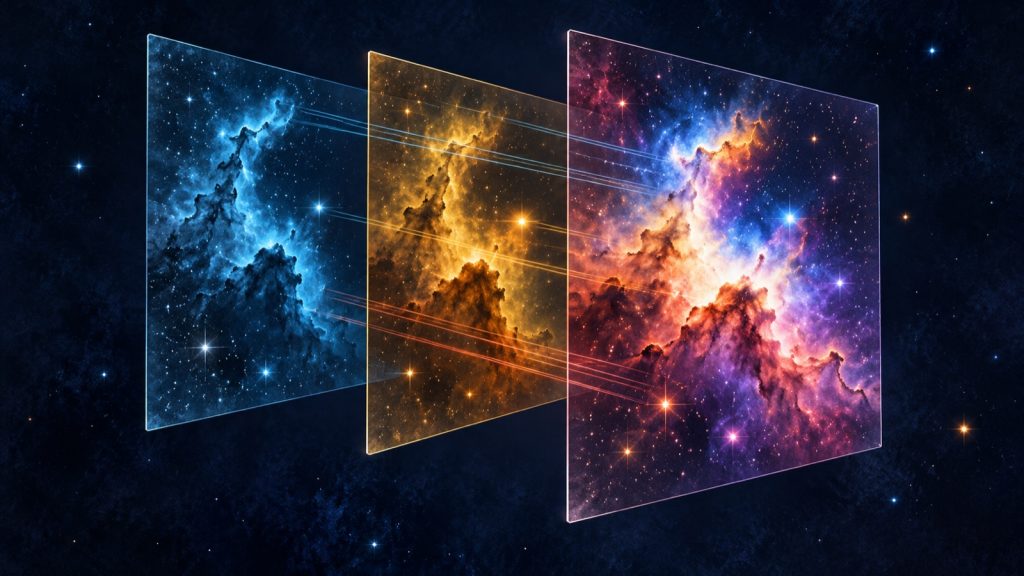
A space image can be faithful to measured light without matching human eyesight. Here is how to read the translation.
Established4 min read
THE OCCASIONAL LETTER
Stay curious.
New stories, book updates, and notes from God Plays Dice, delivered when there is something worth sharing.
EMAIL UPDATES ↗
500 DIGITAL COPIES • GIVEAWAY PREVIEW
Be first to know when the 500-copy reader giveaway opens.
Join for the book launch, verified retailer links, and the announcement for a planned giveaway of 500 digital copies. The giveaway is not open yet: dates, eligibility, a dedicated entry form, and Official Rules will be published first.
Privacy · Check your inbox to confirm your subscription. Newsletter signup alone is not a giveaway entry.