HD-Blast ResearchEssay · personal view
Do physical units make a model’s prediction testable?
A model needs a justified connection between its numbers and a physical measurement. Units are one part of that explanation.
HD-BLAST RESEARCH STORY
Fitting data and testing a prediction answer different questions. A plain-language guide to fair tests and why a good fit does not prove HD-Blast.
A curve can pass through the points on a graph and still leave the hardest question unanswered: will it work on observations that did not help shape it?
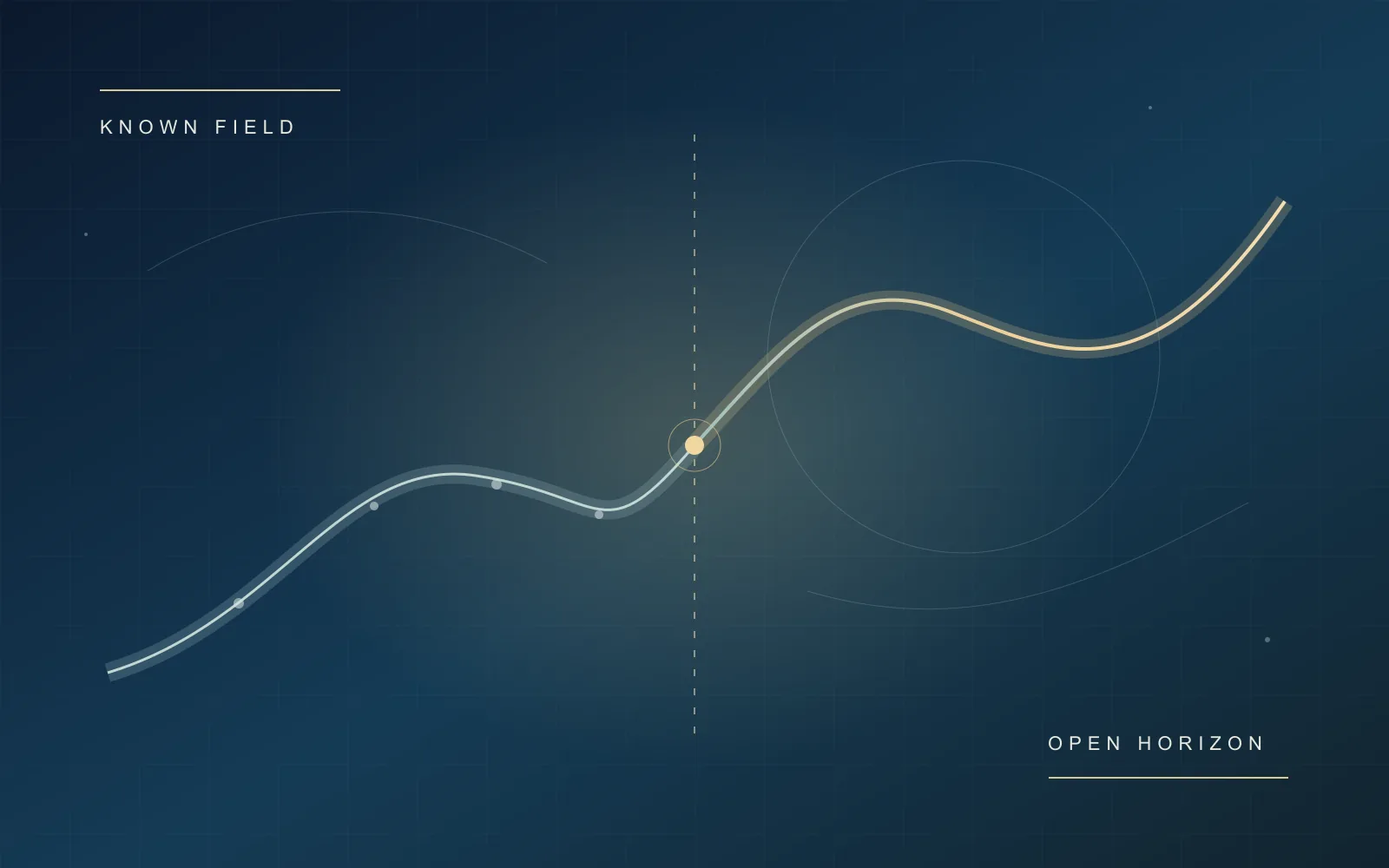
Conceptual illustration of the distinction between fitting known observations and predicting beyond them. The curve is decorative, not scientific data.
Fitting data means adjusting a model to match observations. Testing a prediction means checking what that model says against evidence kept separate from those adjustments. Both matter. They answer different questions.
Imagine practicing with ten questions and keeping the answer sheet beside you. You can learn something useful. You can also become very good at those ten questions.
A fresh set of questions tells you something the practice sheet could not: whether what you learned carries over.
Scientific models face a similar challenge. A model is a simplified description of how something behaves. Its adjustable settings can be chosen using measurements. That is a fit. A close match is worth investigating, but the measurements have already helped choose the answer.
One useful approach is to hold some observations aside while choosing the model and its settings. Another is to state an expectation before new measurements arrive. In either case, the test needs clear rules about what will count as agreement, how uncertain the measurements are, and what would count against the model.
The word “new” can be misleading here. Evidence does not have to be collected tomorrow to test an idea. What matters is whether it was already used to build or tune the particular claim being tested.
There are other checks too. The NIST statistics handbook explains why a single impressive fit score is not enough: the pattern of differences between a model and the measurements also matters.
In GOD PLAYS DICE, I explore HD-Blast, my unproved hypothesis about a higher-dimensional origin of the Big Bang. A curve that matches some observations would not, by itself, establish that proposed cause. Different physical explanations may produce similar patterns.
A useful question is therefore: which observations helped choose this curve, and which could challenge it afterward? A second question follows: could another explanation do as well or better?
That distinction belongs beside the one in my earlier guide to conditional mathematical results. A calculation can be correct under its assumptions while the physical explanation remains open.
I want readers to have a way to ask those questions without needing a physics degree. Explore GOD PLAYS DICE and its free preview for the longer journey.
Source checked September 24, 2026: NIST/SEMATECH e-Handbook, “How can I tell if a model fits my data?” This article explains a testing distinction; it announces no new HD-Blast discovery.

How did the author check whether his matter-antimatter number match was just a coincidence?
In his February 4, 2026 preprint, Ricardo compared his proposed matter–antimatter number match with thousands of other formulas built from quark-coupling…
God Plays Dice answers big questions in plain words, with sources and one of six honest labels.
CONTINUE THE THREAD
HD-Blast ResearchEssay · personal view
A model needs a justified connection between its numbers and a physical measurement. Units are one part of that explanation.
HD-Blast ResearchEssay · personal view
A caption should tell us whether we are looking at observations, a model, a diagram or an illustration—and what each can establish.
HD-Blast ResearchEssay · personal view
Falsifiable means evidence could count against a specific claim. A simple guide to fair tests, uncertainty and the unproved HD-Blast hypothesis.
The Architect AI companion · All Access
Labels describe the evidence for a claim, not the people who hold it.
Match my phone uses your device’s light or dark setting.