Georges Lemaître, a Belgian priest and physicist, proposed the ideas that grew into the Big Bang, and he worked hard to keep his science and his faith distinct.
God Plays Dice Editorial · independently fact-checked · corrections welcomeChecked Sep 29, 20269 min read
THE SHORT ANSWER
Yes. The idea of a cosmic beginning first appeared in scientific form in 1931, from Georges Lemaître, a Belgian physicist and Catholic priest. In 1927 he had already proposed that the universe is expanding. Others added key pieces: Alexander Friedmann’s earlier math and Edwin Hubble’s measurements of galaxies. Lemaître kept his science and his faith distinct on purpose, and he was troubled when Pope Pius XII linked the idea to creation.
In 1927 Georges Lemaître, a priest since 1923, proposed that the universe is expanding.
In a short 1931 letter to Nature, he suggested that the universe had a beginning, in a dense state he called the primeval atom.
Edwin Hubble’s 1929 study of 24 galaxies helped convince most astronomers that the universe is expanding.
In 2018, 78% of voting members of the International Astronomical Union backed the name Hubble–Lemaître law.
Lemaître said his theory stayed outside any religious question.
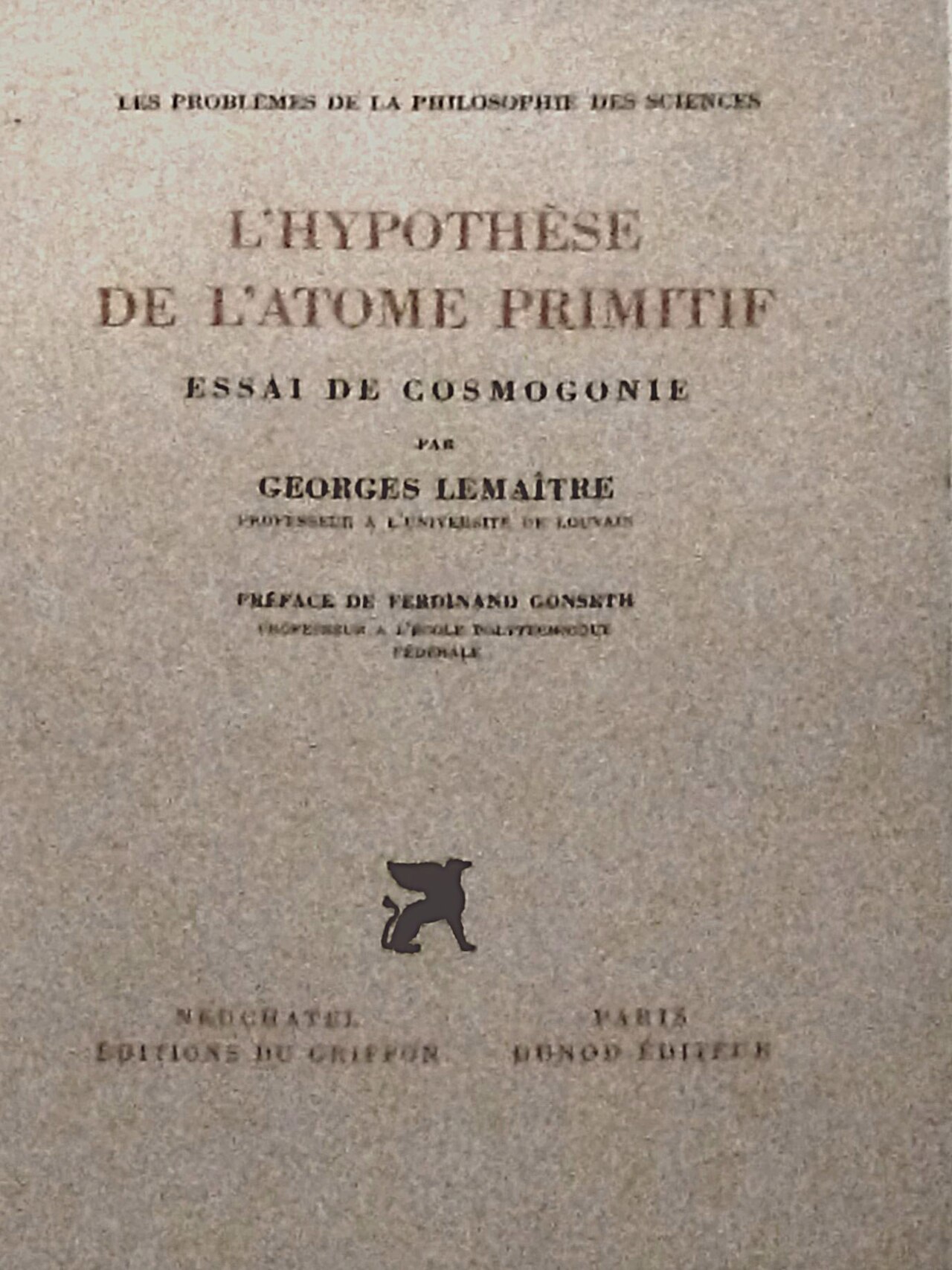
About this picture
Lemaître’s 1946 book on his primeval-atom hypothesis, L’Hypothèse de l’Atome primitif, in the collection of Musée L in Ottignies-Louvain-la-Neuve, Belgium.
A Catholic priest, Georges Lemaître, first put the idea of a cosmic beginning into scientific form.The American Museum of Natural History says the idea first appeared in scientific form in Lemaître’s 1931 paper; his letter in Nature (9 May 1931) is on record, and the University of Navarra history says no one had worked it out scientifically before him.
Lemaître was the first to find expanding-universe solutions to Einstein’s equations.The museum and Bahcall’s PNAS commentary say Alexander Friedmann derived them in 1922, and the IAU resolution says Lemaître rediscovered them; he did not know Friedmann’s work and, unlike Friedmann, tied them to real galaxies.
Hubble’s 1929 measurements helped convince most astronomers that the universe is expanding.The museum says Hubble’s observations and Lemaître’s paper together convinced the majority; a 2015 PNAS commentary by Neta Bahcall calls Hubble’s paper the definitive work that convinced the community.
Lemaître built his cosmology to argue for God.In 1958 he said the theory stays completely outside any metaphysical or religious question (UCLouvain archives); the museum says he insisted on neither a connection nor a conflict, and Artigas writes that he never tried to use science for religion.
The Big Bang shows that God created the universe.Pius XII drew that link in 1951 but said the scientific facts were not conclusive arguments for creation in time; Lemaître said the theory leaves the materialist free to deny any transcendent being; Aquinas taught that a beginning is held by faith, not demonstration.
Accounts differ on whether Lemaître spoke to Vatican staff before the pope’s more careful 1952 speech: one account says yes, and the Louvain archives call it a possibility. Physics has not settled whether the Big Bang was the very start of time. Whether the universe was created is a question science cannot answer.
WHAT WOULD CHANGE THIS ANSWER
New letters or archive finds could change details of the story, as a 1931 letter uncovered in 2011 did. The main answer rests on published papers from 1927 and 1931, so it is very unlikely to change.
Yes. The idea that grew into the Big Bang theory came from Georges Lemaître. He was a Belgian physicist, and he was also a Catholic priest. In 1927 he proposed that the universe is expanding. In 1931 he suggested that it began from a single, dense starting point, which he called the primeval atom. The American Museum of Natural History says this idea of a beginning first appeared in scientific form in his 1931 paper.
People ask this for different reasons. A believer may feel proud, or may wonder if the Big Bang was a religious idea in disguise. A skeptic may be surprised, or may suspect the story has been polished. Both deserve the plain history, with its twists.
The twists matter. Lemaître was not the only builder. The Russian cosmologist Alexander Friedmann had found the same kind of math in 1922. Lemaître did not know it. His own 1927 paper went almost unnoticed. It was in French, in a little-read Belgian journal. Then Edwin Hubble published measurements of galaxies in 1929. His data and Lemaître’s paper won over most astronomers. In 2018, members of the International Astronomical Union voted to recommend a new name for the pattern: the Hubble–Lemaître law.
Lemaître’s faith and his science lived side by side in one person, but he kept them distinct on purpose. He spoke of two paths to truth, and he said his theory stayed outside any religious question. When Pope Pius XII praised the new cosmology in 1951 as a witness to creation, Lemaître was troubled. He had worked hard not to be seen as a priest using physics to argue for God.
So the fair answer is yes: a priest proposed it, and he refused to turn it into a sermon. Whether the universe was created is a different question, one we label Beyond science. You are welcome here, whatever you believe.
THE LONG ANSWER
THE LONG ANSWER · ABOUT 7 MINUTES
You’ve read your 3 free long answers this month.
The short answer, how sure we are, what we don’t know, what would change our mind and every source stay free on every page, for everyone.
All Access members read the long answer: the evidence piece by piece, the strongest objections, and how to check it yourself.
Lemaître’s name for the single, dense starting state he proposed in 1931, from which he thought the whole universe began. Today’s Big Bang theory differs from it in many ways.
Redshift
A shift of a galaxy’s light toward the red end of its spectrum. In an expanding universe, it grows in proportion to the galaxy’s distance.
Hubble–Lemaître law
The pattern that galaxies move away from each other at speeds proportional to their distance. The International Astronomical Union recommended this name in 2018.
Concordism
The effort to line up scientific findings with the words of scripture, or to use science to back up a religious text. Lemaître tried a mild form as a young man and later left it behind.
Pontifical Academy of Sciences
A scientific academy under the pope’s protection that promotes mathematical, physical and natural knowledge. Lemaître joined in 1936 and became its president in 1960.
Sources & further reading
(10) · Checked Sep 29, 2026
Georges Lemaître, Father of the Big Bang (Cosmic Horizons profile) ↗American Museum of Natural History (excerpt from Cosmic Horizons, 2000)Born 1894 in Charleroi; WWI artillery officer; ordained 1923; studied with Eddington; Louvain professor from 1925; Pontifical Academy president 1960–1966; 1927 paper virtually unnoticed; Friedmann derived the solution in 1922; Eddington arranged the translation; Hubble’s observations and Lemaître’s paper convinced the majority; the beginning idea first appeared in scientific form in 1931; ‘primeval atom’; Gamow; learned of the Penzias–Wilson discovery shortly before his death; his statement that the theory remains outside any metaphysical or religious question and the Isaiah ‘hidden God’ line. The live page returns a CAPTCHA to scripted requests; its text was read from the Internet Archive copy of 18 July 2026.
IAU members vote to recommend renaming the Hubble law as the Hubble–Lemaître law (iau1812) ↗International Astronomical Union (29 October 2018)11,072 members invited, 4,060 votes (37%), 78% for, 20% against, 2% abstaining; vote closed 26 October 2018. Background file with the final text of Resolution B4 (https://iauarchive.eso.org/static/archives/announcements/pdf/ann18048a.pdf): the 1927 paper in the Annales de la Société Scientifique de Bruxelles rediscovers Friedmann’s solution, derives redshift proportional to distance and the expansion rate; limited journal and language; Lemaître and Hubble at the 1928 Leiden General Assembly; Hubble’s 1929 PNAS paper; Lemaître translated the paper himself in 1931 and omitted his rate (Livio, Nature 479, 171, 2011, doi:10.1038/479171a); ‘intellectual integrity’; the resolution does not formally rename the law.
The Beginning of the World from the Point of View of Quantum Theory ↗Nature 127, 706 (9 May 1931), G. LemaîtreOne-page letter replying to Eddington, who found a beginning ‘repugnant’; ‘the present state of quantum theory suggests a beginning of the world very different from the present order of Nature’; all the energy of the universe packed in a few or even a unique quantum.
Hubble’s Law and the expanding universe ↗PNAS 112, 3173–3175 (2015), Neta A. Bahcall, Princeton UniversityHubble’s 1929 paper (doi:10.1073/pnas.15.3.168) used 24 galaxies; most velocities from Slipher; Hubble did not connect his result to the expanding solutions of Friedmann (1922) and Lemaître (1927); the paper convinced the scientific community; his distances were too small by a factor of about 7. Full text read on PubMed Central (PMC4371983).
Georges Lemaître, Father of the Big Bang theory (virtual exhibition) ↗UCLouvain Archives (Université catholique de Louvain)Subpages under ‘Beginning or Creation?’: New York Times quote on two paths to truth; Thomistic distinction between Beginning and Creation; early ‘moderate concordism’ later abandoned; Einstein’s ‘abominable’ remark and resistance to the primitive atom; Hoyle’s 1958 accusation and Lemaître’s Solvay reply; the BBC ‘Big Bang’ name; annual retreats and notebooks; 1941 request on behalf of Brussels students; the 1951 Un’Ora speech, his reasons for concern, the 7 September 1952 IAU speech, the O’Connell possibility and his 1963 remark; Pontifical Academy member 1936, president 1960.
Address of Pius XII to the Pontifical Academy of Sciences, 22 November 1951 ↗Pontifical Academy of SciencesEnglish text: cites Hubble’s work at Mount Wilson; science as a witness to the primordial ‘Fiat Lux’; ‘Creation, therefore, in time, and therefore, a Creator; and consequently, God!’; the facts verified so far are not conclusive arguments for creation in time: for creation in its widest sense such arguments come from metaphysics and revelation, and for creation in time from revelation alone; the facts await further investigation and confirmation, and the theories need new developments. Italian original on vatican.va.
Science and faith: the origin of the universe. Georges Lemaître, the father of the Big Bang ↗University of Navarra, Science, Reason and Faith group (Mariano Artigas, 1995)No one had scientifically elaborated the primeval atom before his Nature letter of 9 May 1931; Einstein’s 1927 remark; Einstein by 1933 accepted expansion but not the primeval atom; Lemaître spoke with Daniel O’Connell, director of the Vatican Observatory, before the 1952 speech; the 1936 Mechelen text (‘the supreme Being can never be reduced to a scientific hypothesis’; same means as a non-believing colleague); never tried to exploit science for religion.
Catechism of the Catholic Church, paragraph 159 (Faith and science) ↗The Holy See‘Though faith is above reason, there can never be any real discrepancy between faith and reason… nor can truth ever contradict truth’; methodical research in all branches of knowledge can never conflict with the faith.
Summa Theologiae, First Part, Question 46, Article 2 ↗Thomas Aquinas (New Advent edition)That the world began is ‘an object of faith, but not of demonstration or science’; warning against bringing forward reasons that are not cogent, which give unbelievers occasion to laugh.
The 'war' between science and religion makes a dramatic story, but the real history, and what scientists actually believe, is more surprising and more welcoming.
There is no single religious creation account. Here are three selected texts: Genesis, the Quran and a Rigveda hymn. These examples do not speak for every religion or…
Big beliefs touch identity, family and what feels sacred, so here is what research says helps a hard conversation, a step-by-step way to try it, and why you are allowed to stop.
Supported, still debated9 min read
THE OCCASIONAL LETTER
Stay curious.
New stories, book updates, and notes from God Plays Dice, delivered when there is something worth sharing.
EMAIL UPDATES ↗
500 DIGITAL COPIES • GIVEAWAY PREVIEW
Be first to know when the 500-copy reader giveaway opens.
Join for the book launch, verified retailer links, and the announcement for a planned giveaway of 500 digital copies. The giveaway is not open yet: dates, eligibility, a dedicated entry form, and Official Rules will be published first.
Privacy · Check your inbox to confirm your subscription. Newsletter signup alone is not a giveaway entry.