The UniverseAnswer
Can a Planet Orbit Two Stars?
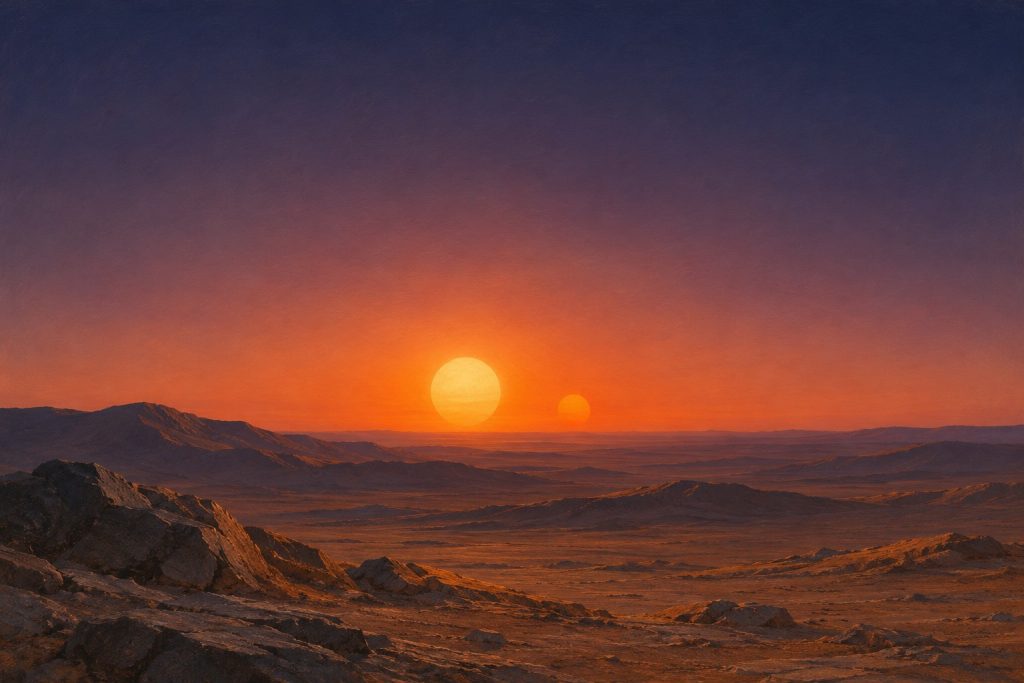
Two stars can circle each other while a planet travels around them both. Astronomers confirmed it by watching the moving stars dim.
THE QUESTION LIBRARY THE UNIVERSE
Earth’s motion, a map’s origin, and a cosmic center are different questions.
Nearby stars shift as Earth orbits the Sun, and Jupiter has moons of its own. Standard cosmology has no unique physical center. Our observable region is centered on our viewpoint. Ancient thinkers disagreed; Aristotle’s Greek account preserves several different ideas.
WHERE THE EVIDENCE STANDS
WHAT WE DON’T KNOW YET
The observable region does not reveal the whole universe’s size or global shape.
WHAT WOULD CHANGE THIS ANSWER
A proposed special cosmic center needs repeatable evidence that standard cosmology cannot explain.
Earth’s motion is measurable, and objects in the sky do not all orbit Earth. The larger claim is different: standard cosmology has no unique physical center, including Earth. Being at the center of our view does not give us a special cosmic address.
Free long answer 1 of 3 this month.
Nearby stars shift slightly against more distant stars as Earth travels around the Sun. This yearly change of viewpoint is called stellar parallax. Try holding up a finger and looking at it first with one eye, then the other: its apparent position changes against the background. Astronomers measure the corresponding tiny shifts in the sky. The measured shifts fit Earth’s changing orbital position; they do not map the entire universe.
There is also a direct counterexample to the idea that everything circles Earth. Galileo observed points near Jupiter whose changing positions revealed moons orbiting that planet. Earth is therefore not the sole center of celestial motion. That observation alone does not prove Earth orbits the Sun, and it does not make Jupiter the center of the universe.
Yes. Coordinates label locations and times. We can describe motion using Earth as the origin, but that choice does not establish a physically privileged center. Describing Earth’s orbit from a viewpoint near the Sun gives a simpler account of this particular system. Convenience does not mean the universe revolves around Earth.
Distant galaxies generally recede from one another, and the leftover glow from the hot early universe fills the sky. These observations support a model of expansion throughout space, rather than an explosion from Earth or another central point. Within that model, an observer elsewhere would see the same broad expansion pattern. What is the universe expanding into? explains that model in more detail.
Our observable region is centered on our location because it is defined by light that can reach us. Another observer has a region defined around their location. This is a limit of observation, not evidence of a universal center. We cannot inspect all space beyond that limit; Is the universe infinite? explores what remains unknown.
There was no single ancient answer. One surviving Greek discussion is Aristotle’s On the Heavens: he described stars as made of heavenly substance and carried by moving celestial circles. He contrasted this with other thinkers’ view that stars were fiery. He also reported that Pythagoreans placed fire at the center and had Earth move around it. That central fire was not our modern Sun-centered model. These examples show disagreement within one ancient discussion; they do not represent every culture or everyone in antiquity.
THREE THINGS TO REMEMBER
Nobody knows yet.
God Plays Dice answers big questions in plain words, with sources and one of six honest labels.
See a mistake? Report a problem. Corrections are made openly.
CONTINUE THE THREAD
The UniverseAnswer
Two stars can circle each other while a planet travels around them both. Astronomers confirmed it by watching the moving stars dim.
The UniverseAnswer
An everywhere-present field, a fleeting particle and a famous nickname. What did CERN’s experiments actually measure?
The UniverseAnswer
Why the matter surplus remains unexplained, what Sakharov's conditions require, and how sphalerons and proposed neutrino mechanisms might connect.
The Architect AI companion · All Access
Labels describe the evidence for a claim, not the people who hold it.
Match my phone uses your device’s light or dark setting.