
How We KnowAnswer
Mutation by Natural Dominance: One Mutation or a Hundred?
If 100 bacteria carry the same DNA change, did it arise once or many times? The answer matters when testing Ricardo Maldonado’s hypothesis.
THE QUESTION LIBRARY HOW WE KNOW
A frozen mammoth tooth can hold readable DNA. A dinosaur fossil can preserve the shape of a bone for far longer. Here’s why those are different feats.
Cold ground can slow DNA’s breakdown enough for short fragments to survive. Researchers read DNA from Siberian mammoth teeth more than a million years old. The last non-avian dinosaurs lived about 66 million years ago, and no DNA sequence from one has been reliably confirmed. A fossil can preserve the shape of a bone long after the genetic information inside it is gone.
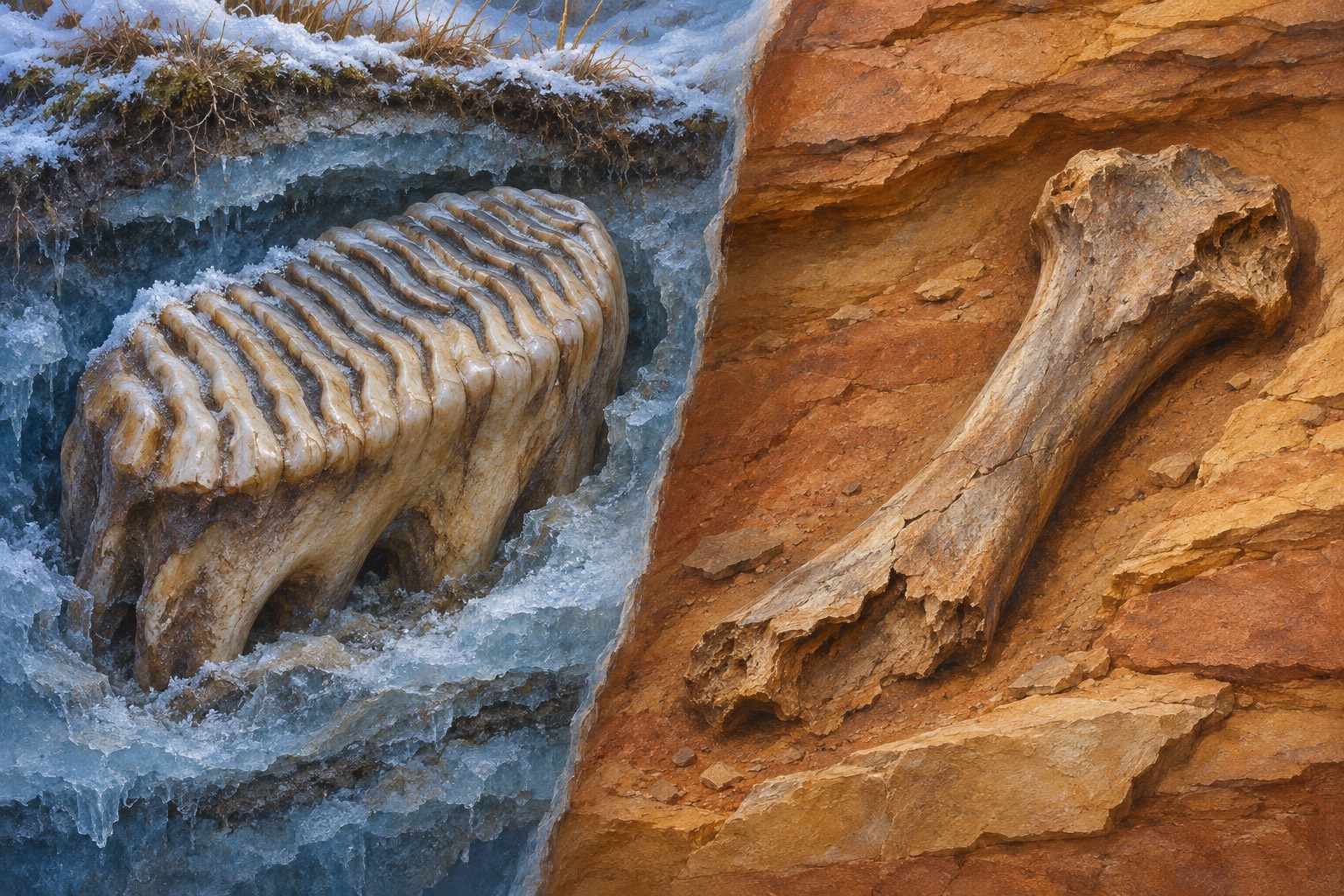
Original AI-generated illustration for God Plays Dice. It pairs a mammoth molar in frozen ground with a fossilized bone in rock. Neither side depicts an actual specimen.
WHERE THE EVIDENCE STANDS
WHAT WE DON’T KNOW YET
There is no universal age limit for readable DNA. Conditions, fragment length and the ability to rule out contamination all matter.
WHAT WOULD CHANGE THIS ANSWER
Independent laboratories recovering authentic, identifiable DNA from a securely dated non-avian dinosaur specimen would change the evidence.
A mammoth tooth can hold readable genetic letters after a million years. A dinosaur fossil can preserve the shape of a bone for tens of millions of years, long after its DNA has broken down. That’s because keeping a shape and keeping a sequence are two different things.
THE LONG ANSWER · ABOUT 3 MINUTES
The short answer, how sure we are, what we don’t know, what would change our mind and every source stay free on every page, for everyone.
All Access members read the long answer: the evidence piece by piece, the strongest objections, and how to check it yourself.
Join All Access · $1 a week Or $6 a month
Billed $52 once a year. Cancel anytime in your account.
Until December 4, 11:59 pm Pacific: the Founding rate is $39 a year, and it stays $39 while you stay a member.
Create a free account: 6 long answers a month, email only.
Paying never buys a different answer. Our Paywall Promise
How do scientists know how old rocks and fossils are?
Scientists combine the order of rock layers with natural atomic clocks that measure time in years.
God Plays Dice answers big questions in plain words, with sources and one of six honest labels.
See a mistake? Report a problem. Corrections are made openly.
CONTINUE THE THREAD
How We KnowAnswer
If 100 bacteria carry the same DNA change, did it arise once or many times? The answer matters when testing Ricardo Maldonado’s hypothesis.
How We KnowAnswer
A space image can be faithful to measured light without matching human eyesight. Here is how to read the translation.
How We KnowAnswer
Why anecdotes feel convincing, what individual cases can show, and how to assess a confident judgment.
The Architect AI companion · All Access
Labels describe the evidence for a claim, not the people who hold it.
Match my phone uses your device’s light or dark setting.