The UniverseExplainer
Is There a Theory of Everything?
Physicists have merged forces of nature before. Gravity is the holdout, and no candidate theory of everything has yet passed a decisive test.
THE QUESTION LIBRARY THE UNIVERSE
Physics already explains three of nature’s four forces with stunning accuracy, so here is what is missing, who is trying to fill the gap, and why some great minds doubt a final theory exists.
Nobody knows yet. A theory of everything would be one set of rules for all four forces of nature and all particles. Today physics has two great theories that each work very well: the Standard Model for particles, and general relativity for gravity. Low-energy quantum calculations work; a complete, tested theory remains missing. The leading attempts to join them, such as string theory and loop quantum gravity, have no confirmed test yet. Some thinkers, including Stephen Hawking, even wondered if a final theory can ever be written down.
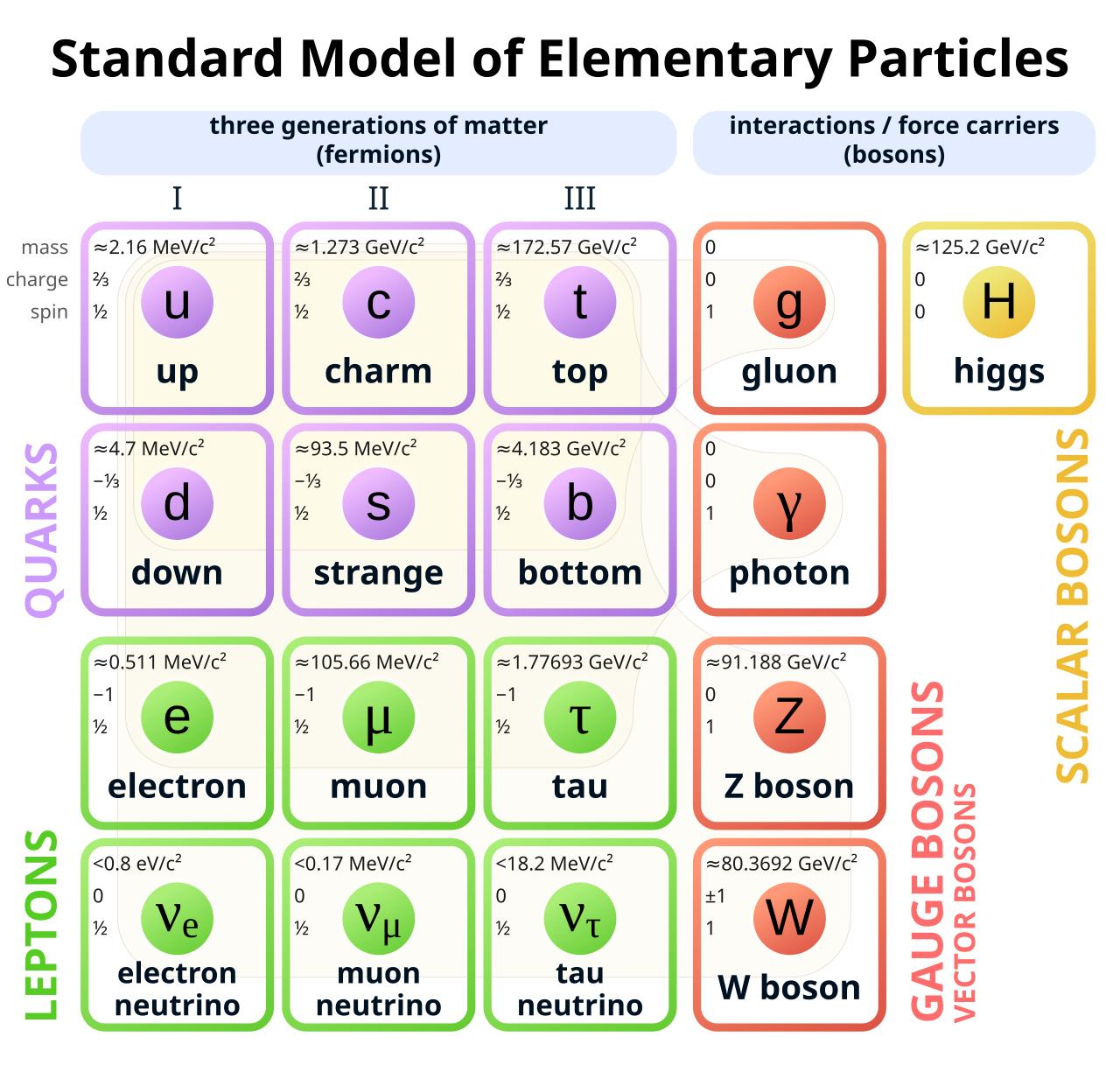
The Standard Model’s particles: twelve matter particles in three generations, the carriers of three forces, and the Higgs boson. Gravity, and its hoped-for carrier the graviton, is not on the chart, which is the gap a theory of everything would fill.
WHERE THE EVIDENCE STANDS
WHAT WE DON’T KNOW YET
Nobody knows which, if any, of today’s candidate theories is right, or how gravity behaves at the very smallest scales. Nobody knows whether a final theory exists, or whether every deeper theory will open new questions.
WHAT WOULD CHANGE THIS ANSWER
A candidate theory that predicted a new, surprising measurement, which experiments then found, would change this answer quickly. A clear lab result showing how gravity behaves at the quantum level would also narrow the field.
Nobody knows yet. A “theory of everything” is the dream of one set of rules that explains all the forces of nature and all the basic particles at once. Physics is closer to that dream than ever, but it is not there, and it may never get there.
Here is where things stand. Nature has four known forces. Gravity is the weakest, but it reaches across the whole universe. Electromagnetism, carried by particles of light called photons, also reaches far and is much stronger. The strong and weak forces work only over tiny distances, at the scale of the particles inside atoms. Three of these four are described by the Standard Model, a theory built in the early 1970s. According to CERN, Europe’s particle physics lab, it has explained almost all experimental results in its field.
Gravity is the odd one out. It is described by Einstein’s general relativity, which also works beautifully. It predicted the gravitational waves that detectors first caught in 2015. The trouble is that the two theories speak different languages. Quantum calculations of gravity work at low energies; a complete theory remains unresolved.
People ask about a theory of everything for many reasons. Some want to know why the world is the way it is. Some have heard that string theory already did the job. Some wonder whether a final answer is even possible. These are fair questions, and the honest answer is that the search is still open.
The leading candidates, string theory and loop quantum gravity, are serious math. But they are very hard to test, because the effects they predict are expected to show up only at energies far beyond any machine on Earth. And some thinkers, including Stephen Hawking, came to suspect that there may be no final theory at all. We label that question Open question.
THE LONG ANSWER · ABOUT 9 MINUTES
The short answer, how sure we are, what we don’t know, what would change our mind and every source stay free on every page, for everyone.
All Access members read the long answer: the evidence piece by piece, the strongest objections, and how to check it yourself.
Join All Access · $1 a week Or $6 a month
Billed $52 once a year. Cancel anytime in your account.
Until December 4, 11:59 pm Pacific: the Founding rate is $39 a year, and it stays $39 while you stay a member.
Create a free account: 6 long answers a month, email only.
Paying never buys a different answer. Our Paywall Promise
WHERE THE AUTHOR’S RESEARCH TOUCHES THIS
Author’s hypothesis. Ricardo Maldonado, author of GOD PLAYS DICE, runs a research program on this question, which the site’s Research Notebook describes on its Unification page. It asks whether one set of ideas could link the laws of the very large with the laws of the very small. Its current public record works on one narrow piece: neutrinos, very light particles, inside a standard textbook setup called the Type-I seesaw. It keeps exact formulas for that setup, and it publishes a self-correction: a proposed cancellation in a harder quantum calculation is now kept only as “conditional algebra.”
The record itself says it does not claim a complete theory of everything or a new prediction confirmed by experiment. The Research Notebook’s status is: math checkpoint with a published self-correction; earlier dated forecasts (January and February 2026) for rare muon events await data. Muons are particles in the same family as electrons, but about 207 times heavier. Those forecasts came from an earlier part of the program, a pattern idea about particle masses, not from the current neutrino record. An idea earns trust when it predicts a new measurement and the prediction holds up. These dated forecasts are that kind of test. Even if experiments see such events, that alone would not single out this idea, because many proposed theories predict them. You can follow the forecasts, and what would count against them, on the Test Ledger.
Did time begin at the Big Bang?
Nobody knows yet.
God Plays Dice answers big questions in plain words, with sources and one of six honest labels.
See a mistake? Report a problem. Corrections are made openly.
CONTINUE THE THREAD
The UniverseExplainer
Physicists have merged forces of nature before. Gravity is the holdout, and no candidate theory of everything has yet passed a decisive test.
The UniverseAnswer
Two stars can circle each other while a planet travels around them both. Astronomers confirmed it by watching the moving stars dim.
The UniverseAnswer
An everywhere-present field, a fleeting particle and a famous nickname. What did CERN’s experiments actually measure?
The Architect AI companion · All Access
Labels describe the evidence for a claim, not the people who hold it.
Match my phone uses your device’s light or dark setting.