Why do we feel awe under the night sky, and is it a spiritual experience?
Psychologists say awe comes from meeting something too vast to take in, and people of every belief feel it, even as city lights hide the Milky Way from many of us.
God Plays Dice Editorial · independently fact-checked · corrections welcomeChecked Sep 26, 20269 min read
THE SHORT ANSWER
We feel awe because the night sky is vast in a way our minds cannot easily take in, psychologists say. For many people, that feeling is spiritual, whether they are religious or not. In a large 2023–24 U.S. survey, 42% of adults with a religion and 39% of adults with no religion said they feel deep wonder about the universe at least weekly. Whether awe points to something beyond nature is a question science cannot settle.
In 2003, psychologists Dacher Keltner and Jonathan Haidt proposed that awe comes from two things: vastness and a need to stretch our understanding.
In a Pew survey of 36,908 U.S. adults, 93% said they feel awe at the beauty of nature at least several times a year.
Americans with and without a religion feel deep wonder about the universe at nearly the same rate: 42% and 39% at least weekly.
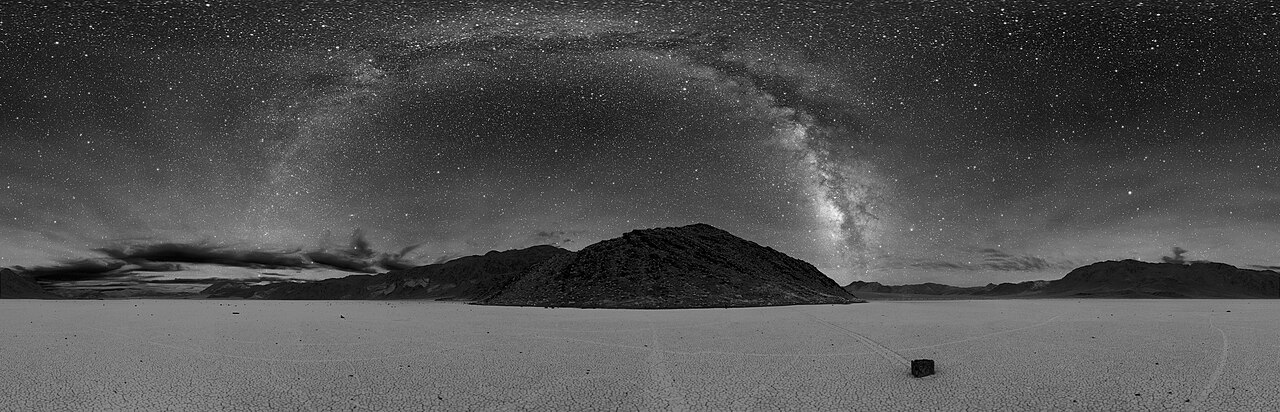
A 2016 world atlas found that light pollution hides the Milky Way from more than one-third of humanity, including nearly 80% of North Americans.
In lab studies, recalling a spiritual experience raised feelings of awe in both religious and nonreligious people.
About this picture
The Milky Way over Racetrack Playa in Death Valley, California, stitched from 30 images in 2005 by Dan Duriscoe of the U.S. National Park Service. Duriscoe later co-wrote the 2016 atlas showing that light pollution hides the Milky Way from more than one-third of humanity.
Dan Duriscoe, U.S. National Park Service, via Wikimedia Commons · Public domain · Image source ↗
WHERE THE EVIDENCE STANDS
How sure are we?
Awe comes from meeting something vast that our usual ideas cannot take in.Proposed by Keltner and Haidt (Cognition and Emotion, 2003) and used in many later studies; a 2018 Berkeley review notes the field is young and many findings are not yet repeated.
Weekly wonder about the universe is nearly as common among religiously unaffiliated Americans as among those with a religion.Pew’s 2023–24 Religious Landscape Study of 36,908 U.S. adults: 42% of religiously affiliated and 39% of unaffiliated adults feel it at least weekly.
Feeling awe can shrink our sense of self and make us kinder.Found by Piff and colleagues (2015, five studies, 2,078 people) and Bai and colleagues (2017, six studies, 2,137 people); the Greater Good Science Center’s 2018 review says many awe findings have yet to be replicated.
Most people in North America and Europe can no longer see the Milky Way from where they live.Falchi and colleagues’ 2016 world atlas (Science Advances): the Milky Way is hidden from 60% of Europeans and nearly 80% of North Americans.
Awe under the stars is contact with God or with something beyond nature.The Stanford Encyclopedia of Philosophy shows careful thinkers arguing both ways; science can study the feeling and the brain activity behind it, but that cannot show what the feeling points to.
Awe research is young, and many findings have not yet been repeated by other teams. Nobody knows for sure why humans evolved to feel awe. And no experiment can show whether awe is a glimpse of something beyond nature.
WHAT WOULD CHANGE THIS ANSWER
Large repeat studies that fail to find awe’s effects on the self or on kindness would weaken that part of this answer. New surveys could shift the numbers. What awe finally points to is not something a measurement can decide.
We feel awe under the night sky because it is the biggest thing most of us ever see, and our minds cannot fit it into everyday thinking. Psychologists call this pair of ingredients vastness and a “need for accommodation.” That means having to stretch what we know in order to take something in. For many people, that stretch feels spiritual. That is true for people of faith and for people with no religion at all.
People ask for different reasons. A believer may feel closer to God under the stars and wonder why. Someone who left religion may miss that feeling and ask if it can live on without faith. A skeptic may wonder if awe is only brain chemistry. Each question is fair.
Here is what the numbers show. In a Pew Research Center survey of 36,908 U.S. adults in 2023 and 2024, 93% said they feel awe at the beauty of nature at least several times a year. About four in ten said they feel a deep sense of wonder about the universe every week. Religious and unaffiliated adults gave almost the same answer: 42% and 39%.
Awe also seems to change us. In studies, people who feel awe describe themselves as smaller and more connected to others. Some studies find they act a bit more kindly. The field is young, though, and many of these results still need to be repeated by other teams.
There is a sad twist. A 2016 atlas of the night sky found that light pollution hides the Milky Way from more than one-third of humanity. For many people, the sky that sparks this feeling is fading from view.
So the feeling is real, common and shared. The science of why we feel it is well supported but still young. Whether awe points to something beyond nature is Beyond science. You are welcome here, whatever your answer.
THE LONG ANSWER
THE LONG ANSWER · ABOUT 8 MINUTES
You’ve read your 3 free long answers this month.
The short answer, how sure we are, what we don’t know, what would change our mind and every source stay free on every page, for everyone.
All Access members read the long answer: the evidence piece by piece, the strongest objections, and how to check it yourself.
The feeling we get in front of something vast that our usual ideas cannot easily take in.
Need for accommodation
Keltner and Haidt’s term for having to stretch or change our ideas to make sense of something.
Small self
The sense, common during awe, of being small next to something larger, with attention shifting away from our own concerns.
Overview effect
The deep awe and sense of connection that many astronauts report when they see Earth from space.
Light pollution
Artificial light that brightens the night sky and hides faint stars and the Milky Way.
Religiously unaffiliated
People who describe their religion as atheist, agnostic or “nothing in particular.”
Sources & further reading
(10) · Checked Sep 26, 2026
Approaching awe, a moral, spiritual, and aesthetic emotion (Keltner and Haidt) ↗Cognition and Emotion 17(2), 297–314 (2003)Abstract (PubMed 29715721): two appraisals central to all clear cases of awe, perceived vastness and a need for accommodation, “defined as an inability to assimilate an experience into current mental structures”; five more: threat, beauty, exceptional ability, virtue and the supernatural. Authors at UC Berkeley and the University of Virginia.
The Science of Awe (Summer Allen) ↗Greater Good Science Center, UC Berkeley, for the John Templeton Foundation (September 2018)“While no one knows for sure why awe evolved”: social cohesion and devotion to leaders (Haidt and Keltner); safe places with large vistas (Chirico and Yaden); Yosemite vs Fisherman’s Wharf self-drawings nearly 33 percent smaller (Bai et al. 2017, doi:10.1037/pspa0000087, six studies, N = 2,137); eucalyptus grove vs tall building, more pens picked up (Piff et al. 2015, doi:10.1037/pspi0000018, five studies, N = 2,078); awe made people more skeptical of weak arguments (Griskevicius, Shiota and Neufeld 2010); “many of the findings discussed in this paper have yet to be replicated.” Piff and Bai abstracts read via Europe PMC. Overview effect section: quotes Yaden et al. 2016 (doi:10.1037/cns0000086) that astronaut accounts “attributed deep feelings of awe and even self-transcendence to this experience”; NASA astronaut Sam Durrance: “this incredible connection to the Earth like nothing I’d ever felt before”; the whole Earth’s “conceptual vastness” conjures thoughts “of home … and of mankind as a whole.”
Spiritual experiences evoke awe through the small self in both religious and non-religious individuals (Preston and Shin) ↗Journal of Experimental Social Psychology 70, 212–221 (2017)Abstract (via OpenAlex): five studies, total N = 1,064; recalling spiritual experiences raised awe and small self in religious and non-religious people; religious people recalled religious and life-and-death events, non-religious people nature, peak experiences, science and yoga or meditation; “the meaning of spirituality without religion.”
Awe, uncertainty, and agency detection (Valdesolo and Graham) ↗Psychological Science 25(1), 170–178 (2014)Abstract (Europe PMC, PMID 24247728; volume and pages via Crossref): across five studies, awe increased supernatural belief and intentional-pattern perception; awe decreased tolerance for uncertainty, which increased the tendency to believe in nonhuman agents and to perceive human agency in random events.
Feelings of spiritual peace, wonder, gratitude and awe in the U.S. (2023–24 Religious Landscape Study) ↗Pew Research Center (February 26, 2025)Awe at the beauty of nature: 93% several times a year or more, 61% weekly; wonder about the universe: 80% several times a year, 41% weekly, 42% of affiliated vs 39% of unaffiliated weekly; 84% of atheists and 66% of agnostics seldom or never feel “the presence of something from beyond this world”; earlier RLS results coded as not comparable. Methodology (https://www.pewresearch.org/religion/2025/02/26/religious-landscape-study-methodology/): NORC, July 17, 2023 to March 4, 2024, 36,908 U.S. adults.
The new world atlas of artificial night sky brightness (Falchi and colleagues) ↗Science Advances 2(6), e1600377 (June 2016)Full text via Europe PMC (PMC4928945): about 83% of the world’s population and more than 99% of the U.S. and European populations live under light-polluted skies; Milky Way hidden from more than one-third of humanity, 60% of Europeans and nearly 80% of North Americans; in Singapore the entire population lives under skies so bright the eye cannot fully dark-adapt. Co-author Dan Duriscoe, U.S. National Park Service Night Skies Division.
Stars Disappear Before Our Eyes, Citizen Scientists Report ↗NSF NOIRLab (January 2023), on Kyba et al., Science 379, 265–268 (2023)More than 50,000 Globe at Night observations, 2011–2022, mostly Europe and North America; sky brightness up 9.6% per year vs about 2% in satellite data; Kyba: a child born where 250 stars were visible would see about 100 by age 18. Paper abstract (Crossref, doi:10.1126/science.abq7781): 51,351 observations, 7 to 10% per year. Globe at Night instructions (https://globeatnight.org/): go out more than an hour after sunset, no Moon, 10 minutes of dark adaptation.
Religious Experience (Mark Webb) ↗Stanford Encyclopedia of Philosophy (revised 2022)Naturalistic explanations: if sufficient, “we have no grounds for positing anything beyond that naturalistic cause”; brain events in religious experience similar to some seizures and drug states; reply (Ellwood): every experience has a corresponding brain state, so this alone does not show it is illusory; Swinburne’s Principle of Credulity; critics say religious and sensory experience differ.
The Milky Way Galaxy ↗NASA Goddard, Imagine the Universe!Milky Way appears as a milky band in a really dark area; about 100 billion stars in a disk about 100,000 light-years across; the Andromeda Galaxy, visible with good eyesight and a very dark sky, is about 2.5 million light-years away and its light takes 2.5 million years to reach us.
Toward a brain-based theory of beauty (Ishizu and Zeki) ↗PLoS ONE 6(7), e21852 (2011)Abstract (Europe PMC, PMC3130765): 21 subjects rated paintings and musical excerpts; only one cortical area, in the medial orbito-frontal cortex, was active during both musical and visual beauty, with activity proportional to the declared intensity of beauty.
You can pursue unanswered questions while caring for people and choosing worthwhile actions. Faith and trust overlap; neither requires pretending to know everything.
Philosophers offer three main families of answers and surveys show where people find meaning, but no lab can say which answer is right.
Beyond science9 min read
THE OCCASIONAL LETTER
Stay curious.
New stories, book updates, and notes from God Plays Dice, delivered when there is something worth sharing.
EMAIL UPDATES ↗
500 DIGITAL COPIES • GIVEAWAY PREVIEW
Be first to know when the 500-copy reader giveaway opens.
Join for the book launch, verified retailer links, and the announcement for a planned giveaway of 500 digital copies. The giveaway is not open yet: dates, eligibility, a dedicated entry form, and Official Rules will be published first.
Privacy · Check your inbox to confirm your subscription. Newsletter signup alone is not a giveaway entry.