About 13.8 billion years, read from the oldest light in the sky and checked against the oldest stars, with one real puzzle still open about how fast space is stretching today.
God Plays Dice Editorial · independently fact-checked · corrections welcomeChecked Sep 26, 202611 min read
THE SHORT ANSWER
About 13.8 billion years. The most precise figure, from the European Space Agency’s Planck satellite, is 13.787 billion years, give or take 20 million. Planck read it from the oldest light in the sky, using the standard model of how the universe grows. Other clocks agree. The oldest star clusters in our galaxy come out a little younger, as they must. One puzzle is still open: two ways of measuring how fast space is stretching today disagree.
ESA’s Planck satellite gives an age of 13.787 billion years, plus or minus 0.020 billion, if the standard model of the universe is right.
A 2020 study of 68 old star clusters in our galaxy found the oldest are about 13.3 billion years old, give or take about half a billion.
Hubble dated the cooling remains of dead stars in the star cluster M4 at 12 to 13 billion years, a check that does not depend on the expansion of space.
Nearby galaxies say space is stretching at a rate near 73, but Planck’s model predicts about 67 (in the units astronomers use). This gap is the Hubble tension.
Webb telescope checks found no simple error in Hubble’s star measurements, but one team using Webb gets about 70, so the cause is still debated.
About this picture
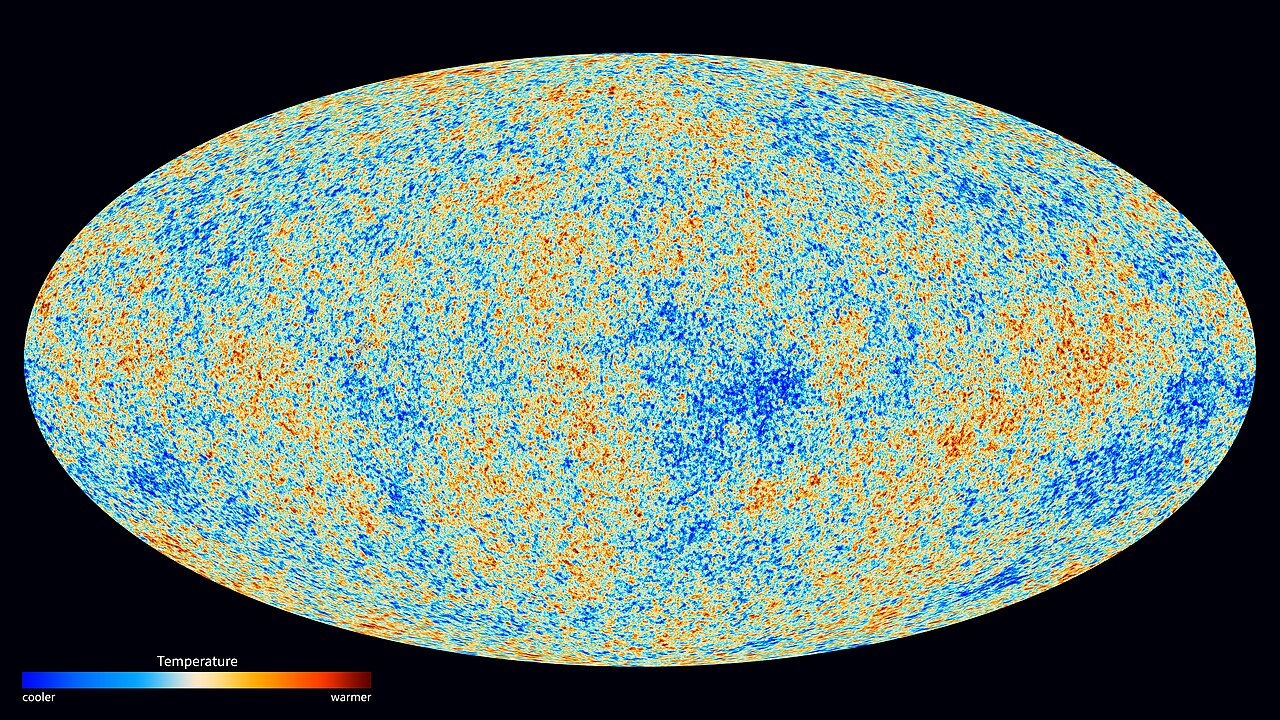
The oldest light in the universe, as mapped by ESA’s Planck satellite from its first 15.5 months of data. The warm and cool spots differ by tiny amounts, and their pattern is what lets cosmologists work out the universe’s age.
NASA Scientific Visualization Studio (Marit Jentoft-Nilsen, Mark Malanoski), from ESA and Planck Collaboration data, via Wikimedia Commons · Public domain · Image source ↗
WHERE THE EVIDENCE STANDS
How sure are we?
The universe is about 13.8 billion years old.Planck 2018 final results: 13.787 ± 0.020 billion years (13.797 ± 0.023 from Planck data alone), assuming the standard Lambda-CDM model; NASA’s WMAP found 13.77 billion to within half a percent.
The oldest stars and star clusters we can date fit within the universe’s age, once their error bars are counted.Valcin et al. 2020: oldest globular clusters 13.32 ± 0.1 (statistical) ± 0.5 (systematic) billion years; Hubble white dwarfs in M4, 12 to 13 billion years (2002); ESO uranium clock in CS 31082-001, 12.5 ± about 3 billion years (2001); the Methuselah star HD 140283, 14.5 ± 0.8 billion years (2013), overlaps the universe’s age.
Measurements of the nearby universe and the early-universe prediction give different expansion rates.SH0ES 2022: 73.04 ± 1.04 km/s/Mpc, a 5-sigma gap from Planck’s 67.4 ± 0.5; the 2026 Local Distance Network: 73.50 ± 0.81; but Freedman’s 2025 result from Hubble and Webb data, 70.4 ± 3%, agrees with Planck within its errors.
The Hubble tension or the Webb telescope shows the Big Bang picture is wrong.Both sides of the tension measure an expanding universe and disagree about today’s rate; NASA lists possible causes such as exotic dark energy, exotic dark matter or a change in our understanding of gravity. A 2024 study reported by NASA found the standard model of cosmology likely isn’t broken by early Webb galaxies.
Nobody knows yet why the two expansion measurements disagree. It could be several measurement errors pushing the same way, or a missing piece in the standard model, such as a surprise in dark energy, dark matter or gravity. The 13.8-billion-year figure also assumes that model, though the star clocks, which do not, agree with it.
WHAT WOULD CHANGE THIS ANSWER
Stars that are clearly older than 13.8 billion years, with small error bars, would force a rethink. So would a new model that fixes the Hubble tension and shifts the age. So far, every independent clock points to about the same answer.
About 13.8 billion years. That is how long ago the universe was extremely hot and dense and began the expansion we still see today. The most precise value comes from the European Space Agency’s Planck satellite: 13.787 billion years, give or take about 20 million years.
It is fair to ask how anyone could know that. Nobody was there to start a clock. The answer is that scientists read several different clocks, and they agree.
The first clock is the oldest light in the sky. About 380,000 years after the Big Bang, the universe cooled enough for light to travel freely. That light still fills space as a faint microwave glow. Planck mapped the tiny warm and cool spots in it. The pattern shows what the universe is made of and how it has grown. Scientists then run the standard model of the universe forward to today and read off how much time has passed.
The other clocks are stars. A star cannot be older than the universe it lives in. In one 2020 study, the oldest star clusters in our galaxy came out at about 13.3 billion years. The cooling cores of dead stars, called white dwarfs, gave 12 to 13 billion years in a Hubble study. The first stars formed less than a billion years after the Big Bang, so these ages fit.
There is one real puzzle. Astronomers measure how fast space is stretching today in two ways, and they get different answers. This is called the Hubble tension. It has not changed the measured age, which rests on more than one clock. But it may mean the standard model is missing something. We label the age Established, and the tension Supported, still debated.
THE LONG ANSWER
THE LONG ANSWER · ABOUT 9 MINUTES
You’ve read your 3 free long answers this month.
The short answer, how sure we are, what we don’t know, what would change our mind and every source stay free on every page, for everyone.
All Access members read the long answer: the evidence piece by piece, the strongest objections, and how to check it yourself.
Author’s hypothesis. Ricardo Maldonado, author of GOD PLAYS DICE, takes this measured age as his starting point. The book’s glossary dates the hot, dense early state of our universe to about 13.8 billion years ago. Its source notes make the same point this page does: the familiar 13.8 billion years is a model-based inference from Planck’s framework, not a direct reading from a cosmic clock.
His HD-Blast idea, the Author’s hypothesis that our Big Bang may be the aftershock of a higher-dimensional event, asks what may have set off that hot beginning. The book sets a firm condition: any such earlier history must reproduce the measured expansion, the thermal history and the pattern of early ripples, not merely sit alongside them in words. Nothing about the idea has been confirmed.
Keep asking
Next on the path “Where did everything come from?” · step 2 of 7
The faint microwave glow that fills the sky, released about 380,000 years after the Big Bang when the universe became clear enough for light to travel.
Hubble constant
How fast space is stretching today, usually given in kilometers per second per megaparsec.
Megaparsec
A unit of distance equal to about 3.26 million light-years.
Globular cluster
A tight ball of hundreds of thousands to a million stars, among the oldest objects in our galaxy.
White dwarf
The hot, dense core left behind when a star dies. It no longer burns fuel and cools at a predictable rate.
Lambda-CDM
The standard model of cosmology: a universe of ordinary matter, cold dark matter and dark energy (Lambda), described by six basic numbers.
Sources & further reading
(10) · Checked Sep 26, 2026
Planck 2018 results. VI. Cosmological parameters ↗Planck Collaboration, Astronomy & Astrophysics 641, A6 (2020)Abstract: base 6-parameter Lambda-CDM; H0 = 67.4 ± 0.5 km/s/Mpc; Omega_m = 0.315 ± 0.007; angular acoustic scale to 0.03%; results only weakly dependent on the cosmological model. Table 2 (arXiv 1807.06209v4, PDF text extracted): Age 13.830 ± 0.037 (TT+lowE), 13.761 ± 0.038 (TE+lowE), 13.800 ± 0.024 (TT,TE,EE+lowE), 13.797 ± 0.023 (+lensing), 13.787 ± 0.020 (+lensing+BAO) Gyr, 68% limits. Table 1 caption: a total systematic uncertainty of around 0.5 sigma may be more realistic. Context: ESA 2013 first Planck results gave 13.82 billion years (https://www.esa.int/Science_Exploration/Space_Science/Planck/Planck_reveals_an_almost_perfect_Universe); NASA’s WMAP overview says WMAP determined 13.77 billion years to within a half percent (https://science.nasa.gov/mission/wmap/wmap-overview/). Also: NASA Universe overview (https://science.nasa.gov/universe/overview/): around 380,000 years after the big bang, atoms formed and light could travel freely. Knox, Christensen and Skordis, ApJ 563, L95 (2001), https://doi.org/10.1086/338655 (abstract read at arXiv astro-ph/0109232): the CMB age is precise because of a tight (and accidental) correlation of the age with the angle subtended by the sound horizon.
Inferring the age of the universe with globular clusters ↗Valcin, Bernal, Jimenez, Verde and Wandelt, Journal of Cosmology and Astroparticle Physics (2020)68 galactic globular clusters; average age of the oldest 13.32 ± 0.1 (stat.) ± 0.5 (sys.) Gyr; inferred age of the universe 13.5 +0.16/−0.14 (stat.) ± 0.5 (sys.) Gyr, compatible with Planck’s 13.8 ± 0.02 Gyr. Abstract read at arXiv 2007.06594.
Hubble Uncovers Oldest ‘Clocks’ in Space to Read Age of Universe ↗NASA (April 24, 2002)White dwarfs in globular cluster M4 (5,600 light-years away, the nearest globular cluster) are 12 to 13 billion years old; first stars formed less than 1 billion years after the big bang; campfire-coals comparison; a completely independent reading not relying on the expansion; late-1970s estimates of 8 to 18 billion years clashed with star ages; globular clusters hold hundreds of thousands to a million stars.
Uranium dates the Universe (eso0106) ↗European Southern Observatory (February 7, 2001)First uranium measurement outside the solar system, in the old star CS 31082-001, with the VLT and UVES; the uranium clock reads 12.5 billion years; uncertainty about 25%, or about ±3 billion years; compared with carbon-14 dating in archaeology; reported in Nature, February 8, 2001.
Hubble Finds Birth Certificate of Oldest Known Star ↗NASA (March 7, 2013)HD 140283, the Methuselah star, 190.1 light-years away: 14.5 ± 0.8 billion years, overlapping the universe’s age of about 13.8 billion; earlier estimates as high as 16 billion; Hubble parallax five times more precise than Hipparcos. Also opened: NASA, “Webb Finds Early Galaxies Weren’t Too Big for Their Britches After All” (Aug. 26, 2024; https://science.nasa.gov/missions/webb/webb-finds-early-galaxies-werent-too-big-for-their-britches-after-all/): black holes made some early galaxies look more massive; “no crisis” for the standard model; still about twice as many massive early galaxies as expected. Also: Edward L. Wright (UCLA), “Frequently Asked Questions in Cosmology” (https://www.astro.ucla.edu/~wright/cosmology_faq.html, last modified May 24, 2013): distances grow while light travels; the current best-fit model with an accelerating expansion gives a maximum distance we can see of 47 billion light-years.
A Comprehensive Measurement of the Local Value of the Hubble Constant with 1 km/s/Mpc Uncertainty from the Hubble Space Telescope and the SH0ES Team ↗Riess et al., The Astrophysical Journal Letters 934, L7 (2022)Cepheids in the hosts of 42 Type Ia supernovae; H0 = 73.04 ± 1.04 km/s/Mpc; a 5-sigma difference with Planck plus Lambda-CDM; source of the discrepancy remains unknown (abstract, arXiv 2112.04510). Units: NASA Roman page (https://roman.gsfc.nasa.gov/feature_hubble_constant.html): a megaparsec is about 3.26 million light-years; an object one Mpc away recedes at 70 to 76 km/s, two Mpc at 140 to 152 km/s.
Webb and Hubble telescopes affirm Universe’s expansion rate, puzzle persists (weic2408) ↗ESA/Webb (March 11, 2024)Five host galaxies of eight Type Ia supernovae with a total of 1,000 Cepheids, out to NGC 5468 at 130 million light-years; the river-and-two-anchors analogy; 10 to 20 billion year range before Hubble. Paper: Riess et al., ApJL 962, L17 (2024), https://doi.org/10.3847/2041-8213/ad1ddd, rejects unrecognized crowding at 8.2 sigma. NASA Webb blog (Sept. 12, 2023; https://science.nasa.gov/blogs/webb/2023/09/12/webb-confirms-accuracy-of-universes-expansion-rate-measured-by-hubble-deepens-mystery-of-hubble-constant-tension/): more than 320 Cepheids; a faster expansion rate leads to a younger age and a slower one to an older age; possible causes include exotic dark energy, exotic dark matter or a revision of gravity.
New measure of the universe’s expansion suggests resolution of a conflict ↗University of Chicago News (May 27, 2025)Freedman’s value 70.4 km/s/Mpc ± 3%, in statistical agreement with the CMB value 67.4 ± 0.7%; red giant and carbon stars; the quoted sentence on the Standard Model holding up. Paper: Freedman et al., ApJ 985, 203 (2025), https://doi.org/10.3847/1538-4357/adce78 (erratum ApJ 993, 252, Nov. 2025: corrects the error bars in Appendix B Figure B1; “do not impact the rest of the paper”). Reply: Riess et al., ApJ 977, 120 (2024), https://doi.org/10.3847/1538-4357/ad8c21: JWST combined three-method result 72.6 ± 2.0; differences explained by sample selection. UChicago explainer (https://news.uchicago.edu/explainer/hubble-constant-explained): speed = distance divided by time gives about 14 billion years.
GOD PLAYS DICE, Volume OneRicardo MaldonadoNotes: the familiar age of roughly 13.8 billion years is a model-based inference from the Planck framework, not a direct reading from a cosmic clock; a higher-dimensional prehistory must reproduce, not merely coexist verbally with, the measured expansion, thermal history and primordial perturbations. Glossary: Big Bang, the hot, dense early state about 13.8 billion years ago. Introduction: the hypothesis that the Big Bang may be the aftershock of a higher-dimensional event.
From the first atomic nuclei back to a possible burst of inflation, here is what scientists have tested about the first second, and where knowledge runs out.
Several serious ideas in physics allow other universes, so here is what each one says, how scientists have tried to test them, and how a scientific braneworld differs from the multiverse in the movies.
Open question8 min read
THE OCCASIONAL LETTER
Stay curious.
New stories, book updates, and notes from God Plays Dice, delivered when there is something worth sharing.
EMAIL UPDATES ↗
500 DIGITAL COPIES • GIVEAWAY PREVIEW
Be first to know when the 500-copy reader giveaway opens.
Join for the book launch, verified retailer links, and the announcement for a planned giveaway of 500 digital copies. The giveaway is not open yet: dates, eligibility, a dedicated entry form, and Official Rules will be published first.
Privacy · Check your inbox to confirm your subscription. Newsletter signup alone is not a giveaway entry.