Is life likely to be rare or common in the universe?
Planets turn out to be everywhere, but we still know of only one living world, so here is what the numbers say, where the arguments split, and how to judge the next headline.
God Plays Dice Editorial · independently fact-checked · corrections welcomeChecked Sep 26, 202610 min read
THE SHORT ANSWER
Nobody knows yet. We know of exactly one living world, our own. Planets turn out to be common: NASA’s Exoplanet Archive listed 6,372 confirmed planets on September 25, 2026, and Kepler data suggest about half of Sun-like stars could have a rocky planet where water could stay liquid. So places for life look common. Whether life actually starts often is unknown, and no claimed sign of life beyond Earth has been confirmed.
NASA’s Exoplanet Archive listed 6,372 confirmed planets beyond our solar system on September 25, 2026.
A NASA-led study of Kepler data found that about half of Sun-like stars could have a rocky planet where liquid water is possible, with wide error bars.
Life appeared on Earth within a few hundred million years of the planet cooling, but studies disagree on whether that means life starts easily.
The Rare Earth argument says complex life is rare. Copernican reasoning says Earth is probably ordinary. Neither idea has been settled by observation.
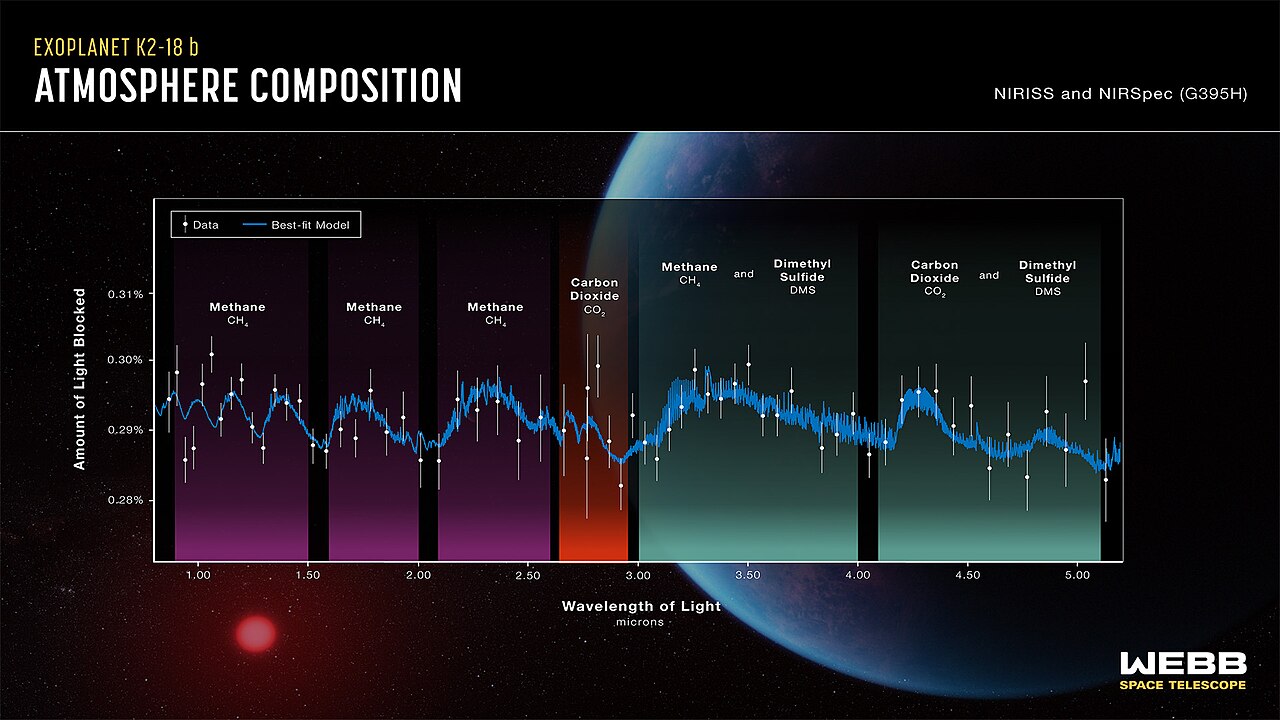
A 2025 claim of possible signs of life on the planet K2-18b fell short of the usual bar for a discovery, and other teams found the evidence too weak.
About this picture
Webb’s 2023 spectrum of K2-18b, with the team’s model and labels. Methane and carbon dioxide held up. The dimethyl sulfide labels mark a hint that NASA called less robust, and several later analyses found the evidence for it insufficient. Note the error bars on each point.
NASA, ESA, CSA, Ralf Crawford (STScI), Joseph Olmsted (STScI); science: Nikku Madhusudhan (IoA), via Wikimedia Commons · Public domain · Image source ↗
WHERE THE EVIDENCE STANDS
How sure are we?
Planets are common, and our galaxy likely has more planets than stars.NASA’s Exoplanet Archive listed 6,372 confirmed exoplanets on Sept. 25, 2026; NASA says nine years of Kepler data showed more planets than stars in our galaxy.
Many Sun-like stars have a rocky planet in the habitable zone.Bryson et al. (2021) found 0.37 to 0.60 rocky habitable-zone planets per Sun-like star for a cautious zone, with large uncertainties because Kepler found few such small planets.
Life exists somewhere beyond Earth.No detection has been confirmed. Studies of life’s early start on Earth disagree: Spiegel and Turner find it consistent with life being very rare; Kipping finds modest odds for a fast origin.
The Webb telescope has found signs of life on the planet K2-18b.The 2025 DMS claim reached three sigma, below the five-sigma discovery bar; independent reanalyses (Luque et al. 2025; Welbanks et al. 2025; Stevenson et al. 2025) found the evidence insufficient, and Luque et al. found that ethane fits as well.
Life elsewhere could be built mainly on silicon instead of carbon.A 2020 review by Petkowski, Bains and Seager found silicon-based life implausible in every environment studied; a 2007 National Research Council study for NASA notes that life based on chemistry without carbon compounds is possible and suggests research on it.
Nobody knows how easily life begins, because we have only one example. We also don’t know how often simple life leads to complex life, or how long technological civilizations last.
WHAT WOULD CHANGE THIS ANSWER
Finding life that began separately from Earth’s, even microbes on Mars, would be strong evidence that life is not extremely rare. A biosignature on another planet, confirmed by several teams and instruments, would do the same. Many more careful searches that find nothing would slowly tip the balance toward rare.
Nobody knows yet. That is the honest answer, not a dodge. We know of exactly one living world, Earth, and you cannot tell how common something is from a single example. What we can do is take the steps life needs, one at a time, and ask which ones we have measured.
The first steps turned out to be generous. The first planets around other stars were found in the 1990s. On September 25, 2026, NASA’s Exoplanet Archive counted 6,372 confirmed ones. NASA says our galaxy holds more planets than stars. A NASA-led study of Kepler telescope data found that about half of Sun-like stars could have a rocky planet in the habitable zone. That is the range of distances from a star where water could stay liquid on the surface. Even the most cautious reading leaves at least 300 million such worlds in our galaxy.
The later steps are the hard part. Does life start wherever conditions allow? Does simple life often grow complex? On Earth, life appeared within the first few hundred million years after the planet cooled. Some researchers read that as a hint that life starts easily. Others point out a catch: if intelligent life takes billions of years to evolve, an early start may be needed for anyone to be here asking. So the clue is weaker than it looks.
Two big pictures compete. The Rare Earth argument says simple life might be widespread but complex life rare. Copernican reasoning starts from a working assumption of astronomy: we do not live in a special place. If that holds for life too, life should be common. Both are serious arguments. Neither is a measurement.
And the headlines? In 2025, a team using the Webb telescope reported possible signs of life on a planet called K2-18b. Other teams checked the same data and found the evidence too weak. No claimed sign of life beyond Earth has been confirmed. So the big question stays an Open question. For the related puzzle of why no one seems to be calling, see The Fermi Paradox: Where Is Everybody?
THE LONG ANSWER
THE LONG ANSWER · ABOUT 9 MINUTES
You’ve read your 3 free long answers this month.
The short answer, how sure we are, what we don’t know, what would change our mind and every source stay free on every page, for everyone.
All Access members read the long answer: the evidence piece by piece, the strongest objections, and how to check it yourself.
The range of distances from a star where temperatures could allow liquid water on a planet’s surface. It is a first cut, not proof a planet can support life.
Biosignature
A sign, such as a gas or a pattern in a rock, that might be made by life. A “potential” biosignature still needs more data before anyone can conclude life was present.
Drake equation
A 1961 formula by Frank Drake that multiplies seven factors to estimate how many detectable civilizations exist in our galaxy.
Sigma
A measure of how far a signal stands above random noise. Five sigma is the usual bar for claiming a discovery.
Selection effect
A bias that comes from the fact that we can only observe situations that allow observers like us to exist.
Sources & further reading
(10) · Checked Sep 26, 2026
NASA Exoplanet Archive ↗NASA / Caltech-IPACHome page counter read on Sept. 25, 2026 (Pacific time): 6,372 Confirmed Planets, dated 09/25/2026. A TAP query of the Planetary Systems Composite table the same day returned 6,372 planets, 4,709 of them with discovery method “Transit” and 4,779 host stars. NASA’s “How many exoplanets are there?” page says the first exoplanets were discovered in the 1990s.
About Half of Sun-Like Stars Could Host Rocky, Potentially Habitable Planets ↗NASA (Oct. 29, 2020; updated Nov. 2)About half of Sun-like stars; at least 300 million potentially habitable worlds on the most conservative interpretation; nine years of Kepler data showed more planets than stars; Kepler final data combined with ESA Gaia; lead author Steve Bryson, NASA Ames. Paper: Bryson et al., Astronomical Journal 161, 36 (2021), https://doi.org/10.3847/1538-3881/abc418: conservative habitable-zone occurrence 0.37 to 0.60 planets per star, optimistic 0.58 to 0.88; large uncertainties due to the small number of detected small habitable-zone planets.
The Drake Equation ↗SETI InstituteWritten by Frank Drake in 1961 as the agenda for a meeting at the Green Bank Observatory in November 1961; seven factors; essentially only the star-formation rate was known in 1961; the 1961 planet-factor guesses are within a factor of two or three of modern estimates; estimates of N range from 1 to several million; Drake suggested N = 10,000; Drake likened it to estimating the number of students at a university; there is little basis for estimating L, which depends on alien behavior. Also: Sandberg, Drexler and Ord, “Dissolving the Fermi Paradox” (2018), https://arxiv.org/abs/1806.02404: uncertainties spanning multiple orders of magnitude; a substantial probability of no other intelligent life in the observable universe.
Bayesian analysis of the astrobiological implications of life’s early emergence on Earth ↗Spiegel and Turner, PNAS 109, 395–400 (published online Dec. 2011)Life arose in the first few hundred million years after Earth cooled; the prior dominates the result; the early start is consistent with an arbitrarily low probability of abiogenesis; one independent case of life would be much stronger evidence. Also: Lineweaver and Davis, Astrobiology 2, 293–304 (2002), https://doi.org/10.1089/153110702762027871: probability of biogenesis above 13% at 95% confidence on terrestrial planets older than about 1 billion years, which does not necessarily mean life is common; Kipping, PNAS 117, 11995 (2020), https://doi.org/10.1073/pnas.1921655117 (abstract via Europe PMC): the selection effect that a slow evolution of intelligence would make life’s early start a prerequisite to our existence; rapid abiogenesis at least 2.8 times more likely than slow; rare intelligence slightly favored at 3:2 odds.
Rare Earth: Why Complex Life is Uncommon in the Universe ↗Peter D. Ward and Donald Brownlee, Copernicus / Springer-Verlag New York (2000)Book record read through the Internet Archive copy of Sept. 10, 2025 (the live page shows a script challenge). Chapter titles include “Why Life Might Be Widespread in the Universe,” “How to Build Animals,” “Mass Extinctions and the Rare Earth Hypothesis,” “The Surprising Importance of Plate Tectonics” and “The Moon, Jupiter, and Life on Earth.”
Philosophy of Cosmology ↗Stanford Encyclopedia of PhilosophyThe Copernican principle: no point is distinguished from other points (“there are no ‘special locations’”); it is an assumption that cannot be established directly by observation. Also: Frank and Sullivan (A. Frank and W. T. Sullivan III), Astrobiology 16, 359–362 (2016), https://doi.org/10.1089/ast.2015.1418: as long as the probability that a habitable-zone planet develops a technological species exceeds about 10^-24, humanity is not the only time technological intelligence has evolved.
Strongest hints yet of biological activity outside the solar system ↗University of Cambridge (April 17, 2025)DMS and/or DMDS at three sigma (0.3% chance); five sigma means below 0.00006%; 16 to 24 hours of follow-up may reach five sigma; K2-18b is 8.6 times as massive and 2.6 times as large as Earth, 124 light-years away; an ocean teeming with life best fits the team’s data; more data needed. Paper: Madhusudhan et al., ApJL 983, L40 (2025), https://doi.org/10.3847/2041-8213/adc1c8. 2023 results: Madhusudhan et al., ApJL 956, L13, https://doi.org/10.3847/2041-8213/acf577; NASA release, Sept. 11, 2023 (https://science.nasa.gov/missions/webb/webb-discovers-methane-carbon-dioxide-in-atmosphere-of-k2-18-b/): methane and carbon dioxide; DMS inference less robust and requires further validation; 120 light-years; cool dwarf star.
Insufficient evidence for DMS and DMDS in the atmosphere of K2-18 b ↗Luque et al., Astronomy & Astrophysics 700, A284 (2025)Joint 0.6–12 micron analysis finds insufficient evidence for DMS/DMDS; ethane fits equally well; about 25 more MIRI transits needed. Other reanalyses: Taylor, RNAAS 9, 118 (2025), https://doi.org/10.3847/2515-5172/add881 (no strong statistical evidence for spectral features); Welbanks et al., Nature Astronomy 10, 234 (2025), https://doi.org/10.1038/s41550-025-02730-4 (claims vanish when the model space is expanded); Stevenson et al., AJ 170, 257 (2025), https://doi.org/10.3847/1538-3881/ae0338 (red noise in MIRI data; does not meet standards of evidence); Hu et al. (preprint, July 2025; first author Renyu Hu, Jet Propulsion Laboratory), https://arxiv.org/abs/2507.12622 (four new NIRSpec transits; DMS marginal, none above 3 sigma; DMS may form abiotically in massive H2-rich atmospheres; Madhusudhan a co-author); Pica-Ciamarra et al., ApJL 1002, L34 (2026), https://doi.org/10.3847/2041-8213/ae5dcc (661 molecules; only DMS consistently at ln B ≥ 2.0, a threshold set just below the conventional 2.5 for moderate preference; more observations needed); Lavvas et al., A&A 709, A272 (2026), https://arxiv.org/abs/2603.26474, and Tsai et al. (preprint, 2026), https://arxiv.org/abs/2603.19803 (Lavvas: a high-metallicity H2-rich atmosphere reproduces the spectrum, no DMS in the explanation; Tsai: supports a sub-Neptune scenario without invoking DMS).
Can We Find Life? ↗NASA ScienceHabitable zone as a first cut; also needs suitable size, atmosphere and a stable star not prone to sterilizing flares; confirming true biosignatures needs hundreds of hours of observing, follow-up studies and multiple converging lines of evidence. Also: JPL, “NASA Says Mars Rover Discovered Potential Biosignature Last Year” (Sept. 10, 2025; https://www.jpl.nasa.gov/news/nasa-says-mars-rover-discovered-potential-biosignature-last-year/): definition of a potential biosignature; the Sapphire Canyon sample; the seven-benchmark Confidence of Life Detection (CoLD) scale.
On the Potential of Silicon as a Building Block for Life ↗Petkowski, Bains and Seager, Life 10(6), 84 (2020)In no environment is life based primarily on silicon chemistry a plausible option; in water, silica formation limits silicon’s chemistry (abstract via Crossref). Also: National Research Council, The Limits of Organic Life in Planetary Systems (2007), https://nap.nationalacademies.org/catalog/11919/the-limits-of-organic-life-in-planetary-systems: study for NASA; its summary says it is possible that life is based on chemical reactions that do not involve carbon compounds or occurs in solvents other than water, and the book offers suggestions for future research.
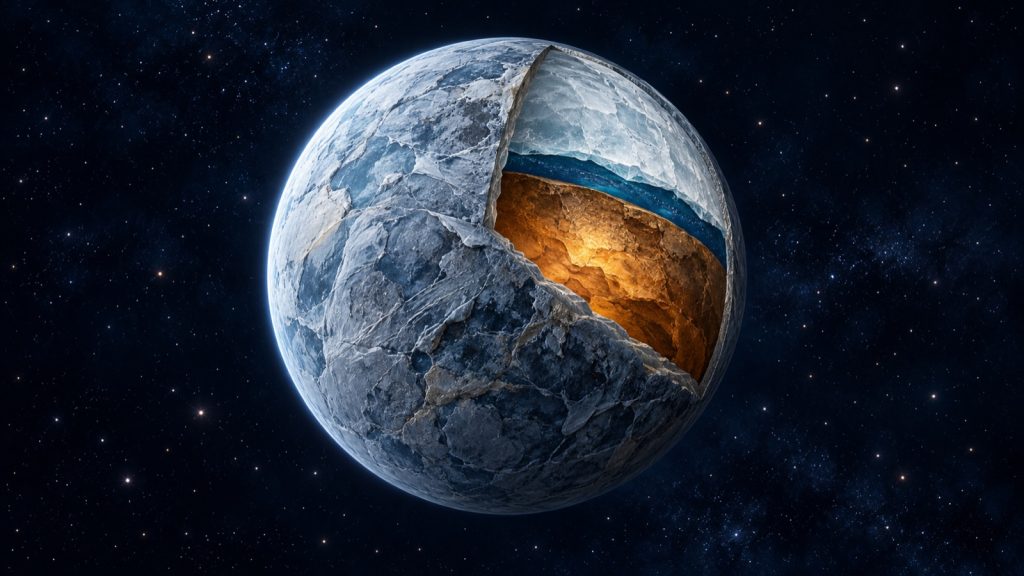
A world with no sunrise could still have internal heat. The question is whether it can keep water liquid and supply usable energy.
Open question4 min read
THE OCCASIONAL LETTER
Stay curious.
New stories, book updates, and notes from God Plays Dice, delivered when there is something worth sharing.
EMAIL UPDATES ↗
500 DIGITAL COPIES • GIVEAWAY PREVIEW
Be first to know when the 500-copy reader giveaway opens.
Join for the book launch, verified retailer links, and the announcement for a planned giveaway of 500 digital copies. The giveaway is not open yet: dates, eligibility, a dedicated entry form, and Official Rules will be published first.
Privacy · Check your inbox to confirm your subscription. Newsletter signup alone is not a giveaway entry.