Smart, caring people share false videos every day, so here is a calm routine for tracing a clip to its source, and what research says about spotting AI fakes.
God Plays Dice Editorial · independently fact-checked · corrections welcomeChecked Sep 28, 20269 min read
THE SHORT ANSWER
Pause, then check where it came from. Ask who first posted it, when and where it was filmed, and what trusted outlets say about it. Search for older copies by putting screenshots into a reverse image search. Don’t count on your eyes to catch AI fakes: in one large study, people did about as well as a coin toss. Labels and tools can help, but none catches everything. If you can’t confirm a video, hold off on sharing it.
In a study of 45 experienced internet users, the 10 professional fact-checkers reached better-supported judgments, in less time, by leaving a site to read what others said about it.
In a 2024 study of 1,276 people, the average ability to tell real media from AI-made media was close to chance.
Most people say it matters to share only accurate news; experiments suggest people often share false posts because their attention is elsewhere.
Much misleading video is real footage with a false caption, an old date or missing context.
Tools such as Content Credentials and Google’s SynthID can show where some content came from, but a missing label proves nothing.
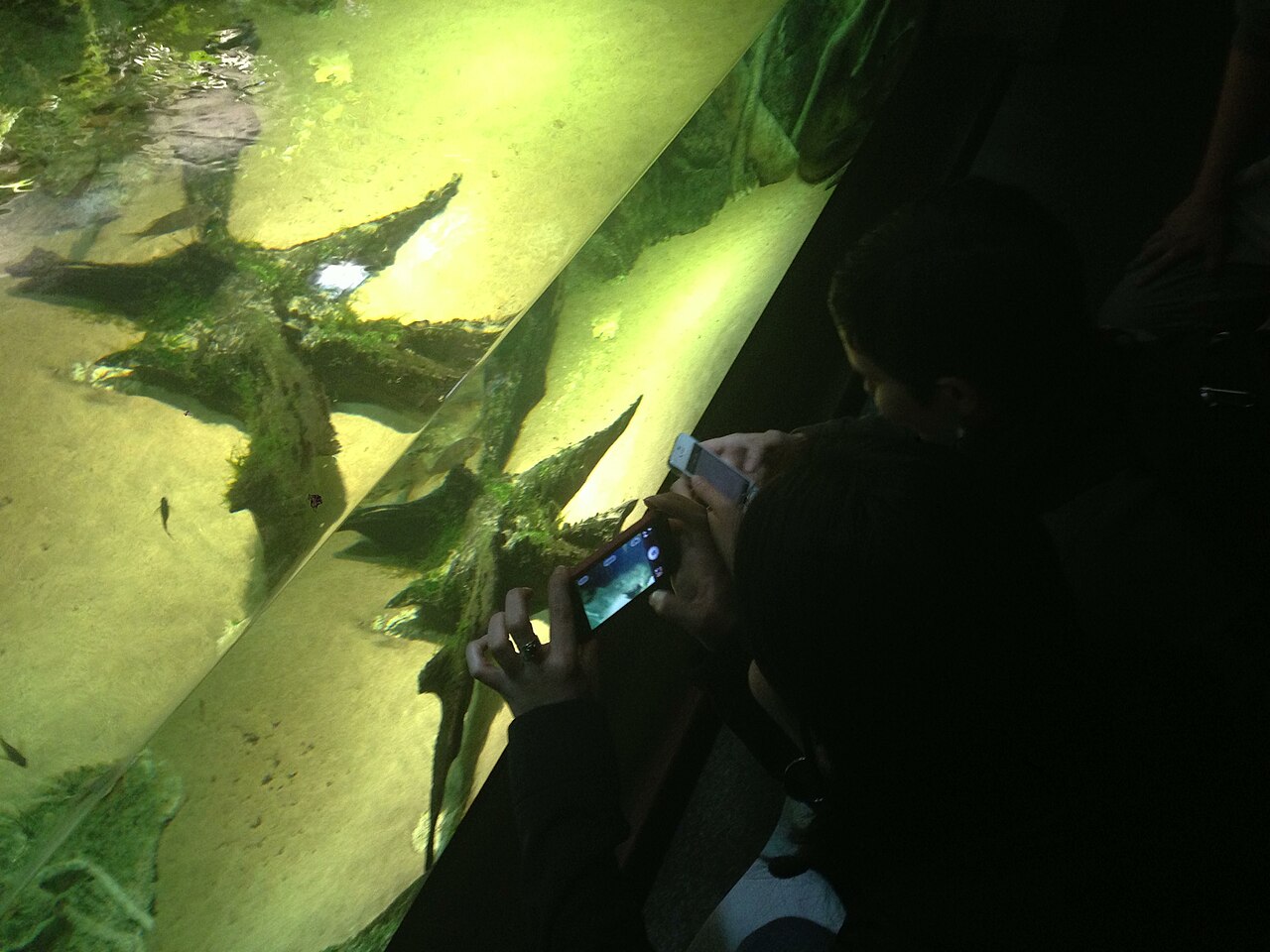
About this picture
Visitors photograph fish at an aquarium exhibit; the photographer’s description places it at the California Academy of Sciences. Every viral video starts as someone’s recording, and finding that first recording is the heart of checking it.
Leaving a source to read what others say about it works better than studying the source itself.Wineburg and McGrew (Teachers College Record, 2019): in one think-aloud study of 10 fact-checkers, 10 PhD historians and 25 Stanford students, the fact-checkers read laterally and reached better-supported conclusions in a fraction of the time. It is one small study.
Most people can spot a deepfake video if they look closely.Köbis and colleagues (iScience, 2021, 210 people) found people cannot reliably detect deepfakes and overestimate their skill; Cooke and colleagues (1,276 people) found average accuracy close to chance.
People who share false posts mostly don’t care whether they are true.Pennycook and colleagues (Nature, 2021), abstract: most participants said it is important to share only accurate news, and subtly shifting their attention to accuracy improved the quality of what they shared.
A detector or watermark can settle whether any video is real.NIST AI 100-4 (2024) calls detection a constant cat-and-mouse game, says detectors are often tied to specific generators and may only work well on them, and notes that metadata is often stripped when files are shared.
False news spreads farther and faster online than true news.Vosoughi, Roy and Aral (Science, 2018) studied about 126,000 Twitter cascades from 2006 to 2017 and found false news 70% more likely to be retweeted. It is one large study of one platform.
Nobody knows yet whether watermarks and content labels will spread widely enough to help with most videos. AI video tools keep improving, so today’s tips may not work next year. Researchers are still testing which habits help ordinary viewers most.
WHAT WOULD CHANGE THIS ANSWER
If content labels became standard on cameras, apps and platforms, and were hard to strip, checking a video could get much faster. If AI detectors proved reliable across all video tools, and not just some, relying on them would make more sense.
Pause first, then check where the video came from. That one habit catches a lot. You don’t need special training. You need a few minutes and a willingness to wait before you share.
Start with a fair point: people who share a false video are usually not foolish. Gordon Pennycook and his colleagues found that most people in their studies said it matters to share only accurate news. Yet in their tests, whether a headline was true had little effect on whether people wanted to share it. The problem was attention. People’s minds were on other things, not on whether the post was true. When the researchers subtly turned people’s attention to accuracy, the quality of what they shared went up.
Speed works against us too. A large study of Twitter found that false news was 70% more likely to be retweeted than true news. The authors suggest one reason: false stories tend to feel new and surprising.
And now some videos are made by AI. In one study of 1,276 people, the average ability to tell real media from AI-made media was close to a coin toss. Knowing more about AI did not help much. So the old advice, “look closely for glitches,” is not enough.
The good news is that checking where a video came from still works, whether it is AI-made or real footage with a false caption. Ask who first posted it, when and where it was filmed, and what trusted outlets say. Put a screenshot into a reverse image search to find older copies. Look for content labels, but don’t treat a missing label as proof of anything. If you still can’t confirm the video, you can wait. Waiting is free.
THE LONG ANSWER
THE LONG ANSWER · ABOUT 7 MINUTES
You’ve read your 3 free long answers this month.
The short answer, how sure we are, what we don’t know, what would change our mind and every source stay free on every page, for everyone.
All Access members read the long answer: the evidence piece by piece, the strongest objections, and how to check it yourself.
Shifting attention to accuracy can reduce misinformation online (Pennycook et al., 2021) ↗NatureAbstract: veracity has little effect on sharing intentions despite a large effect on accuracy judgments; most participants say it is important to share only accurate news; four survey experiments and a Twitter field experiment; shifting attention to accuracy improves shared news. Published 17 March 2021.
5. Verifying and questioning images (Guy, Vis and Faulkner), Verification Handbook ↗DataJournalism.com (European Journalism Centre)Guy, Vis and Faulkner repeat First Draft’s five visual-verification questions; list tools including InVID, Yandex, TinEye, Google Image Search and Forensically; say the more common problem is low-tech misleading photos and videos, especially those shown out of context, rather than deepfakes.
Viral video compilation tries to pass off old footage as Hurricane Helene clips (Grace Abels, September 27, 2024) ↗PolitiFact (Poynter Institute)Compilation shared Sept. 25, 2024 on Instagram as Hurricane Helene footage; PolitiFact tracked the 10 clips: Nash County, North Carolina, July 2023; Urbandale, Iowa tornado, July 2024; flying trampoline, Rock Hill, South Carolina, July 2021; inflatable duck, Birch Run, Michigan, earlier in 2024; other clips found online before landfall. Rated False. (The InVID plugin page, https://www.invid-project.eu/tools-and-services/invid-verification-plugin/, linked in the text, confirms: free toolkit for journalists; keyframes searchable on Google, Yandex, TinEye and Baidu; mp4 metadata; magnifier for signs and banners.)
Making it easier to understand how content was created and edited (May 19, 2026) ↗GoogleA company announcement, re-read 2026-09-27. Google says SynthID verification for image, video and audio was added to the Gemini app and is expanding to Search and, over the coming weeks, Chrome; C2PA Content Credentials verification rolling out in Gemini, coming to Search and Chrome in the coming months; OpenAI, Kakao and ElevenLabs bringing SynthID to more of their AI-generated content. Not an independent test.
How it works: Content Credentials ↗Content Authenticity InitiativeContent Credentials are verifiable metadata based on the C2PA standard, ‘essentially a nutrition label’; can show who produced content, when, and which tools; cryptographically signed and tamper-evident; not intended to prescriptively indicate whether content is ‘real’.
You don't need a lab to test a shocking headline: a few quick habits borrowed from professional fact-checkers can show whether a claim deserves your trust.
If 100 bacteria carry the same DNA change, did it arise once or many times? The answer matters when testing Ricardo Maldonado’s hypothesis.
Author’s hypothesis5 min read
THE OCCASIONAL LETTER
Stay curious.
New stories, book updates, and notes from God Plays Dice, delivered when there is something worth sharing.
EMAIL UPDATES ↗
500 DIGITAL COPIES • GIVEAWAY PREVIEW
Be first to know when the 500-copy reader giveaway opens.
Join for the book launch, verified retailer links, and the announcement for a planned giveaway of 500 digital copies. The giveaway is not open yet: dates, eligibility, a dedicated entry form, and Official Rules will be published first.
Privacy · Check your inbox to confirm your subscription. Newsletter signup alone is not a giveaway entry.