How We KnowAnswer
Why Can We Read Mammoth DNA but Not Dinosaur DNA?
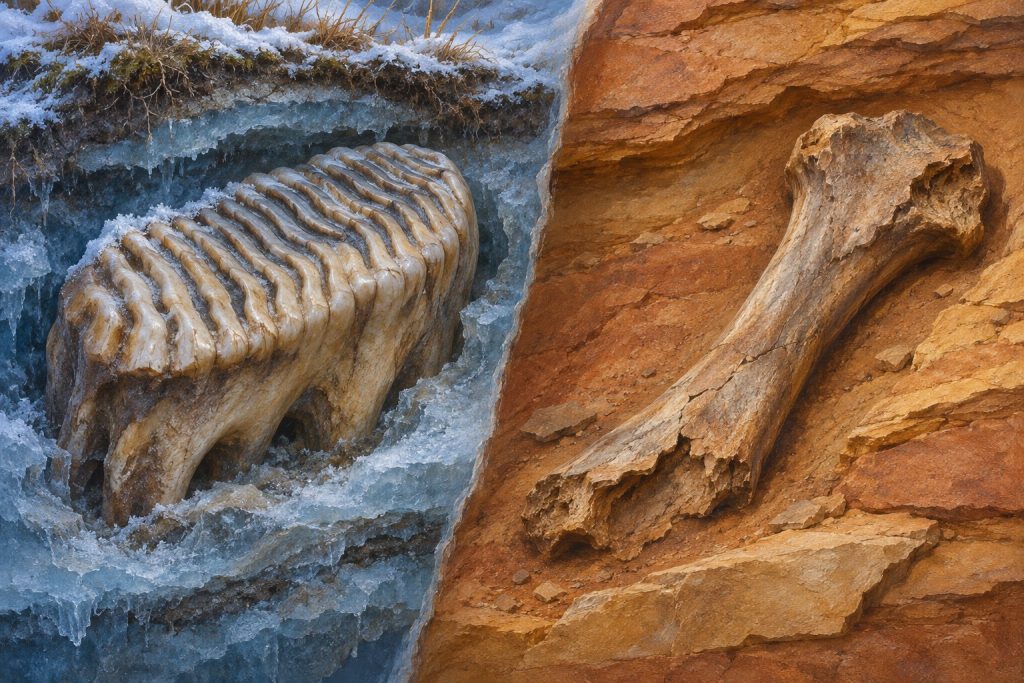
A frozen mammoth tooth can hold readable DNA. A dinosaur fossil can preserve the shape of a bone for far longer. Here’s why those are different feats.
THE QUESTION LIBRARY HOW WE KNOW
If 100 bacteria carry the same DNA change, did it arise once or many times? The answer matters when testing Ricardo Maldonado’s hypothesis.
You can’t tell from the count alone. All 100 bacteria could have inherited the change from one ancestor, or the same DNA change could have arisen independently in several families. It might have been present before the experiment began. Researchers estimate independent origins using evidence about ancestry, timing and DNA transfer, alongside the sequence itself.

Original AI-generated editorial illustration for God Plays Dice. The amber branch represents one imagined mutation inherited by several descendants. The tree illustrates a possible history and depicts no measured bacterial lineage.
WHERE THE EVIDENCE STANDS
WHAT WE DON’T KNOW YET
An endpoint count cannot resolve independent origins, losses or transfers. TMD’s predictive advantage on new, matched biological observations remains open.
WHAT WOULD CHANGE THIS ANSWER
Time-resolved, lineage-linked samples can narrow the plausible histories. An independent comparison of forecasts on suitable new data could change the assessment of TMD.
A scientist sequences 100 bacteria and finds the same changed DNA letter at the same position in all of them. One early mutation could account for every carrier. What would it take to tell that history apart from several independent origins?
Picture two histories that end with the same sample. In the first, one cell acquires a mutation early. It divides, its descendants divide, and eventually you pick 100 cells from that family. You would put one mark on the tree, on the branch that led to all 100.
In the second history, two cells on separate branches independently acquire the same DNA change. One family contributes 80 of the sampled cells and the other contributes 20. You still read the same changed letter 100 times. This time you would put two marks on the tree. Those numbers are an illustration. Both histories fit the final count.
The starting point matters, too. If the cell that founded the culture already carried the change, there could be zero new origins of it during your experiment. A family that dies out before sampling can also disappear from the record entirely.
For scientists studying resistance, that difference changes what a count of surviving cells can tell them. A large family of resistant cells may trace back to one early event.
In 1943, Salvador Luria and Max Delbrück grew separate bacterial cultures and tested them for resistance to a virus. Some cultures yielded many more resistant bacteria than others. An early mutation could give one resistant cell time to leave a large family before the virus arrived. A late mutation would have less time to leave descendants. The variation between cultures supported the explanation that resistance mutations arose before exposure to the virus. The researchers inferred that timing pattern from the counts across cultures. Read the original fluctuation experiment.
That experiment used resistance as the visible trait. Two bacteria can resist the same virus through different genetic changes. Even matching the exact DNA change in both would still leave the ancestry question open.
Earlier samples can show when a change first became detectable. Other shared DNA changes can help trace which cells are related. A change confined to one family fits inheritance from a common ancestor. The same change on separate branches whose ancestors lacked it can support independent origins, provided researchers also consider DNA transfer and measurement errors. In bacteria, existing DNA can move between cells. A cell can therefore acquire a change that already arose elsewhere. The original Avery–MacLeod–McCarty experiment demonstrated an inherited change after bacteria received DNA-containing material from other bacteria.
A detection time puts a limit on what you can say. A change found on Friday was present by Friday. It may already have been present on Thursday in a family too small to appear in Thursday’s sample. Identifying the DNA letter accurately and capturing the event that produced it are two different achievements.
Author’s hypothesis. Did a genetic route arise often, or did a rare change leave many descendants? Ricardo Maldonado’s Mutation by Natural Dominance (TMD) proposes a framework for predicting which genetic routes to an adaptation will take hold, and when, under specified conditions. A route is one genetic way to reach a trait. A route might arise often because many mutations can produce it. Another might arise rarely but spread readily once it occurs. The final abundance can reflect both how often a route arose and how its descendants grew. Explore the free Evolution & Mutation notebook.
A real example shows why the experimental design matters. Lind and colleagues studied three genetic routes to a wrinkled colony type in bacteria. In one part of the study, each strain retained only one of those three routes. Fluctuation tests estimated how often each route produced the trait. The study also tested a strain with all three routes intact. Each measurement has to be interpreted according to its design. Counts of mutants collected from the separate single-route strains cannot tell us which route appeared first in a population where all three were available. See the experiment and how the strains were constructed.
The public record includes early route forecasts, checks on analysis software and studies using computer-generated results. Those studies examine how conclusions change when laboratory controls give an imperfect guide to how often different routes are recovered and measured in biological samples.
The later GitHub work on ancestry focuses on the distinction this article began with: an original mutation and the copies inherited by its descendants.
Whether TMD adds predictive value remains an Open question. A meaningful test would compare forecasts made in advance with competing forecasts based on how often mutations arise and how well their carriers survive and reproduce. It would use independent populations and the same definition of success for both. If the forecast concerns the first route to establish a lasting lineage, a tally of cells at the end cannot settle it. The project status page describes the biological comparison still needed.
When a mutation is described as “found 100 times,” ask does that mean 100 cells, 100 separate cultures, or 100 independently traced origins? Those counts answer different questions. Knowing which one you have is the first step toward judging the evolutionary explanation.
Related reading: Would evolution repeat itself? and How do fitness and luck shape evolution?.
Why Can We Read Mammoth DNA but Not Dinosaur DNA?
Cold ground can slow DNA’s breakdown enough for short fragments to survive.
God Plays Dice answers big questions in plain words, with sources and one of six honest labels.
See a mistake? Report a problem. Corrections are made openly.
CONTINUE THE THREAD
How We KnowAnswer
A frozen mammoth tooth can hold readable DNA. A dinosaur fossil can preserve the shape of a bone for far longer. Here’s why those are different feats.
How We KnowAnswer
A space image can be faithful to measured light without matching human eyesight. Here is how to read the translation.
How We KnowAnswer
Why anecdotes feel convincing, what individual cases can show, and how to assess a confident judgment.
The Architect AI companion · All Access
Labels describe the evidence for a claim, not the people who hold it.
Match my phone uses your device’s light or dark setting.