Several serious ideas in physics allow other universes, so here is what each one says, how scientists have tried to test them, and how a scientific braneworld differs from the multiverse in the movies.
God Plays Dice Editorial · independently fact-checked · corrections welcomeChecked Sep 30, 20269 min read
THE SHORT ANSWER
Nobody knows yet. Several serious ideas in physics allow other universes: regions of space far beyond what we can see, bubble universes from cosmic inflation, the many worlds of one reading of quantum physics, and sheet-like universes in extra dimensions. None has been observed. A 2011 search of the Big Bang’s afterglow for scars from other bubble universes found no evidence for them. Scientists still argue about whether most multiverse ideas can ever be tested.
Max Tegmark sorts parallel-universe ideas into four levels, from far-off parts of our own space to universes with entirely different laws.
In eternal inflation, fast expansion never stops everywhere, leaving pocket universes; the Stanford Encyclopedia says accounts of this rely on speculative physics.
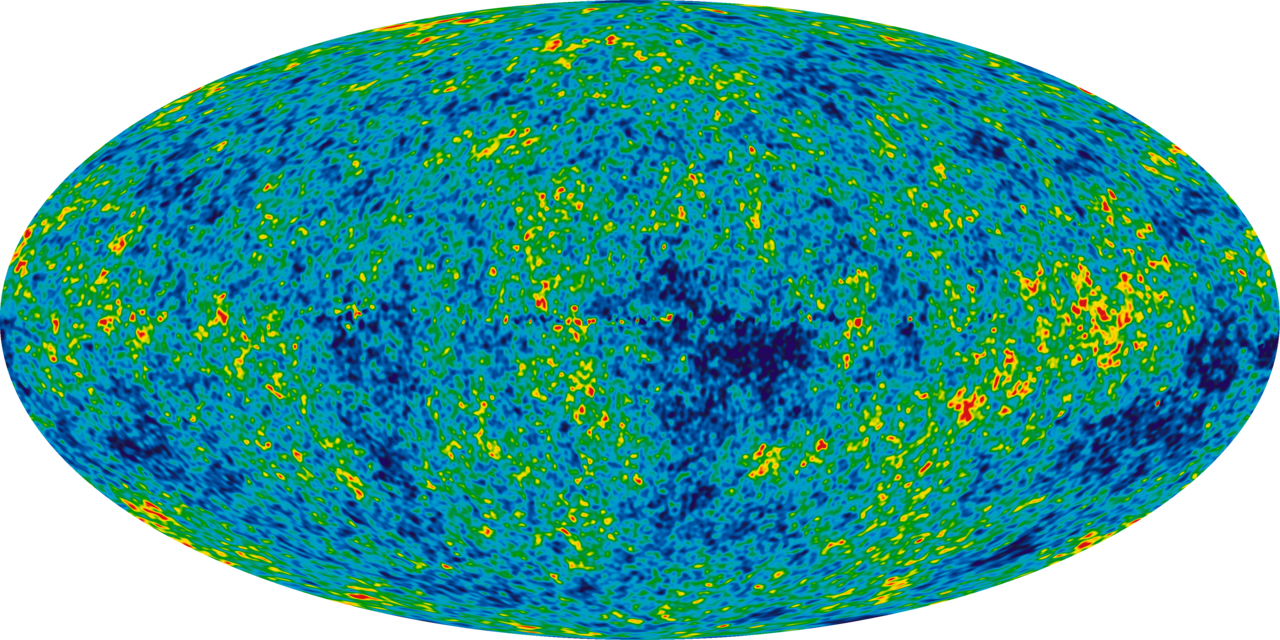
A 2011 search of WMAP satellite data for marks of collisions with other bubble universes found no evidence for them.
The many-worlds reading of quantum physics says every outcome of a quantum event happens, each in its own world, but a decisive test is beyond today’s technology.
In a braneworld model, our universe is a 3D sheet in a larger space; no such model has been shown to be real by experiment.
About this picture
The whole sky in microwaves, from nine years of NASA WMAP data. The colors show tiny temperature differences in the Big Bang’s afterglow. A 2011 study searched earlier WMAP data for round scars from other bubble universes and found no evidence for them.
NASA / WMAP Science Team, via Wikimedia Commons · Public domain · Image source ↗
WHERE THE EVIDENCE STANDS
How sure are we?
Space goes on far beyond the part of the universe we can see.Max Tegmark calls this first level “uncontroversial” in the standard picture of cosmology. Whether space is infinite, or finite but huge, is still unknown; see our answer on whether the universe is infinite.
Cosmic inflation creates many bubble universes with different laws or constants.Many cosmologists argue for eternal inflation, but the Stanford Encyclopedia’s cosmology entry notes that not all inflation models lead to it and that different constants in each bubble is an assumption not yet backed by a well-tested theory.
Scientists have found marks of a collision with another universe.Feeney and colleagues (Physical Review Letters, 2011) searched WMAP data and found that the data do not call for bubble collisions, limiting the average number of detectable collisions on the whole sky to fewer than 1.6 (at 68% confidence).
Every quantum event splits the world into many real worlds.This is the many-worlds interpretation. The Stanford Encyclopedia says a decisive test would need interference involving a large, everyday-sized object, which today’s technology cannot do.
Our universe is a brane floating in a higher-dimensional space.Randall and Sundrum (1999) showed that such a model can still give ordinary gravity. CERN describes how collider experiments could test for extra dimensions and writes of them conditionally (“if extra dimensions exist”); the GOD PLAYS DICE book also notes that no braneworld model has been established by experiment.
Nobody knows whether any other universe exists, or whether space goes on forever. Nobody knows how to count probabilities across an infinite multiverse, which some physicists see as the key barrier to testing it. Whether the many worlds of quantum physics are real is still debated.
WHAT WOULD CHANGE THIS ANSWER
A clear, repeatable mark in the Big Bang’s afterglow that only a collision with another bubble universe could explain would change this answer. So would collider evidence for extra dimensions. Evidence for a physical process that collapses quantum possibilities into one outcome would count against many worlds.
Nobody knows yet. Other universes have never been observed. But this is not only a movie idea. Several serious theories in physics allow other universes, and some scientists think one or more of them may be real. Others doubt the idea can ever be tested.
People ask for many reasons. Movies and TV shows have made the multiverse familiar. Some readers want to know if there is another version of them somewhere. Others have heard that many universes could explain why our universe seems fine-tuned for life. And some simply wonder whether everything we see is all there is.
It helps to know that “other universes” means different things to different scientists. Max Tegmark sorts the ideas into four levels.
Far-off space. If space goes on far enough, there are regions so distant that their light has not had time to reach us. Some call these other universes, though they share our laws.
Bubble universes. In one version of cosmic inflation, a burst of very fast expansion at the start, the expansion never stops everywhere. It keeps making new “pocket” universes, which might have different constants of nature.
Many worlds. In one reading of quantum physics, every possible outcome of a quantum event happens, each in its own world.
Other mathematics. Tegmark’s boldest level imagines universes with entirely different laws of physics.
There is also the braneworld, a model in which our universe is like a thin sheet floating in a larger space with extra dimensions. It is a mathematical idea with possible tests, not a portal to a copy of Earth.
So the plain picture is this. Other universes are allowed by some serious theories. No evidence yet shows that any exist. And scientists still argue about whether most of these ideas can be tested.
THE LONG ANSWER
THE LONG ANSWER · ABOUT 7 MINUTES
You’ve read your 3 free long answers this month.
The short answer, how sure we are, what we don’t know, what would change our mind and every source stay free on every page, for everyone.
All Access members read the long answer: the evidence piece by piece, the strongest objections, and how to check it yourself.
Author’s hypothesis. Ricardo Maldonado, author of GOD PLAYS DICE, uses a braneworld-style picture as a possible stage for his idea. His HD-Blast idea asks whether the hot, dense start of our universe was the local aftermath of a short burst of energy in a larger space with more dimensions than we can see. No one has observed such an event, and the idea does not yet say what caused it. In Chapter 8, the book notes that in some braneworld pictures our universe is one brane among others. It sketches a brane collision as one of three broad kinds of possible event, and says none of the three is a completed model yet.
The book is careful about limits. It says extra dimensions and branes are serious mathematical research programs, but none has been shown to exist by experiment. HD-Blast does not claim that a higher-dimensional blast happened. To make the idea testable, the book fixes one clue: its benchmark curve says the slow hum of gravitational waves should bend, like a knee, at about one cycle per year. Its public status, as of 29 September 2026, is a frozen benchmark waiting for later independent pulsar-timing data. No test of the frozen curve against later, independent pulsar-timing data has been published. See What is the HD-Blast hypothesis?, the research notebook page and the test ledger.
A proposed collection of many universes. Different theories mean very different things by it.
Cosmic inflation
A proposed burst of extremely fast expansion in the universe’s first instant. Eternal inflation is a version in which it never stops everywhere.
Cosmic microwave background
The faint afterglow of the hot early universe, which fills the whole sky.
Many-worlds interpretation
A reading of quantum physics in which every possible outcome of a quantum event happens, each in its own world.
Brane
Short for membrane. In braneworld models, our universe is a thin sheet floating in a larger space called the bulk.
Sources & further reading
(10) · Checked Sep 30, 2026
Parallel Universes (Max Tegmark) ↗arXiv; in Science and Ultimate Reality, Cambridge University Press (2003)Abstract: four-level hierarchy of multiverses (Level I infinite ergodic universe from inflation, including an identical copy of you far away; Level II regions with different effective constants in chaotic inflation; Level III quantum branches; Level IV other mathematical structures with different fundamental equations); the key question is how many levels there are; Level I is “the uncontroversial cosmological concordance model”; severe measure problem for Levels II–IV. Book details from the arXiv journal-reference line.
Philosophy of Cosmology (Christopher Smeenk and George Ellis) ↗Stanford Encyclopedia of Philosophy (first published 26 September 2017)Section 4.3: many cosmologists argue for eternal inflation (pocket universes); supporters say the multiverse should be accepted as an inevitable consequence of an established theory; EI not inevitable (not all models, arguably including those favored by CMB data) and relies on speculative physics; Guth (2007) quote; variation of constants between pockets is “just an assumption” not yet justified by a well-tested theory; measure problem; if everything happens, any potential observation is compatible; bubble-collision traces not generically predicted and early collisions erased; Weinberg’s (1987) prediction for Lambda as the most widely cited evidence, which some advocates call the most compelling, with rival explanations (Wang, Zhu and Unruh 2017); unease about multiverse proposals.
First Observational Tests of Eternal Inflation ↗Physical Review Letters 107, 071301 (2011), S. M. Feeney, M. C. Johnson, D. J. Mortlock and H. V. PeirisAbstract (arXiv 1012.1995): WMAP 7-year data do not warrant adding bubble collisions; average number of detectable collisions on the full sky below 1.6 at 68% confidence; Planck data can test the hypothesis more definitively. Journal details from Crossref.
Many-Worlds Interpretation of Quantum Mechanics (Lev Vaidman) ↗Stanford Encyclopedia of Philosophy (substantive revision 17 June 2026)Everett (1957); all outcomes obtained, each in a different world; many versions of the same person in different worlds; the primary reason for adoption is avoiding collapse; lets nature avoid “playing dice”; decisive test needs interference of a macroscopic body, impossible with today’s technology; burden of proof argued to lie with opponents; collapse models tested, some but not all ruled out; realistic experiments cannot distinguish MWI from Bohmian mechanics (Wallace 2023, Vaidman 2024).
An Alternative to Compactification ↗Physical Review Letters 83, 4690–4693 (1999), L. Randall and R. SundrumAbstract (arXiv hep-th/9906064): a single 3-brane embedded in five dimensions reproduces four-dimensional Newtonian and general relativistic gravity.
The Ekpyrotic Universe: Colliding Branes and the Origin of the Hot Big Bang ↗Physical Review D 64, 123522 (2001), J. Khoury, B. A. Ovrut, P. J. Steinhardt and N. TurokAbstract (arXiv hep-th/0103239): hot big bang from the collision of a brane in the bulk with a bounding orbifold plane; distinguishing prediction: a strongly blue gravitational-wave spectrum.
Extra dimensions, gravitons, and tiny black holes ↗CERNHow the LHC could test for extra dimensions: Kaluza-Klein states (heavier versions of known particles), gravitons escaping as missing energy, microscopic black holes.
Scientific method: Defend the integrity of physics ↗Nature 516: 321–323 (16 December 2014), G. Ellis and J. SilkStandfirst: attempts to exempt speculative theories of the Universe from experimental verification undermine science, argue George Ellis and Joe Silk. Volume, pages and 16 December 2014 date from the article metadata. Only the standfirst and author lines were readable without a subscription, so the page paraphrases the standfirst and nothing more.
Fine-Tuning (Simon Friederich) ↗Stanford Encyclopedia of Philosophy (substantive revision 26 February 2026)Many regard the multiverse as the main alternative to the designer hypothesis; Hacking’s inverse gambler’s fallacy charge (1987); multiverse scenarios extremely difficult to test.
GOD PLAYS DICE, Volume OneRicardo MaldonadoChapter 8, section 2: braneworld ideas became important in the late 1990s; extra dimensions and branes are mathematically serious research programs but none has been experimentally established; the book proposes an event class in the bulk and does not identify a unique culprit. Section 5: three broad classes of offstage events; 5.1 “In some braneworld pictures, our universe is one brane among others”; the three scenes are mechanism classes, not completed models. Status wording from the Research Notebook page /research/hd-blast/ (status reviewed 29 September 2026).
Many physicists say life depends on a few numbers of nature falling in narrow ranges, so here is what that means, why 137 is famous, and how design, many universes and luck each try to explain it.
Cosmic expansion means distances between faraway galaxies grow; it does not require a wall, an edge, or a room beyond space.
Established7 min read
THE OCCASIONAL LETTER
Stay curious.
New stories, book updates, and notes from God Plays Dice, delivered when there is something worth sharing.
EMAIL UPDATES ↗
500 DIGITAL COPIES • GIVEAWAY PREVIEW
Be first to know when the 500-copy reader giveaway opens.
Join for the book launch, verified retailer links, and the announcement for a planned giveaway of 500 digital copies. The giveaway is not open yet: dates, eligibility, a dedicated entry form, and Official Rules will be published first.
Privacy · Check your inbox to confirm your subscription. Newsletter signup alone is not a giveaway entry.