What is sleep paralysis, and why do people sometimes sense a presence in the dark?
Waking up unable to move while sensing someone in the room is frightening, common and well studied; here is what happens in the brain, why the presence feels so real, and what can help.
God Plays Dice Editorial · independently fact-checked · corrections welcomeChecked Sep 28, 20269 min read
THE SHORT ANSWER
Sleep paralysis is a short spell, while falling asleep or waking up, when your mind is awake but your body cannot move. It happens because the stillness of dreaming sleep lingers for a moment. About 7.6% of people in the general population have had at least one episode. Many sense a presence, feel pressure on the chest, or see a figure. Scientists can even make healthy people feel a presence in the lab. The experience is real and can be scary, but the NHS calls it harmless.
A 2011 review of 35 studies found that 7.6% of the general population, 28.3% of students and 31.9% of psychiatric patients had had at least one episode.
During REM sleep the muscles normally stay still; in sleep paralysis the mind wakes up before the body does.
A sensed presence, fear, strange sounds or shapes, and chest pressure often come together, and such accounts are strikingly similar across time and cultures.
In the lab, stimulating one brain spot in a patient, and a robot that scrambled body signals in healthy volunteers, produced the feeling that someone was nearby.
When it is hard to see, as at night, people tend to judge that others are looking at them.
About this picture
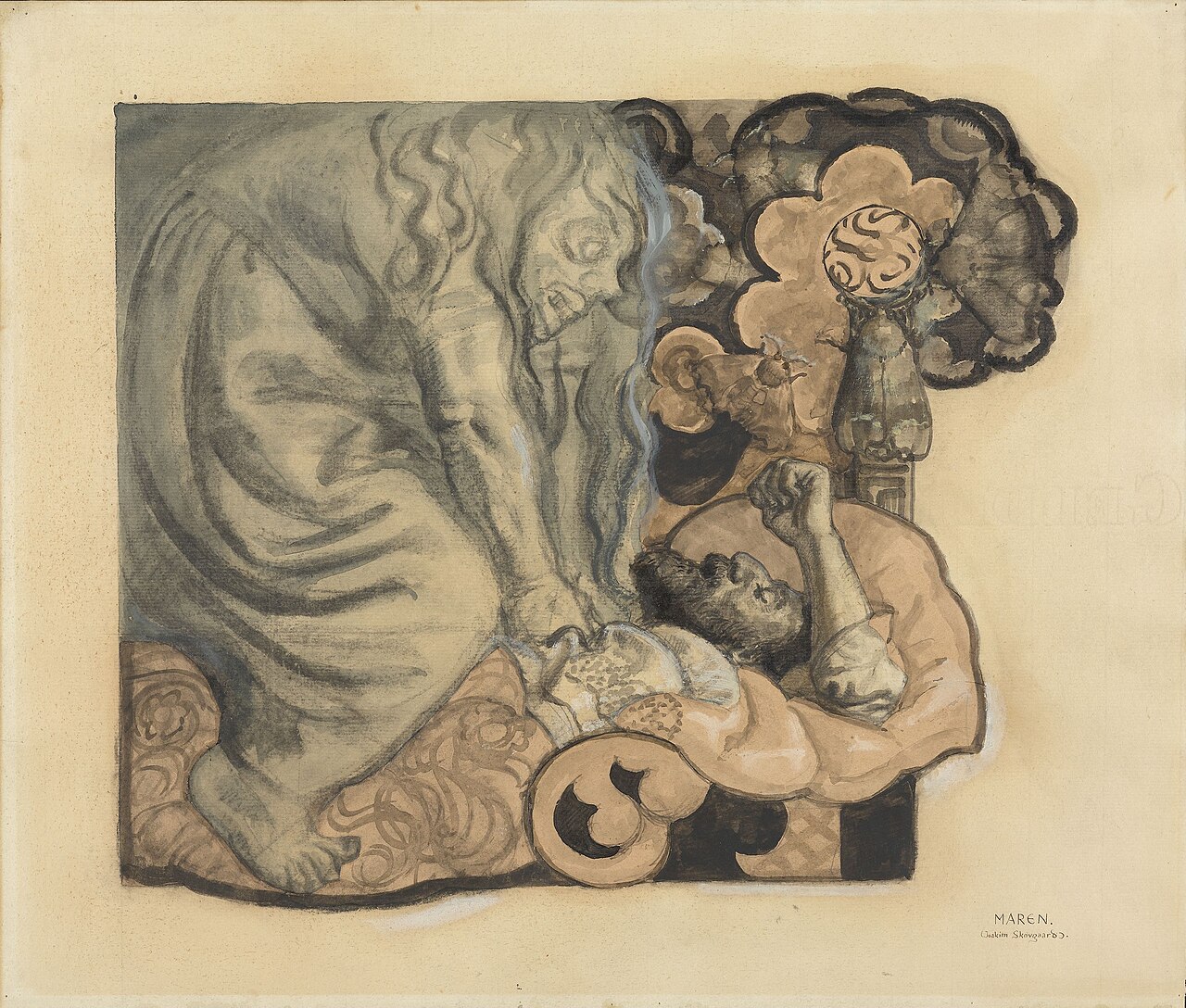
Maren (The Mare), drawn by Joakim Skovgaard around 1890. Sweden’s Institute for Language and Folklore notes that old accounts of the mare describe sleepers who struggled to breathe, felt as if someone sat on their chest, and could not move or call for help; today this is called sleep paralysis.
Joakim Skovgaard, Maren (about 1890–1893); photo: Nasjonalmuseet, via the Institute for Language and Folklore (Sweden) and Wikimedia Commons · CC BY 4.0 · Image source ↗
WHERE THE EVIDENCE STANDS
How sure are we?
Sleep paralysis happens when the mind wakes while the body is still in REM sleep mode.MedlinePlus (U.S. National Library of Medicine) describes waking from REM with the body still unable to move; Sharpless and Barber (2011) note that sleep studies trace episodes to REM activity carrying over into the shift between sleep and waking.
Sensing a presence or seeing an intruder is a common part of sleep paralysis.Cheyne and colleagues (1999) found an “Intruder” cluster of sensed presence, fear and hallucinations across several large samples; Hinton and colleagues (2005) found that 91% of Cambodian refugee patients with sleep paralysis saw an approaching being.
A healthy brain can create the feeling that someone is nearby when no one is.Arzy and colleagues (2006) induced a “shadow person” by stimulating the brain of an epilepsy patient; Blanke and colleagues (2014) induced the feeling in healthy volunteers with a robot that scrambled body signals.
We know why some people have sleep paralysis often and others rarely or never.MedlinePlus says the exact cause is not fully known, though it is linked to lack of sleep, irregular schedules, stress, sleeping on the back and some conditions; Jalal and Hinton (2013) found higher rates in Egypt (44%) than in Denmark (25%).
People can sense an unseen stare from behind.Colwell and colleagues (2000) found above-chance guessing only with feedback on sequences that were not truly random, and none with truly random ones. On the other side, Utts (1995) reported two SAIC experiments in which skin response was higher while a distant observer watched the person on a monitor; she wrote that the result raises substantially more questions than it answers.
Nobody knows exactly why some people have sleep paralysis often and others never do, or why rates differ so much between countries. Why the half-awake mind so often adds a threatening intruder is also still being studied.
WHAT WOULD CHANGE THIS ANSWER
If a figure seen during sleep paralysis ever showed up on a camera, or passed on a fact the sleeper could not have known that was checked later, that would call for a new explanation. So far, the studies point to the sleeping brain.
You wake up in the dark. You are fully aware, but you cannot move or speak. Then you feel it: someone is in the room. Maybe a weight presses on your chest. Soon it is over, and your heart is pounding. If this has happened to you, you are far from alone, and there is a name for it.
It is called sleep paralysis. It happens as you fall asleep or wake up. Your mind is awake, but your body is still in the mode of REM sleep, the stage of sleep when vivid dreams are most common. During REM sleep, your muscles normally don’t move. MedlinePlus, from the U.S. National Library of Medicine, says an episode lasts from a few seconds to a minute or two; Britain’s National Health Service (NHS) says the feelings can last up to several minutes. A 2011 review of 35 studies found that about 7.6% of people in the general population have had at least one.
The sense of a presence is one of its common features. A research team at the University of Waterloo in Canada found that a sensed presence, fear, and strange sounds or shapes tend to come together, as do chest pressure and trouble breathing. The team noted that such accounts are remarkably similar across time and cultures. People have explained them as witchcraft, evil spirits and even aliens. In one Cairo study, nearly half (48%) of people from the general population with sleep paralysis blamed the jinn, spirit-like beings from Islamic tradition.
Why would a waking brain feel someone who is not there? In the lab, they have made healthy people feel a presence by scrambling the brain’s signals about the person’s own body. When it is hard to see, people also tend to assume that others are looking at them. Darkness itself makes us jumpier.
Sleep paralysis is real, common and well studied. The NHS calls it harmless, though it can be scary. The presence feels real because the experience is real. The evidence points to the half-awake brain as its source. We label this Established.
THE LONG ANSWER
THE LONG ANSWER · ABOUT 7 MINUTES
You’ve read your 3 free long answers this month.
The short answer, how sure we are, what we don’t know, what would change our mind and every source stay free on every page, for everyone.
All Access members read the long answer: the evidence piece by piece, the strongest objections, and how to check it yourself.
A short spell while falling asleep or waking up when a person is aware but cannot move or speak.
REM sleep
Rapid eye movement sleep, the stage when the eyes move quickly and vivid dreams are most common. The body’s muscles normally stay still during it.
Hallucination
Seeing, hearing or feeling something that is not there. In sleep paralysis these are often dream-like images mixed with the real room.
Sensed presence
The strong feeling that someone is nearby when no one can be seen.
Startle reflex
The automatic jump or blink when a sudden loud sound or surprise hits.
Sources & further reading
(10) · Checked Sep 28, 2026
Sleep paralysis ↗NHS (National Health Service, UK)“It can be scary but it’s harmless”; feeling someone is in the room or something pushing you down; can last up to several minutes; links to insomnia, disrupted sleep, narcolepsy, PTSD, anxiety, panic disorder, family history; prevention tips (7 to 9 hours, regular times, exercise not in the last hour, no big meal, smoking, alcohol or caffeine before bed, not sleeping on the back); see a GP if frequent with anxiety about sleep or constant tiredness; treatments include low-dose antidepressant medicine and CBT. Page last reviewed 9 September 2026.
Sleep paralysis ↗MedlinePlus, U.S. National Library of MedicineDuring REM sleep the muscles don’t move; waking suddenly from REM leaves the body in REM mode; episodes last from a few seconds to 1 or 2 minutes and end on their own or when touched or moved; exact cause not fully known; links to lack of sleep, irregular schedule, stress, sleeping on the back, narcolepsy, PTSD, panic disorder; sleep paralysis can be a sign of narcolepsy; “in rare cases” dream-like sensations or hallucinations. Review date 4/10/2025.
Lifetime prevalence rates of sleep paralysis: a systematic review (Sharpless and Barber) ↗Sleep Medicine Reviews (2011)35 studies, N = 36,533: 7.6% general population, 28.3% students, 31.9% psychiatric patients. Full text (PMC3156892): muscles inhibited while eye movements, breathing and awareness remain; more likely sleeping supine; cultural explanations from witchcraft and malevolent spirits to extraterrestrials; genesis in REM activity carrying into sleep transitions; fear in 90% of a student sample and 98% of a web sample (Cheyne et al.); common themes include levitation, seeing one’s own body and malevolent intruders.
Explanations of sleep paralysis among Egyptian college students and the general population in Egypt and Denmark (Jalal, Simons-Rudolph, Jalal and Hinton) ↗Transcultural Psychiatry (2014)48% of the general Egyptian (Cairo) sample attributed their sleep paralysis to the Jinn; American University in Cairo students less likely, Denmark least likely to give supernatural causes. Companion study, Jalal and Hinton, Culture, Medicine and Psychiatry (2013, https://doi.org/10.1007/s11013-013-9327-x): lifetime rates 25% (56/223) in Denmark vs 44% (207/470) in Egypt; mean lifetime episodes 6.0 vs 19.4; in Egypt, supernatural beliefs associated with fear and longer immobility.
Neurological and robot-controlled induction of an apparition (Blanke et al.) ↗Current Biology (2014)Robot-generated sensorimotor conflicts induced the feeling of a presence in healthy participants; the illusion is caused by misperceiving the source and identity of signals from one’s own body; authors at EPFL, Lausanne, Switzerland. Earlier: Arzy et al., “Induction of an illusory shadow person,” Nature (2006, https://doi.org/10.1038/443287a): stimulation of the left temporoparietal junction in a patient undergoing presurgical epilepsy evaluation produced an illusory person who closely “shadowed” the patient’s body position and posture.
The ability to detect unseen staring: a literature review and empirical tests (Colwell, Schröder and Sladen) ↗British Journal of Psychology (2000)Above-chance accuracy on staring trials only with feedback on non-random sequences, explained as implicit learning; no difference from chance with genuinely random sequences. Other side: Utts, An Assessment of the Evidence for Psychic Functioning (1995, https://ics.uci.edu/~jutts/air.pdf), Appendix 2, Experiment 7 (Remote Observation): observee filmed with galvanic skin response recorded; a distant observer, seeing the observee on a monitor during 16 random 30-second “influence” periods, tried to influence their physiology; greater activity during watched than control periods in both experiments (combined effect size .39); it “raises substantially more questions than it answers, since the mechanism for the shift in physiology is unknown.”
What evidence exists for Bigfoot and the Loch Ness monster? Examine tested hairs, the Loch Ness DNA survey, detection limits and what a verified discovery would require.
Can animals sense earthquakes or storms? Separate early-wave detection and observed storm avoidance from reliable prediction, with evidence and limits.
Supported, still debated3 min read
THE OCCASIONAL LETTER
Stay curious.
New stories, book updates, and notes from God Plays Dice, delivered when there is something worth sharing.
EMAIL UPDATES ↗
500 DIGITAL COPIES • GIVEAWAY PREVIEW
Be first to know when the 500-copy reader giveaway opens.
Join for the book launch, verified retailer links, and the announcement for a planned giveaway of 500 digital copies. The giveaway is not open yet: dates, eligibility, a dedicated entry form, and Official Rules will be published first.
Privacy · Check your inbox to confirm your subscription. Newsletter signup alone is not a giveaway entry.