The UniverseAnswer
Can a Planet Orbit Two Stars?
Two stars can circle each other while a planet travels around them both. Astronomers confirmed it by watching the moving stars dim.
THE QUESTION LIBRARY THE UNIVERSE
An extra coordinate in a model needs an experimental case before it becomes a discovery.
An extra spatial dimension would add an independent coordinate to locate a position. Some models hide extra directions by making them small or limiting how ordinary matter can move. These are proposed explanations, not discoveries. Experiments can test specific versions; mathematics alone does not show that nature has an extra dimension, or explain uniquely why three are large.
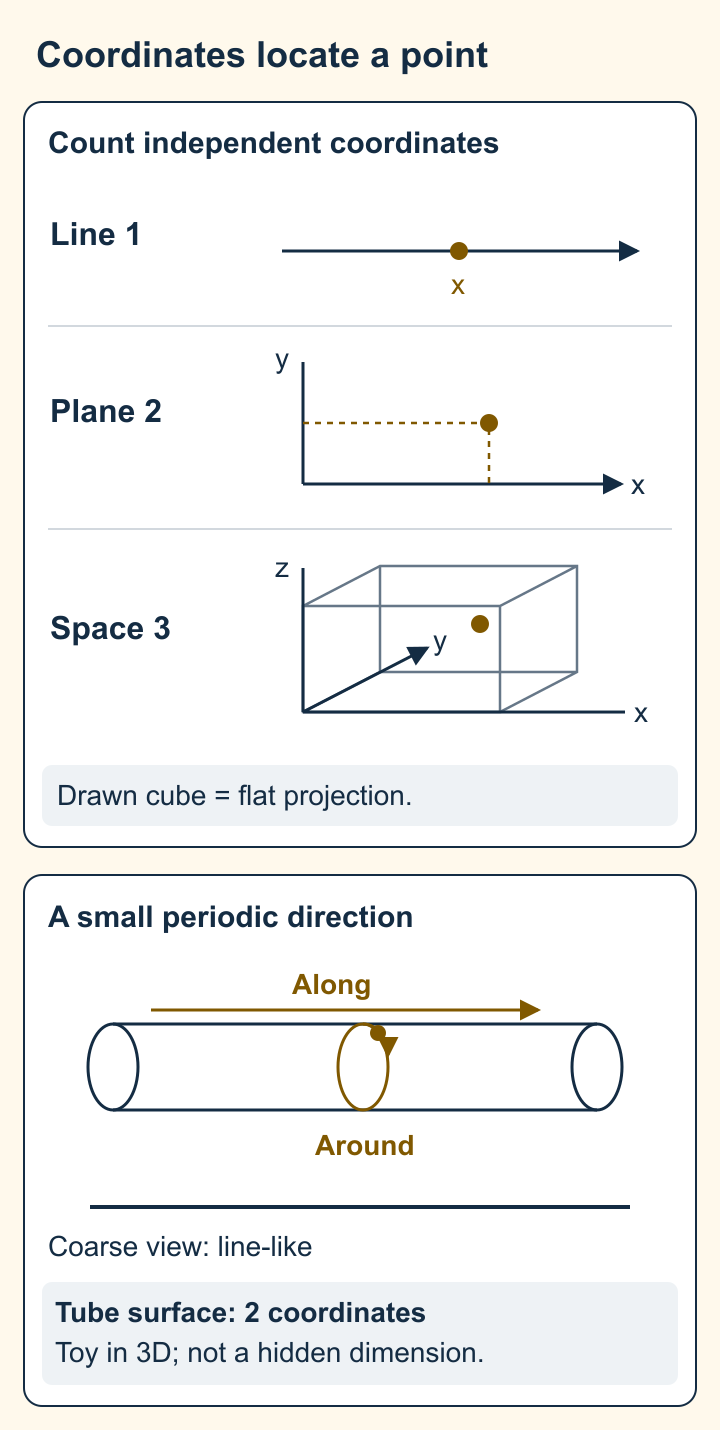
Original explanatory diagram, created with AI assistance. Dimensions count coordinates. A tube surface in familiar 3D illustrates a small periodic direction; it does not depict a hidden dimension.
WHERE THE EVIDENCE STANDS
WHAT WE DON’T KNOW YET
Whether additional spatial dimensions exist, their geometry and size if they do, and which fields could move through them remain unresolved. A complete model must explain its observable behavior and agree with existing measurements.
WHAT WOULD CHANGE THIS ANSWER
A repeatable signal with predictions that distinguish a specific extra-dimensional model from ordinary physics and competing explanations would change the evidence. Several measurements agreeing on the same model would be stronger than an isolated missing-momentum event or an attractive geometric picture.
An extra spatial dimension would add an independent direction for locating positions.
The relativity account of space-time also includes time: an event needs a where and a when. Time has a different causal role from the spatial directions. Calling space-time four-dimensional is not evidence for a fourth direction in space that we could step into.
Why study extra space directions? Certain proposals use them to address puzzles about gravity or the consistency of quantum theories. Some make the extra directions small; others restrict ordinary matter's motion. These are conditional ideas to investigate, rather than an extra direction already measured.
A good test starts with a specific prediction: which measurement should change, by how much, and under which assumptions? A 2020 gravity experiment and a 2021 CMS particle search provide real examples. Neither study establishes an extra dimension. Their results constrain particular proposals; they do not settle every possible extra-dimensional geometry.
Free long answer 2 of 3 this month.
A line uses one coordinate, a plane two, and familiar space three. Einstein Online's glossary explains this coordinate meaning.
The count is local. Curvature does not increase a surface’s dimension. A drawn cube is a projection, not another physical direction.
Compactification can make a coordinate periodic: going around it returns you to the starting position. David Tong's string-theory lectures describe a circular example. Low-energy physics may not excite motion around that small circle.
Another possibility concerns what can move there. Arkani-Hamed, Dimopoulos and Dvali's 1998 proposal lets gravity propagate through extra directions while ordinary fields are confined at accessible low energies. This is a feature of that model. Smallness and confinement are different mechanisms, and a model can use both.
For a scale analogy, consider a tube's surface. A coarse view may show little more than a line. Close up, positions on its surface have an along coordinate and an around coordinate. CERN uses a related cable analogy. This illustrates limited resolution, not a discovered dimension. The tube itself sits in familiar three-dimensional space; its surface has two dimensions. It is not a picture of our universe.
Conventional critical superstring constructions require ten space-time dimensions: nine spatial and time. Tong explains the assumptions behind this result. Other constructions need separate treatment.
The 1998 extra-dimension proposal asks why gravity's characteristic scale is so different from the scale of particle interactions. It offers a possible account using additional space directions. A proposal's ability to address a puzzle motivates a test. It does not mean its additional directions have been observed.
For the broader search, read the theory-of-everything answer. It covers routes beyond extra dimensions.
In some models, gravity changes behavior at distances related to an extra direction's size. Lee and colleagues' 2020 torsion-balance study tested the familiar inverse-square law at separations down to 52 micrometers. Their measurements agreed with Newtonian gravity.
That smallest separation is an apparatus scale, not a universal bound on every extra dimension. Translating the data into a size limit requires a chosen geometry and force model. The paper gives specific interpretations, including a toroidal case. A different model can predict different effects, or effects outside that experiment's reach.
A future deviation would also need checks for experimental error and competing physics. An unexpected force would be a finding to explain, rather than an automatic photograph of another direction.
The CMS study published in 2021 examined energetic jets and missing transverse momentum: momentum not accounted for perpendicular to the proton beams. Its data showed no significant excess over expected Standard Model backgrounds. The authors translated that result into limits on specified extra-dimensional models.
Missing momentum does not identify its cause by itself. Known neutrinos can escape detection; other hypothetical particles could produce similar clues. The number of extra directions, the assumed gravity scale and the signal calculation affect a model's predicted event pattern and its resulting limits.
Nor must every useful test take place in a laboratory. A 2001 analysis of Supernova 1987A examined whether extra-dimensional gravitational modes would carry energy away in a way inconsistent with the neutrino observations. Its bounds rely on the supernova calculation and on which modes the model permits. The authors explicitly restrict their result to particular flat or weakly warped cases.
Mathematics describes spaces with different numbers of dimensions. That ability does not select which space describes nature. The Einstein Online discussion separates familiar space from space-time and mathematical generalizations. The inference here is simple: allowing a number in the mathematics is not a measurement of that number.
A model’s consistency requirements do not automatically explain why three space directions are large. Compactified geometry and physical state also matter. Counting dimensions is not an explanation of our observed three.
Changing a coordinate system also leaves the physical space intact. An extra axis labeled temperature or age on a graph describes another quantity; it does not supply another direction in which an object can move.
Ask which proposal was tested. Then separate what the apparatus measured from the model used to interpret it. Was there an unexpected signal, a better limit, or only a proposed test? A null result can eliminate particular settings without eliminating every version of an idea.
One concern is that researchers can make a proposal harder to test by moving its effects beyond the data. That is a fair concern. State the assumptions and predicted signals clearly, so a failed prediction cannot silently become a different success story. A useful scientific proposal earns its place through what it explains and risks getting wrong.
THREE THINGS TO REMEMBER
What is a theory of everything, and will we ever have one?
Nobody knows yet.
God Plays Dice answers big questions in plain words, with sources and one of six honest labels.
See a mistake? Report a problem. Corrections are made openly.
CONTINUE THE THREAD
The UniverseAnswer
Two stars can circle each other while a planet travels around them both. Astronomers confirmed it by watching the moving stars dim.
The UniverseAnswer
An everywhere-present field, a fleeting particle and a famous nickname. What did CERN’s experiments actually measure?
The UniverseAnswer
Why the matter surplus remains unexplained, what Sakharov's conditions require, and how sphalerons and proposed neutrino mechanisms might connect.
The Architect AI companion · All Access
Labels describe the evidence for a claim, not the people who hold it.
Match my phone uses your device’s light or dark setting.