
Life in the UniverseAnswer
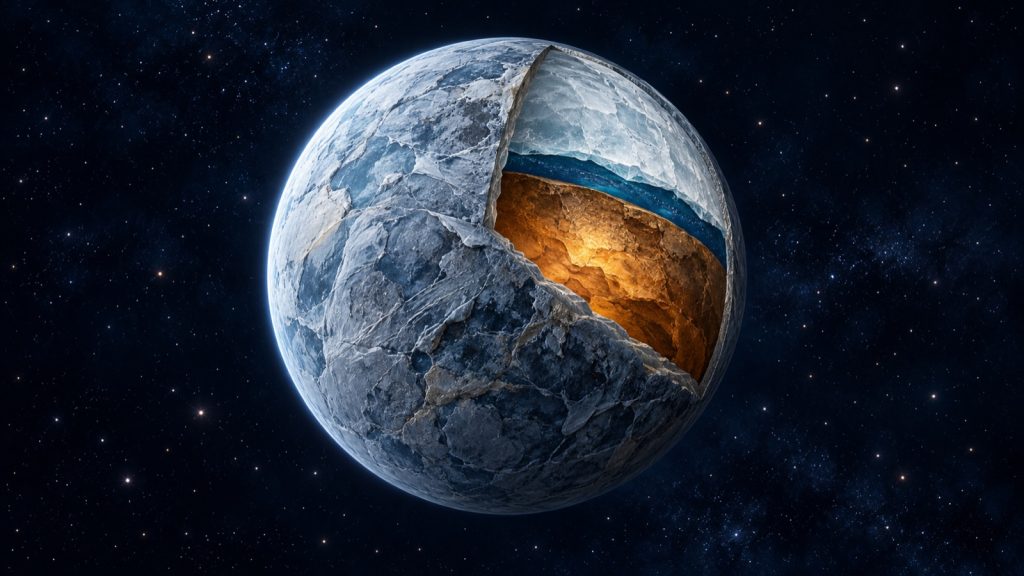
Could a planet without a star support life?
A world with no sunrise could still have internal heat. The question is whether it can keep water liquid and supply usable energy.
THE QUESTION LIBRARY LIFE IN THE UNIVERSE
Distant worlds can reveal themselves through changes in starlight and the motion of their stars.
Astronomers often find exoplanets by measuring a small, repeating dip in a star’s light when a planet crosses in front of it, or by detecting the star’s slight motion caused by a planet’s gravity. Follow-up observations help rule out other explanations. Finding a planet does not by itself show what its surface looks like or whether it hosts life.
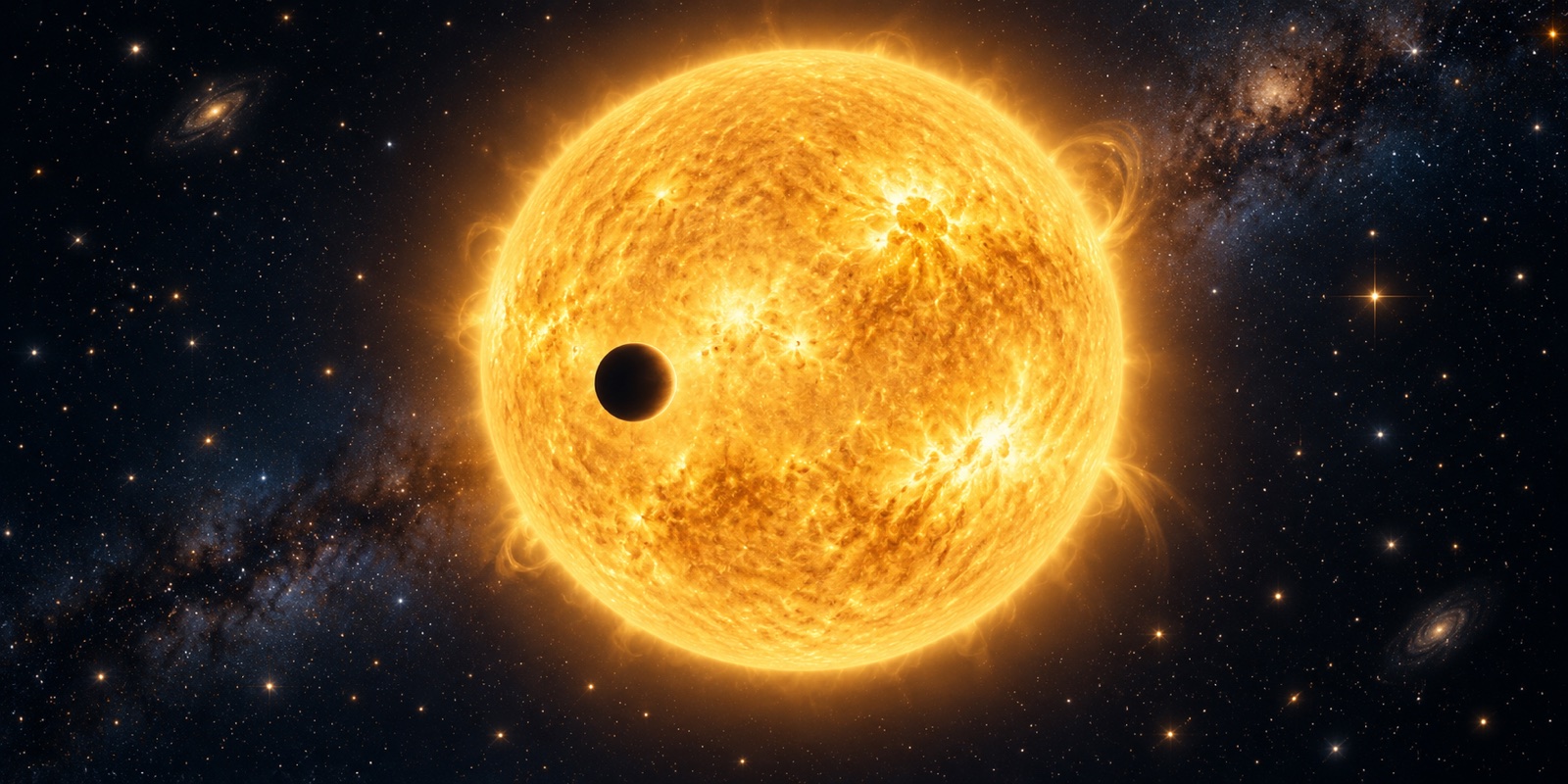
Original AI-generated conceptual illustration for God Plays Dice, October 2026. This is not a telescope photograph; the planet’s size, colors and stellar detail are illustrative.
WHERE THE EVIDENCE STANDS
WHAT WE DON’T KNOW YET
Many planets do not transit from our viewpoint. A detection alone does not establish a planet’s surface conditions, atmospheric composition or life.
WHAT WOULD CHANGE THIS ANSWER
Additional observations and independent methods can refine a candidate’s properties or show that a different source produced the signal.
A distant planet can be far too faint to pick out beside its star. Yet its presence can leave a measurable trace: a small, repeating dip in the star’s light, or a subtle wobble in the star’s motion. Those traces let astronomers discover worlds they cannot photograph in detail.
THE LONG ANSWER · ABOUT 4 MINUTES
The short answer, how sure we are, what we don’t know, what would change our mind and every source stay free on every page, for everyone.
All Access members read the long answer: the evidence piece by piece, the strongest objections, and how to check it yourself.
Join All Access · $1 a week Or $6 a month
Billed $52 once a year. Cancel anytime in your account.
Until December 4, 11:59 pm Pacific: the Founding rate is $39 a year, and it stays $39 while you stay a member.
Create a free account: 6 long answers a month, email only.
Paying never buys a different answer. Our Paywall Promise
God Plays Dice answers big questions in plain words, with sources and one of six honest labels.
See a mistake? Report a problem. Corrections are made openly.
CONTINUE THE THREAD
Life in the UniverseAnswer
A world with no sunrise could still have internal heat. The question is whether it can keep water liquid and supply usable energy.
Life in the UniverseAnswer
Identical twins develop from one fertilized egg and begin with almost the same DNA. Yet their conditions before birth, later environments and gene activity can differ. Shared DNA…
Life in the UniverseAnswer
Humans and chimpanzees inherited much of their DNA from a shared ancestor. Similar DNA can produce different bodies when some protein instructions and patterns of gene activity differ.…
The Architect AI companion · All Access
Labels describe the evidence for a claim, not the people who hold it.
Match my phone uses your device’s light or dark setting.