How We KnowAnswer
Mutation by Natural Dominance: One Mutation or a Hundred?
If 100 bacteria carry the same DNA change, did it arise once or many times? The answer matters when testing Ricardo Maldonado’s hypothesis.
THE QUESTION LIBRARY HOW WE KNOW
A frozen mammoth tooth can hold readable DNA. A dinosaur fossil can preserve the shape of a bone for far longer. Here’s why those are different feats.
Cold ground can slow DNA’s breakdown enough for short fragments to survive. Researchers read DNA from Siberian mammoth teeth more than a million years old. The last non-avian dinosaurs lived about 66 million years ago, and no DNA sequence from one has been reliably confirmed. A fossil can preserve the shape of a bone long after the genetic information inside it is gone.
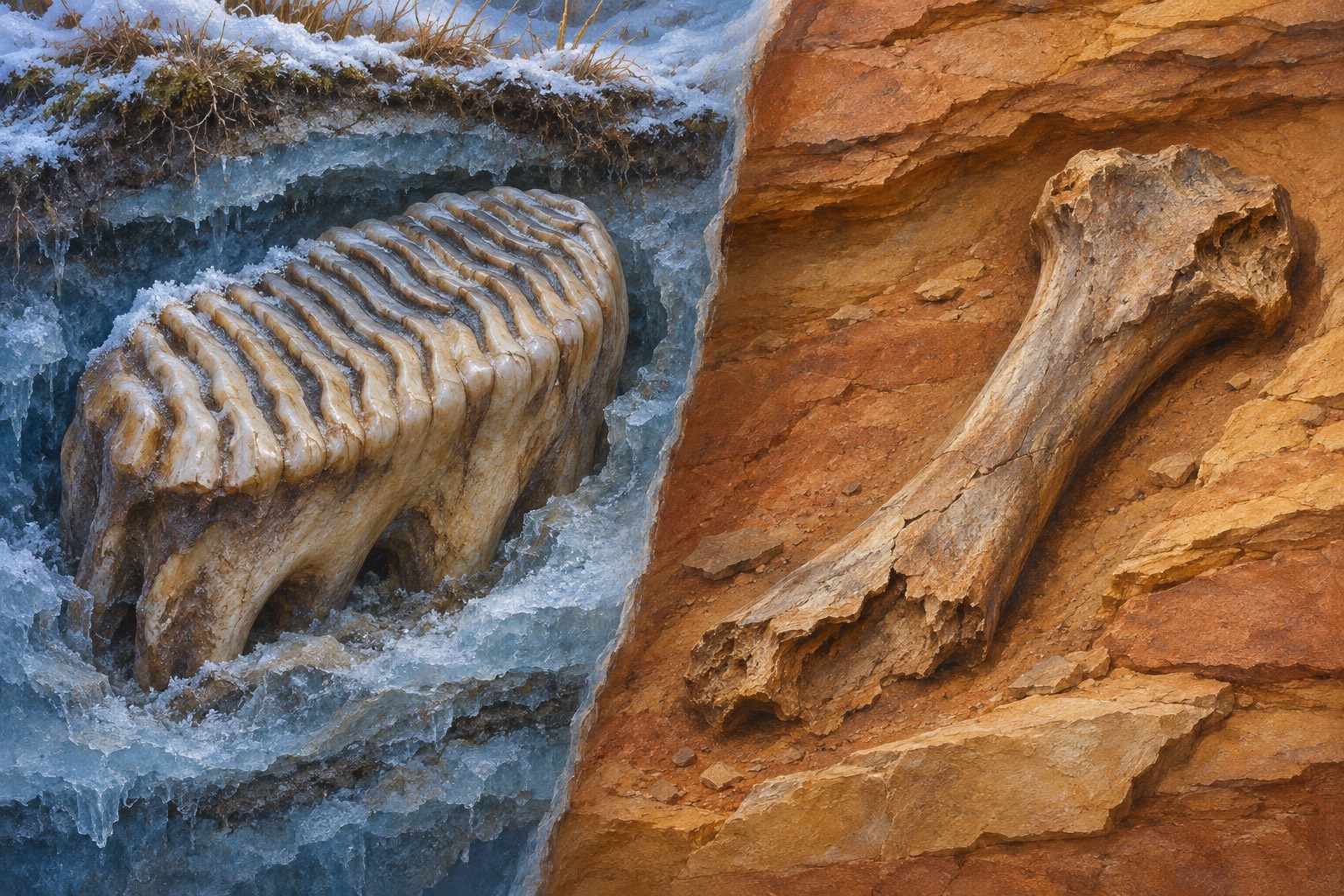
Original AI-generated illustration for God Plays Dice. It pairs a mammoth molar in frozen ground with a fossilized bone in rock. Neither side depicts an actual specimen.
WHERE THE EVIDENCE STANDS
WHAT WE DON’T KNOW YET
There is no universal age limit for readable DNA. Conditions, fragment length and the ability to rule out contamination all matter.
WHAT WOULD CHANGE THIS ANSWER
Independent laboratories recovering authentic, identifiable DNA from a securely dated non-avian dinosaur specimen would change the evidence.
A mammoth tooth can hold readable genetic letters after a million years. A dinosaur fossil can preserve the shape of a bone for tens of millions of years, long after its DNA has broken down. That’s because keeping a shape and keeping a sequence are two different things.
Free long answer 2 of 3 this month.
In 2021, a team studying three mammoth molars from Siberia recovered DNA from all three. Two of the specimens were more than a million years old. The cold of the permafrost helped slow the chemical reactions that damage DNA. Even there, the team had to work with short, damaged fragments.
Think of a shredded book. A long scrap can be matched to a likely spot in a reference copy. A scrap with only a few letters might fit almost anywhere. The researchers compared their DNA fragments with reference DNA from elephants and mammoths, filtered out reads too short to place reliably, and looked for patterns of chemical damage typical of ancient DNA. Those checks help separate real evidence from misleading matches or DNA left by modern microbes and people.
There’s no single expiration date. DNA strands break into shorter pieces, and their chemical letters can change. In a study of 158 moa bones from New Zealand, researchers estimated that, under the conditions they studied, the number of surviving copies of a particular 242-letter stretch of DNA fell by half roughly every 521 years. That figure describes one stretch in one set of bones; it doesn’t tell us when all DNA will disappear from any fossil.
The setting matters. In 2022, researchers reported roughly two-million-year-old DNA from sediment in northern Greenland. They recovered a mixture of fragments from plants and animals rather than the complete genome of one creature. The team found evidence that binding to minerals helped protect some of those fragments.
Minerals can fill spaces in a buried bone and preserve its shape and fine structure while DNA breaks apart. The youngest non-avian dinosaur remains are still about 66 million years old. Birds are living dinosaurs; here, “dinosaur DNA” means DNA from extinct non-avian dinosaurs such as T. rex.
In a 2026 study of a 115-million-year-old dinosaur bone, researchers reported chemical traces related to heme, a component of hemoglobin, and structures they interpreted as fossilized red blood cells. The study did not report a dinosaur DNA sequence. Even if that interpretation holds up, a preserved cell shape or a chemical trace doesn’t establish that readable DNA survived with it.
Finding DNA in a fossil sample would be the start. Researchers would have to show that it came from the dinosaur itself. A convincing result would include fragments long enough to place reliably, damage patterns consistent with their age, controls that rule out contamination and independent replication. DNA found in a bone can come from organisms that entered it after burial.
That’s the missing step in the familiar Jurassic Park idea: no confirmed non-avian dinosaur DNA has turned up in bone or amber. Better instruments can read smaller surviving pieces. They can’t recover a sequence from a specimen if the information that distinguished it has been destroyed.
How do scientists know how old rocks and fossils are?
Scientists combine the order of rock layers with natural atomic clocks that measure time in years.
God Plays Dice answers big questions in plain words, with sources and one of six honest labels.
See a mistake? Report a problem. Corrections are made openly.
CONTINUE THE THREAD
How We KnowAnswer
If 100 bacteria carry the same DNA change, did it arise once or many times? The answer matters when testing Ricardo Maldonado’s hypothesis.
How We KnowAnswer
A space image can be faithful to measured light without matching human eyesight. Here is how to read the translation.
How We KnowAnswer
Why anecdotes feel convincing, what individual cases can show, and how to assess a confident judgment.
The Architect AI companion · All Access
Labels describe the evidence for a claim, not the people who hold it.
Match my phone uses your device’s light or dark setting.