Evolution is established science; many faith traditions make room for it and some reject it, so here is what several of them say in their own words.
God Plays Dice Editorial · independently fact-checked · corrections welcomeChecked Sep 29, 20269 min read
THE SHORT ANSWER
Yes. Many people accept evolution and keep their faith. The Catholic Church, many Protestant churches and many Jewish and Muslim scholars teach that evolution and belief in a Creator can fit together. Other believers, often those who read their scripture literally, reject it. Evolution itself is established science, backed by fossils and DNA. Whether God stands behind it is a question science cannot answer, so we label it Beyond science.
In 1950, Pope Pius XII said the Church does not forbid research and discussion of evolution as an account of the human body, while holding that God creates each soul directly.
In 1996, Pope John Paul II said new knowledge had led to seeing evolution as “more than a hypothesis.”
More than 15,700 Christian clergy have signed a letter saying the Bible and modern science “may comfortably coexist.”
In a Pew experiment published in 2019, the share of U.S. adults who rejected evolution fell from 31% to 18% when the question let them say God guided or allowed it.
DNA shows that humans and chimpanzees share an ancestor that lived between 8 and 6 million years ago, the Smithsonian reports.
About this picture
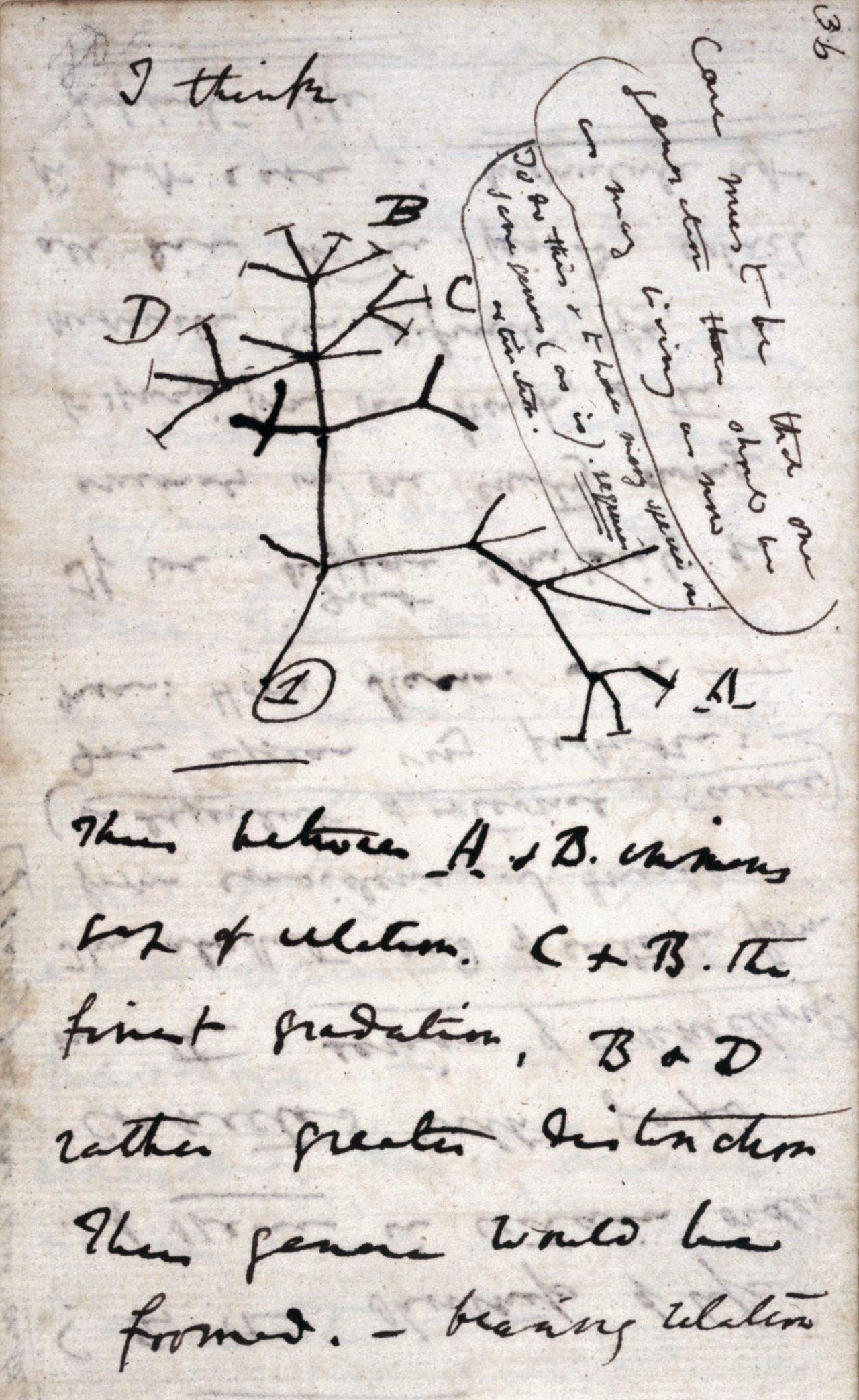
A page from Charles Darwin’s Notebook B, begun in July 1837. Under the words “I think,” he sketched living things branching from a common ancestor, marked 1.
Charles Darwin, Notebook B (1837–38), page 36, from Darwin Online, via Wikimedia Commons · Public domain · Image source ↗
WHERE THE EVIDENCE STANDS
How sure are we?
Living things, humans included, evolved over millions of years from shared ancestors.The National Academies say evolution has stood up to testing by many thousands of scientists for more than a century. The Smithsonian cites fossils, and DNA showing that humans and chimpanzees share an ancestor that lived 8 to 6 million years ago.
Many religious bodies and scholars teach that evolution can fit with faith in God.Pius XII (1950), John Paul II (1996) and Pope Francis (2014); 15,747 signers of the Christian Clergy Letter; BioLogos; Rabbi Elliot Dorff; Islamic studies professor Mustansir Mir; 12 of the 20 Muslim thinkers Malik reviews accept evolution in some form. The National Academies say many denominations have issued statements accepting evolution.
To accept evolution, a person has to give up belief in God.Pew (2019): nearly all white evangelical Protestants who say humans evolved believe God had a role. BioLogos accepts evolution and affirms the Resurrection. Whether evolution weakens the case for God is a separate, philosophical question argued on both sides.
Earth and life are only a few thousand years old.The National Academies say several independent lines of evidence, including radioactive dating of materials from Earth, the Moon and meteorites, indicate that Earth is about 4.5 billion years old. Answers in Genesis holds a recent creation based on its reading of Genesis.
God guided evolution, or evolution happened with no God behind it.John Paul II said the step to the spiritual cannot be observed by science; BioLogos says science is not the right tool to ask whether there is a creator God; the National Academies say supernatural beings cannot be investigated by science.
Scientists still study how evolution works in detail, such as how some early human species are related, but not whether it happened. Survey numbers shift with how a question is worded. Whether God guided the process is a question science cannot answer.
WHAT WOULD CHANGE THIS ANSWER
The science would change only if strong new evidence overturned common descent, which has stood up to more than a century of testing. The religious picture would change if major traditions revised their teaching, or if new surveys found different views.
Yes. Many people accept evolution and keep their faith. The Catholic Church, many Protestant churches, and many Jewish and Muslim thinkers teach that evolution and belief in a Creator can fit together. Other believers reject evolution, often because they read their scripture literally, for example taking the opening chapters of Genesis as a day-by-day history. Both groups include sincere, thoughtful people.
People ask this for different reasons. A student may love biology class but worry about what her church will say. A parent may wonder what to tell a curious child. Someone may have left a faith over this very question, or kept it and never talked about it. These are fair questions, and they deserve clear answers.
Start with the science. Evolution means that the inherited traits of living things change over many generations. The U.S. National Academies of Sciences, Engineering, and Medicine say the idea has stood up to testing by many thousands of scientists for more than a century. The Smithsonian points to fossils and to DNA, which shows that humans and chimpanzees share an ancestor that lived between 8 and 6 million years ago. We label evolution Established.
Now the faith side. In 1996, Pope John Paul II said that new knowledge had led to seeing evolution as “more than a hypothesis.” More than 15,700 Christian clergy have signed a letter saying the Bible and modern science “may comfortably coexist.” Christians in science, rabbis and Muslim scholars have made their own cases, in their own terms. Others, such as the ministry Answers in Genesis, reject evolution because they read Genesis as a factual account of creation in six 24-hour days. Some skeptics also see a conflict, and argue that evolution counts against belief in God.
What science cannot tell you is whether God stands behind the process. That question is Beyond science. This page lets each view speak in its own words, and it does not tell you what to believe. You are welcome here, whatever you believe.
THE LONG ANSWER
THE LONG ANSWER · ABOUT 7 MINUTES
You’ve read your 3 free long answers this month.
The short answer, how sure we are, what we don’t know, what would change our mind and every source stay free on every page, for everyone.
All Access members read the long answer: the evidence piece by piece, the strongest objections, and how to check it yourself.
Change in the inherited traits of a population over many generations. Populations evolve, not single individuals.
Natural selection
The process in which living things with helpful inherited traits survive and reproduce more, so those traits spread over time.
Common ancestor
An earlier species from which two or more later species descend. Humans and chimpanzees share one that lived 8 to 6 million years ago.
Evolutionary creation
A Christian view, promoted by BioLogos, that God created and sustains all things and that evolution is the best scientific account of how life is related.
Young-earth creationism
The view that the universe and Earth were created only a few thousand years ago, held by groups such as Answers in Genesis.
Encyclical
A letter from the pope to the whole Catholic Church on matters of doctrine, morals or discipline, usually addressed to the bishops. Humani generis (1950) is one.
Sources & further reading
(10) · Checked Sep 29, 2026
Evolution Resources (definitions, FAQs, Compatibility, Religious Leader Statements) ↗National Academies of Sciences, Engineering, and MedicineDefinition of evolution (heritable traits of a population as successive generations replace one another; populations evolve, not individuals); mutation and natural selection; evolution not random though mutations are not directed toward specific goals; withstood extensive testing by many thousands of scientists for more than a century; scientists no longer question whether evolution has occurred; Tiktaalik prediction (sediments about 375 million years old) confirmed; several independent dating techniques, radioactive elements in materials from the Earth, the Moon and meteorites; several independent lines of evidence put Earth at about 4.5 billion years; quotes taken out of context dispute how, not whether; many denominations accept evolution, those that do not tend toward strictly literal interpretations; scientists’ confidence based on evidence from many aspects of the natural world; conclusions must be tested against observations; supernatural entities cannot be investigated by science; god-of-the-gaps claims weaken both science and religion; Religious Leader Statements quote the General Assembly of the Presbyterian Church (no date given): “[T]here is no contradiction between an evolutionary theory of human origins and the doctrine of God as Creator.”
Human Origins Program: Introduction to Human Evolution; Genetics; Broader Social Impacts Committee member essays ↗Smithsonian Institution, Human Origins ProgramIntroduction: scientists do not all agree how early human species are related; many people have reconciled their beliefs with the evidence. Genetics (https://humanorigins.si.edu/evidence/genetics): about 1.2% difference measured on genes humans and chimpanzees share, an additional 4 to 5% counting segments deleted, duplicated or inserted from one part of the genome into another; DNA shows humans and chimpanzees diverged from a common ancestor that lived between 8 and 6 million years ago; we did not evolve directly from any primates living today. Member essays (https://humanorigins.si.edu/about/broader-social-impacts-committee/members-member-resources): Elliot Dorff (Rabbi, Conservative Judaism): God is Creator but we do not know how; at least three biblical descriptions of creation; “There are 70 faces to the Torah” (Numbers Rabbah). Mustansir Mir (Muslim; University Professor of Islamic Studies, Youngstown State University): scientific account primarily biological, religious account primarily moral; “If this argument is accepted,” no conflict need exist. Randy Isaac (Protestant/Evangelical; Executive Director Emeritus, American Scientific Affiliation): two-book model; “Science can tell us what happened but not why.” Lee Meadows (Baptist; retired science educator): grew up in fundamentalist Christianity in north Mississippi; teachers can stay true to science and honor students’ faith-based questions.
Humani generis (encyclical, 12 August 1950) ↗The Holy See (Pope Pius XII)Addressed to patriarchs, primates, archbishops, bishops and other local ordinaries. Paragraph 36: the Church does not forbid research and discussion of evolution as the origin of the human body from pre-existent living matter; the reasons for and against must be weighed with seriousness, moderation and measure; some rashly act as if it were already settled; Catholic faith holds that souls are immediately created by God. Paragraph 37: the faithful cannot embrace polygenism (many first parents rather than one Adam). Glossary definition of encyclical: Britannica, “encyclical” (Internet Archive copy of 14 Sept 2026, https://web.archive.org/web/20260914190458/https://www.britannica.com/topic/encyclical): a pastoral letter written by the pope for the whole Roman Catholic Church on matters of doctrine, morals, or discipline, usually addressed to Catholic bishops.
Message to the Pontifical Academy of Sciences (22 October 1996); Address of Pope Francis (27 October 2014) ↗Pontifical Academy of Sciences (John Paul II); The Holy See (Francis)John Paul II: new knowledge leads us to recognise the theory of evolution as more than a hypothesis; the convergence, neither sought nor fabricated, of independent results is a significant argument in favour of the theory; theories that consider the mind as emerging from the forces of living matter, or as a mere epiphenomenon of it, are incompatible with Catholic teaching on the human person and cannot ground the dignity of the person; the moment of transition to the spiritual cannot be the object of this kind of observation. Francis, 27 October 2014 (https://www.vatican.va/content/francesco/en/speeches/2014/october/documents/papa-francesco_20141027_plenaria-accademia-scienze.html): we risk imagining God as a magician with a magic wand; evolution in nature does not conflict with the notion of creation, because evolution presupposes the creation of beings who evolve.
The Clergy Letter – from American Christian Clergy ↗The Clergy Letter Project (Michael Zimmerman)The overwhelming majority of Christians do not read the Bible literally, as they would a science textbook; the timeless truths of the Bible and the discoveries of modern science may comfortably coexist. Counts on every page of the site: 15,747 signatures on the Christian letter and 847 on the Rabbi letter as of 09/26/26. Rabbi letter (https://www.theclergyletterproject.org/Jewish_Clergy/JewishClergyLtr.htm): it is possible to be inspired by the Bible while not taking a literalist approach and while accepting evolution. Background (https://www.theclergyletterproject.org/Backgd_info.htm): Zimmerman, founder and executive director, worked with Wisconsin clergy in the fall of 2004.
About BioLogos; What is Evolutionary Creation? ↗BioLogos (Internet Archive copies)The live site returns a rate-limit or security page to scripted requests (HTTP 429), so both pages were read from Internet Archive copies. About (1 May 2026 copy): Collins, best known for leading the Human Genome Project and directing the National Institutes of Health, founded BioLogos (the page says in 2009; no year is used). Evolutionary creation (4 Aug 2025 copy, the newest in the archive, https://web.archive.org/web/20250804014708/https://biologos.org/common-questions/what-is-evolutionary-creation): God is the creator and sustainer of all things, and evolution is the best scientific explanation for the relatedness of life; the Bible is God’s inspired and authoritative word; bodily resurrection of Jesus and the biblical miracles affirmed; evolutionary creationists differ on a historical Adam and Eve; passages read for their meaning to the original audience; science is not the right tool for whether there is a creator God. The site does not call itself evangelical, so the text says “Christians in science.”
Islam and Evolution: Al-Ghazālī and the Modern Evolutionary Paradigm ↗Routledge (2021), Shoaib Ahmed Malik; open access, CC BY-NC-ND 4.0Read as the open-access text from the OAPEN Library (handle 20.500.12657/48443; Crossref: Routledge, 3 May 2021, CC BY-NC-ND 4.0). Introduction: four positions (creationism, human exceptionalism, Adamic exceptionalism, no exceptions); Malik moved from no exceptions to Adamic exceptionalism; Dawkins, Dennett, Harris and Hitchens, the “four horsemen” of the new atheism, hold that evolution makes a strong claim against religious beliefs, particularly God’s existence, and Dennett calls Darwinian evolution a “universal acid”; Nuh Ha Mim Keller treats belief in human evolution as unbelief (kufr), while Salman Younas, who thinks an evolutionary reading of the Quran is at best erroneous, says Keller is mistaken to apply that label to a devout Muslim who believes God created Adam. Table 4.3: 20 thinkers (8 creationism, 3 human exceptionalism, 1 Adamic exceptionalism, 8 no exceptions).
Statement of Faith ↗Answers in GenesisGenesis 1–11 a simple but factual presentation of actual events; the Bible’s authority includes its assertions in history and science; “six consecutive, 24-hour days”; approximately 4,000 years from creation to Christ; theistic evolution (i.e., evolutionary creation) and other views that fit evolution or millions of years into Genesis are incompatible with Scripture; death, suffering and natural evils entered the world as a direct consequence of man’s sin.
The Evolution of Pew Research Center’s Survey Questions About the Origins and Development of Life on Earth ↗Pew Research Center (2019)Random split: single question with a God-guided-or-allowed option vs the older two-step question; creationist view 18% vs 31% of U.S. adults; eight in ten say humans evolved in the single-question version. No fieldwork dates are given, so the text says “published in 2019.” Short read of the same day (https://www.pewresearch.org/short-reads/2019/02/06/how-highly-religious-americans-view-evolution-depends-on-how-theyre-asked-about-it/): white evangelical Protestants 66% creationist in the two-step format, 62% say humans evolved in the single question; nearly all who say humans evolved believe God had a role. The World’s Muslims, ch. 7 (2013, https://www.pewresearch.org/religion/2013/04/30/the-worlds-muslims-religion-politics-society-science-and-popular-culture/): at least half say humans evolved in 13 of 22 countries; at least half say humans have remained in their present form in four. Israel’s Religiously Divided Society (2016, https://www.pewresearch.org/religion/2016/03/08/israels-religiously-divided-society/ and the chapter https://www.pewresearch.org/religion/2016/03/08/education-values-and-science/): 5,601 adults, face to face, Oct. 2014 to May 2015; 53% of Israeli Jews say humans evolved; Hilonim (secular) 83%, Haredim (commonly translated ultra-Orthodox) 3%.
Religion and Science (Helen De Cruz) ↗Stanford Encyclopedia of PhilosophySection 1: the New Atheist movement (Dawkins, Harris, Dennett, Hitchens) treats religious claims such as God’s existence as testable scientific hypotheses. Section 3.2, Human origins: findings from geology, paleoanthropology, archaeology and evolutionary biology “challenge traditional religious accounts of humanity, including the special creation of humans, the imago Dei, the historical Adam and Eve, and original sin”; contemporary science and religion authors have reconsidered human uniqueness, the imago Dei, the Incarnation and the historicity of original sin.
The 'war' between science and religion makes a dramatic story, but the real history, and what scientists actually believe, is more surprising and more welcoming.
There is no single religious creation account. Here are three selected texts: Genesis, the Quran and a Rigveda hymn. These examples do not speak for every religion or…
Established2 min read
THE OCCASIONAL LETTER
Stay curious.
New stories, book updates, and notes from God Plays Dice, delivered when there is something worth sharing.
EMAIL UPDATES ↗
500 DIGITAL COPIES • GIVEAWAY PREVIEW
Be first to know when the 500-copy reader giveaway opens.
Join for the book launch, verified retailer links, and the announcement for a planned giveaway of 500 digital copies. The giveaway is not open yet: dates, eligibility, a dedicated entry form, and Official Rules will be published first.
Privacy · Check your inbox to confirm your subscription. Newsletter signup alone is not a giveaway entry.