If we could replay the history of life, would evolution turn out the same?
Evolution mixes chance with patterns that repeat, so here is what flasks of bacteria, eyes that evolved more than once, and a famous debate reveal about how predictable life really is.
God Plays Dice Editorial · independently fact-checked · corrections welcomeChecked Oct 1, 202613 min read
THE SHORT ANSWER
Partly. If life’s history could be rerun, many details would very likely differ, because chance mutations and rare events steer each path. But evolution also repeats itself. Bacteria in separate flasks often evolve the same kinds of fixes, and eyes capable of true vision arose separately several times in different animal groups. So evolution mixes chance with repeatable patterns. How similar a rerun living world would be in its big picture is still debated among scientists. Separate populations test repeatability; simulations explore assumptions; plans recorded before outcomes help distinguish predictions from discoveries made afterward.
In 1989, the scientist Stephen Jay Gould argued that replaying the “tape of life” would give a very different living world.
The Cambridge scientist Simon Conway Morris argues the opposite: that evolution often reaches the same solutions again and again.
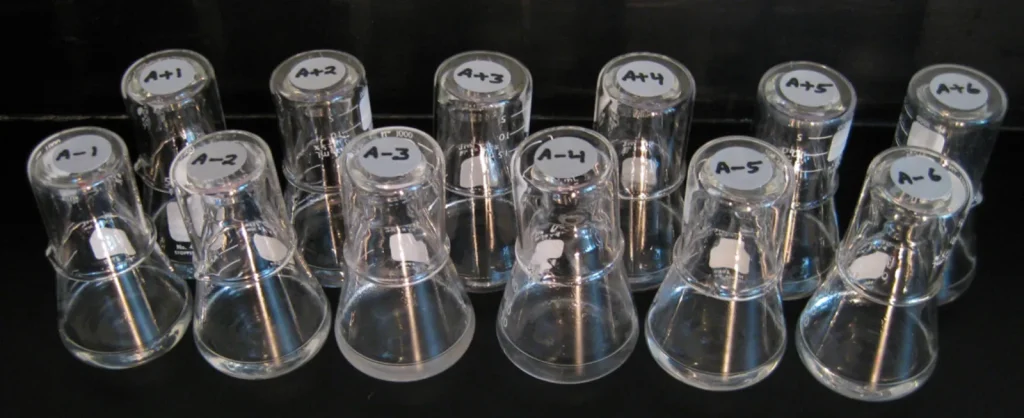
In Richard Lenski’s experiment, 12 flasks of initially identical E. coli bacteria, started in 1988, often evolved in parallel.
By the time of a 2008 report, only one of the 12 populations had evolved the ability to use citrate (by generation 31,500), and it depended on earlier changes.
Some mutations simply happen more often than others, and a 2026 study found this can shape which fixes win, even in large populations.
About this picture
The 12 populations of Richard Lenski’s long-term evolution experiment on 25 June 2008. The cloudy flask, Ara-3 (labeled A-3), holds the population that evolved to use citrate, so it grows far more cells than the others.
Evolution involves both chance events and repeatable patterns.A 2018 review in Science by Blount, Lenski and Losos: natural selection is a deterministic force, but it works on variation from random mutation, and replay experiments often show parallel changes alongside one-of-a-kind outcomes.
Separate populations facing the same challenge often evolve similar changes.In Lenski’s experiment, all 12 populations improved in fitness and grew faster on their sugar, and at least three genes changed in all 12 (Blount, Borland and Lenski, PNAS 2008).
In one Lenski population, the ability to use citrate evolved only after earlier changes made it possible.Replays from frozen samples re-evolved the trait only from later-generation clones, pointing to a potentiating change by generation 20,000 (PNAS 2008); genome work traced the trait to a gene duplication (Nature 2012).
A replay of all of life would give a broadly similar living world, perhaps including beings like us.Nobody can replay all of life. Blount, Lenski and Losos (Science, 2018) find evolution surprisingly repeatable among close relatives, but disparate outcomes become more likely as history runs deeper; Conway Morris argues for strong predictability and himself calls the idea heterodox.
Mutation bias, meaning some mutations happen more often, helps decide which adaptations win.Barber and Couce (Nature Communications, 2026) found the effect need not fade in large E. coli populations and can persist or even grow, depending on how the bias lines up with selection; they note the idea is still controversial.
A computer model alone confirms how real bacteria will evolve.Its rules are assumptions; predictions need checks against living populations.
Nobody knows how often key steps in life’s history, such as the rise of complex cells or of minds like ours, would happen again in a replay. It is also hard to count how often convergence happens across all of nature.
WHAT WOULD CHANGE THIS ANSWER
More replay experiments in many kinds of living things, run for longer and started from more distant points in history, would sharpen this answer. Finding life elsewhere, with its own separate history, would give the first test of evolution on another world.
Partly. If we could rewind the history of life and press play again, many details would very likely come out differently. But not everything. Evolution keeps finding some of the same solutions, again and again.
The question has a famous history. In 1989, the scientist Stephen Jay Gould wrote a book called Wonderful Life. He argued that evolution is full of chance and quirky turns. If we replayed the “tape of life” from the distant past, he said, the living world would look far different from today’s. Simon Conway Morris, an Earth scientist at the University of Cambridge, argued back. He pointed to convergent evolution, when unrelated living things evolve the same kind of trait on their own. In his view, life takes many routes but reaches only a few destinations.
We cannot rewind all of life. But we can replay small pieces of it. In 1988, the biologist Richard Lenski started 12 flasks of the same bacteria, E. coli, and let them evolve side by side. By 2008 they had passed 40,000 generations. Samples are frozen along the way, so the team can go back in time and run history again.
The results show both sides. All 12 populations got better at living in their flasks, often through similar changes. But only one population evolved the ability to eat a food called citrate, after more than 30,000 generations, as a 2008 paper reported. Replays showed that it needed earlier changes first. That is chance and history at work.
Nature shows the same mix. Eyes capable of true vision arose separately several times in different animal groups. Sharp, high-resolution eyes come in different designs, such as camera eyes and compound eyes.
So the plain answer is that evolution mixes chance with patterns that repeat. That much is Established. Our overall answer, “partly,” is Supported, still debated. Whether a full replay would give a broadly similar world, including anything like us, is an Open question.
THE LONG ANSWER
THE LONG ANSWER · ABOUT 11 MINUTES
You’ve read your 3 free long answers this month.
The short answer, how sure we are, what we don’t know, what would change our mind and every source stay free on every page, for everyone.
All Access members read the long answer: the evidence piece by piece, the strongest objections, and how to check it yourself.
Author’s hypothesis. The Research Notebook’s Evolution & mutation page describes a research program by Ricardo Maldonado, author of GOD PLAYS DICE, called the Theory of Mutation by Natural Dominance (TMD). It starts from the pattern on this page: when many populations of the same microbe face the same challenge, such as an antibiotic, they often evolve similar fixes. It asks whether the “winning” mutations follow patterns we could predict, and how much the setting matters.
Its newest software version, 2.6.5, is dated 5 September 2026 and was posted on Zenodo on 30 September 2026. It is for analysis only. Its tools include a check that a lab runs first, checks on results sent in from outside, and a log of every step that others can replay. Version 2.6.4 compares the proposed patterns with competing explanations based on known mechanisms. Passing software checks does not show the pattern happens in nature.
On the same day, Ricardo posted a separate report. It says its aim is “to make predictions that can fail fairly on new data.” It corrects how earlier work used some counts, and it takes a new look at data that other scientists published in 2021. It calls that look “exploratory, not preregistered.” Because it reuses published data, it is not a test fixed in advance. Neither version 2.6.5 nor the report describes a new lab experiment, and TMD does not establish a new law of evolution or replace natural selection.
The Research Notebook’s status, reviewed 30 September 2026, is: software and workflow release; no new lab test reported. Its strongest challenge is the mainstream work on mutation bias described above: to count, TMD would have to pick the winners better than those models, on new data. You can follow what would count against it on the Test Ledger.
Historical contingency and the evolution of a key innovation in an experimental population of Escherichia coli (Blount, Borland and Lenski) ↗PNAS 105, 7899–7906 (2008), doi:10.1073/pnas.0803151105Gould, Wonderful Life (Norton, 1989) and the tape of life; Conway Morris: “the evolutionary routes are many, but the destinations are limited”; LTEE started in 1988 with 12 populations; about 6.64 generations per day; parallel fitness gains, faster growth, larger cells, at least three genes changed in all 12; no citrate use for over 30,000 generations despite billions of mutations; Cit+ by 31,500 generations, noticed after about 33,127; 72 replay populations for about 3,700 generations, Cit+ re-evolved in four, all from later clones; potentiating mutation by 20,000 generations.
Contingency and determinism in evolution: Replaying life’s tape (Blount, Lenski and Losos) ↗Science 362, eaam5979 (2018)Abstract (read via Europe PMC): selection is deterministic but acts on random mutation and drift; replay experiments often show parallel changes plus idiosyncratic outcomes; convergence is hard to quantify; evolution surprisingly repeatable among close relatives, disparate outcomes more likely as history grows deeper.
Evolution: like any other science it is predictable (Simon Conway Morris) ↗Philosophical Transactions of the Royal Society B 365, 133–145 (2010)Open-access full text: Department of Earth Sciences, University of Cambridge; argues evolution is remarkably predictable and calls the idea heterodox; key transitions very probable, if not inevitable; cites Lenski’s experiment as the best approximation of re-running the tape.
Eye evolution and its functional basis (Dan-E. Nilsson) ↗Visual Neuroscience 30, 5–20 (2013)Open-access full text (Lund Vision Group, Lund University): directional photoreception proceeded several times independently to true vision; high-resolution (class IV) eyes only in vertebrates, cephalopods and arthropods, of camera and compound type; eye evolution driven by increasingly demanding visually guided behavior; shared Pax-6 expression has been taken as evidence eyes evolved once, and the multiple-origin scenario is compatible with it.
Mutation-biased adaptation is consequential even in large bacterial populations (J. N. Barber and A. Couce) ↗Nature Communications 17, 7357 (published 10 June 2026)Open access, published 10 June 2026: the idea that mutational tendencies influence adaptation is “still controversial”; two E. coli mutator lineages evolving cefotaxime resistance; mutation-biased adaptation “may not wane in large populations” and can persist or intensify depending on its alignment with selection; describes a view of “the likeliest among the fittest”.
A world with no sunrise could still have internal heat. The question is whether it can keep water liquid and supply usable energy.
Open question4 min read
THE OCCASIONAL LETTER
Stay curious.
New stories, book updates, and notes from God Plays Dice, delivered when there is something worth sharing.
EMAIL UPDATES ↗
500 DIGITAL COPIES • GIVEAWAY PREVIEW
Be first to know when the 500-copy reader giveaway opens.
Join for the book launch, verified retailer links, and the announcement for a planned giveaway of 500 digital copies. The giveaway is not open yet: dates, eligibility, a dedicated entry form, and Official Rules will be published first.
Privacy · Check your inbox to confirm your subscription. Newsletter signup alone is not a giveaway entry.