OriginsExplainer
How Big Is the Universe, and Does It Have an Edge?
The part we can see is about 93 billion light-years wide, but whether the whole universe ends, loops back or goes on forever is still unknown.
THE QUESTION LIBRARY THE UNIVERSE
The night sky brings us old light, carrying clues about distant places and earlier times.
Yes: when we look at stars, we see light that left them in the past. Even sunlight takes about eight minutes to reach Earth. A light-year measures distance, not time: it is how far light travels in a year. Telescopes collect old light and split it into patterns that reveal the matter it met. Very distant views also depend on cosmic expansion. They show earlier events, rather than a live view of every object today.
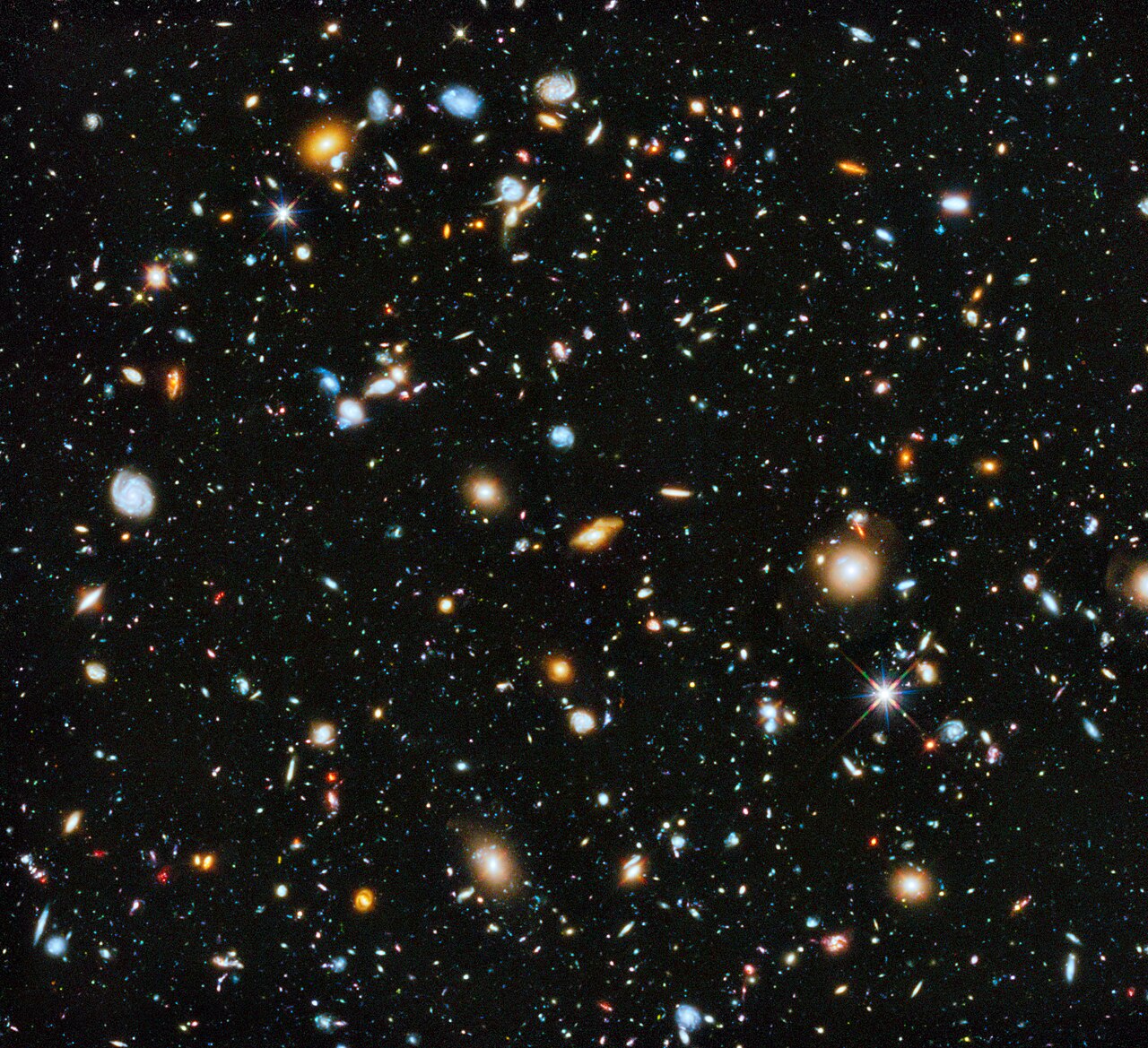
The Hubble Ultra Deep Field combines light from galaxies at different distances. Each galaxy appears as it was when the light we receive left it.
WHERE THE EVIDENCE STANDS
WHAT WE DON’T KNOW YET
We cannot directly see what a distant star is doing now before its newer light arrives. How the earliest stars and galaxies formed remains an active question.
WHAT WOULD CHANGE THIS ANSWER
New observations can change a particular star’s distance, age or makeup. A repeatable failure of light-travel or spectral predictions would require changes to the relevant physical model.
Yes, looking at the stars means receiving light from the past. The delay is real. Light travels fast, but space is wide. The Sun we see is the Sun of about eight minutes ago. A distant star reaches us through light that has been traveling for years.
This can feel strange because the sky looks like a single scene. It is better understood as many arrivals happening together. Light from nearby and distant sources reaches your eyes on the same night, although it began its journey at different times. The scene is present to you; the events it shows are earlier.
A light-year helps express those distances. It means the distance light travels in one year. The word year can make it sound like a clock, but the whole term names a length. For nearby stars, the distance in light-years also gives a useful estimate of how many years their light took to reach us.
Old light can tell us more than where a bright dot appears. Spread it into a spectrum, a pattern ordered by wavelength, and you can find marks made by atoms. An element absorbs and emits particular kinds of light. Comparing those patterns with laboratory measurements helps us learn what distant stars contain.
Our eyes receive only a small part of the range of light. Telescopes also detect radio waves, infrared light and X-rays. Each view adds information. Colors assigned to those invisible signals help us read a picture; they need not be colors an unaided eye would see.
The view has limits. Cosmic expansion complicates very large distances, and earlier cosmic matter blocked light from traveling freely. A telescope is a way to study earlier events. It does not let us step into them, alter them or see every distant object as it is today.
THE LONG ANSWER · ABOUT 6 MINUTES
The short answer, how sure we are, what we don’t know, what would change our mind and every source stay free on every page, for everyone.
All Access members read the long answer: the evidence piece by piece, the strongest objections, and how to check it yourself.
Join All Access · $1 a week Or $6 a month
Billed $52 once a year. Cancel anytime in your account.
Until December 4, 11:59 pm Pacific: the Founding rate is $39 a year, and it stays $39 while you stay a member.
Create a free account: 6 long answers a month, email only.
Paying never buys a different answer. Our Paywall Promise
How old is the universe, and how do we know?
About 13.8 billion years.
God Plays Dice answers big questions in plain words, with sources and one of six honest labels.
See a mistake? Report a problem. Corrections are made openly.
CONTINUE THE THREAD
OriginsExplainer
The part we can see is about 93 billion light-years wide, but whether the whole universe ends, loops back or goes on forever is still unknown.
The UniverseAnswer
Two stars can circle each other while a planet travels around them both. Astronomers confirmed it by watching the moving stars dim.
The UniverseAnswer
An everywhere-present field, a fleeting particle and a famous nickname. What did CERN’s experiments actually measure?
The Architect AI companion · All Access
Labels describe the evidence for a claim, not the people who hold it.
Match my phone uses your device’s light or dark setting.