The UniverseAnswer
Can a Planet Orbit Two Stars?
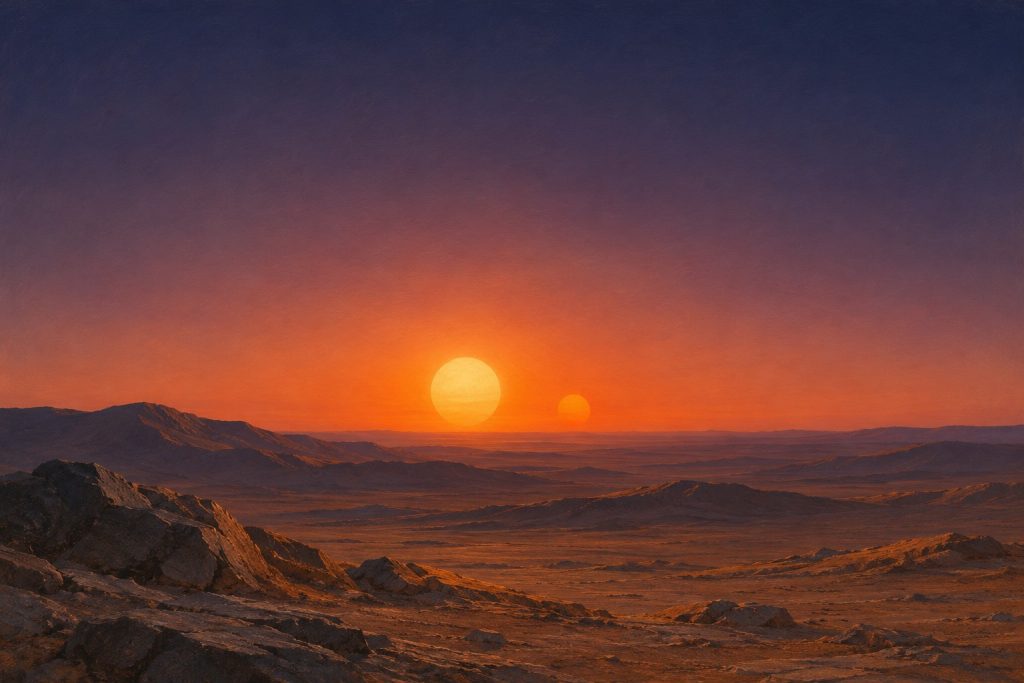
Two stars can circle each other while a planet travels around them both. Astronomers confirmed it by watching the moving stars dim.
THE QUESTION LIBRARY THE UNIVERSE
A vast number of stars does not mean their light has filled every direction for an unlimited time.
The night sky is dark because stars have not shone forever, and light takes time to reach us. Our cosmic expansion history goes back about 13.8 billion years. Its expansion also stretches light to longer wavelengths and makes distant light fainter. An endless, unchanging universe filled with long-lived stars would present a different picture. A dark visible sky does not mean space contains no light.
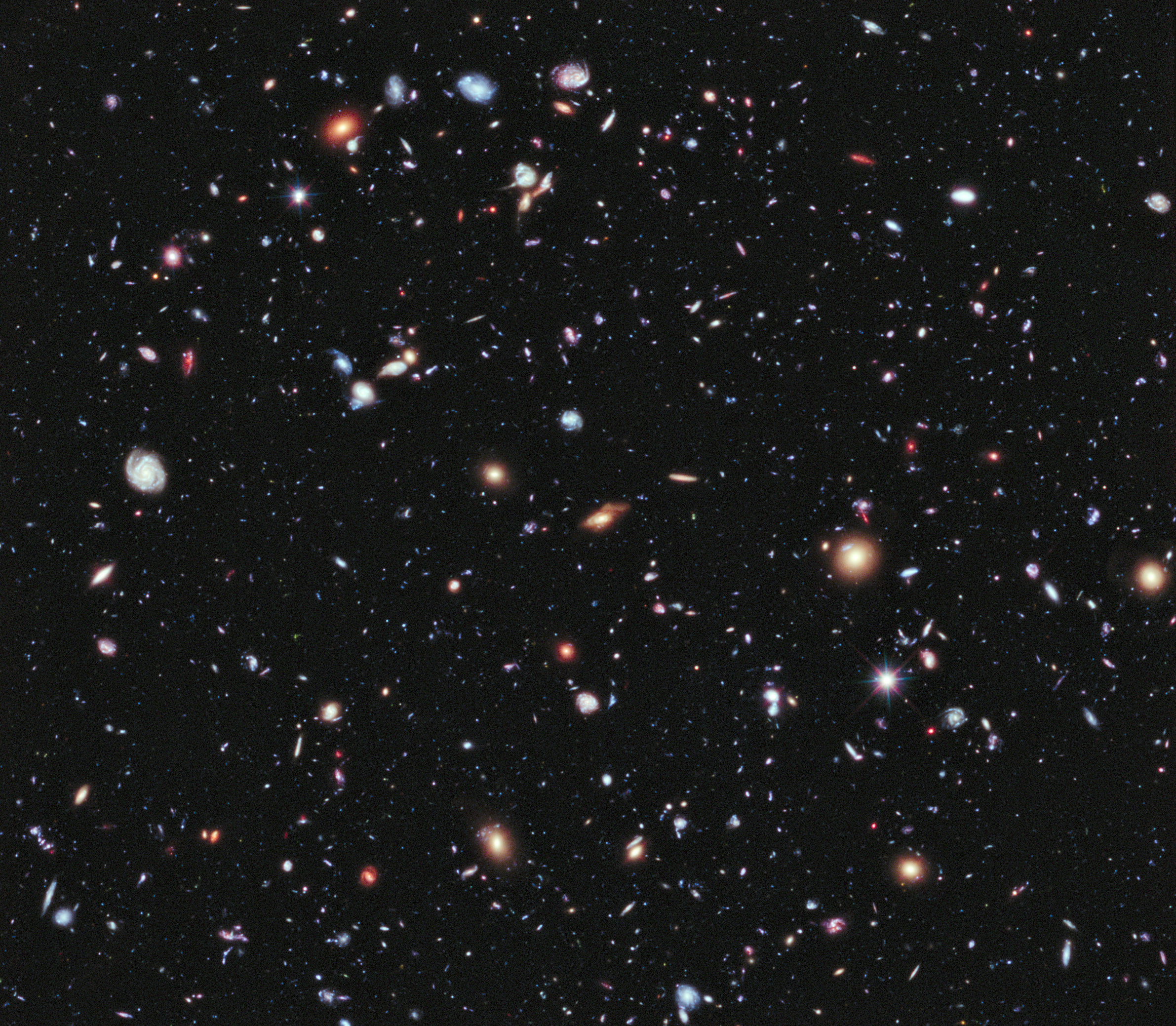
The Hubble Extreme Deep Field combines long exposures to reveal faint galaxies in a small dark-looking patch; this is not a naked-eye view.
WHERE THE EVIDENCE STANDS
WHAT WE DON’T KNOW YET
We do not know the full size of the universe or whether space extends without end. We also lack exact counts of all stars and all sand grains on Earth.
WHAT WOULD CHANGE THIS ANSWER
Repeatable measurements of cosmic background light that disagreed with predictions from the measured expansion and star-formation history would challenge this account. An alternative would need to explain the light, expansion, and galaxy observations together; better counts can also refine stellar estimates.
A dark sky holds bright stars and stretches that seem black. Why does light from countless distant stars not fill every gap?
This question is called Olbers’ paradox. It tests a particular picture: a universe that is static, has no limit in space, and has been full of shining stars for an unlimited time. In that picture, more distant layers of space contain more stars. Each star looks fainter, but there are more of them. The two effects balance in a way that prevents distance alone from solving the puzzle.
Our universe does not fit that picture. Its known expansion history goes back about 13.8 billion years, with stars forming later. Light travels at a finite speed. We do not receive light from an unlimited past filled with stars. Space also expands. That stretches light’s wavelength, shifting some of it beyond what our eyes can see and reducing the light we receive.
Darkness is not the same as absence. A long telescope exposure can reveal faint galaxies in a patch that looks empty to our eyes. Other instruments detect light beyond the visible range. The sky carries a faint background of radiation as well as individual bright objects.
None of this requires a wall around the whole universe. The region whose light can reach us is not automatically the full extent of space. It also does not require an exact tally of every star. The important question is how much light arrives, over what history, and in which wavelengths. Once those limits enter the picture, a huge population of stars and a dark night sky can fit together.
Are there more stars than sand grains on Earth? There is no exact census or definitive winner here. A comparison needs a stated stellar estimate for the observable universe and a defined sand inventory, with uncertainty for both.
THE LONG ANSWER · ABOUT 6 MINUTES
The short answer, how sure we are, what we don’t know, what would change our mind and every source stay free on every page, for everyone.
All Access members read the long answer: the evidence piece by piece, the strongest objections, and how to check it yourself.
Join All Access · $1 a week Or $6 a month
Billed $52 once a year. Cancel anytime in your account.
Until December 4, 11:59 pm Pacific: the Founding rate is $39 a year, and it stays $39 while you stay a member.
Create a free account: 6 long answers a month, email only.
Paying never buys a different answer. Our Paywall Promise
Nobody knows yet.
God Plays Dice answers big questions in plain words, with sources and one of six honest labels.
See a mistake? Report a problem. Corrections are made openly.
CONTINUE THE THREAD
The UniverseAnswer
Two stars can circle each other while a planet travels around them both. Astronomers confirmed it by watching the moving stars dim.
The UniverseAnswer
An everywhere-present field, a fleeting particle and a famous nickname. What did CERN’s experiments actually measure?
The UniverseAnswer
Why the matter surplus remains unexplained, what Sakharov's conditions require, and how sphalerons and proposed neutrino mechanisms might connect.
The Architect AI companion · All Access
Labels describe the evidence for a claim, not the people who hold it.
Match my phone uses your device’s light or dark setting.