Any two people share almost all of their DNA, so here is what that number means, where our shared family tree leads, and what race does and does not capture.
God Plays Dice Editorial · independently fact-checked · corrections welcomeChecked Sep 29, 202610 min read
THE SHORT ANSWER
Very closely. Any two people’s DNA is about 99.6% the same when every kind of difference is counted. Counting only single-letter changes, it is about 99.9%. Most of the small differences are found among people of the same population, not between populations. All living people trace most of their ancestry to Africa. Our species arose there about 300,000 years ago. And family-tree models suggest that everyone alive today shares ancestors who lived just a few thousand years ago.
The U.S. National Human Genome Research Institute says any two people’s genomes are, on average, about 99.6% identical when every kind of difference is counted.
In a study of 1,056 people from 52 populations, differences among people within the same population made up 93 to 95% of the genetic variation.
Our species arose in Africa about 300,000 years ago, and its descendants spread across much of the world within the past 100,000 years.
Humans have less genetic variety than many other mammals: one chimpanzee subspecies in central Africa has more than all humans worldwide.
A 2023 National Academies report calls race a socially constructed label and a misleading and harmful stand-in for genetic differences between populations.
About this picture
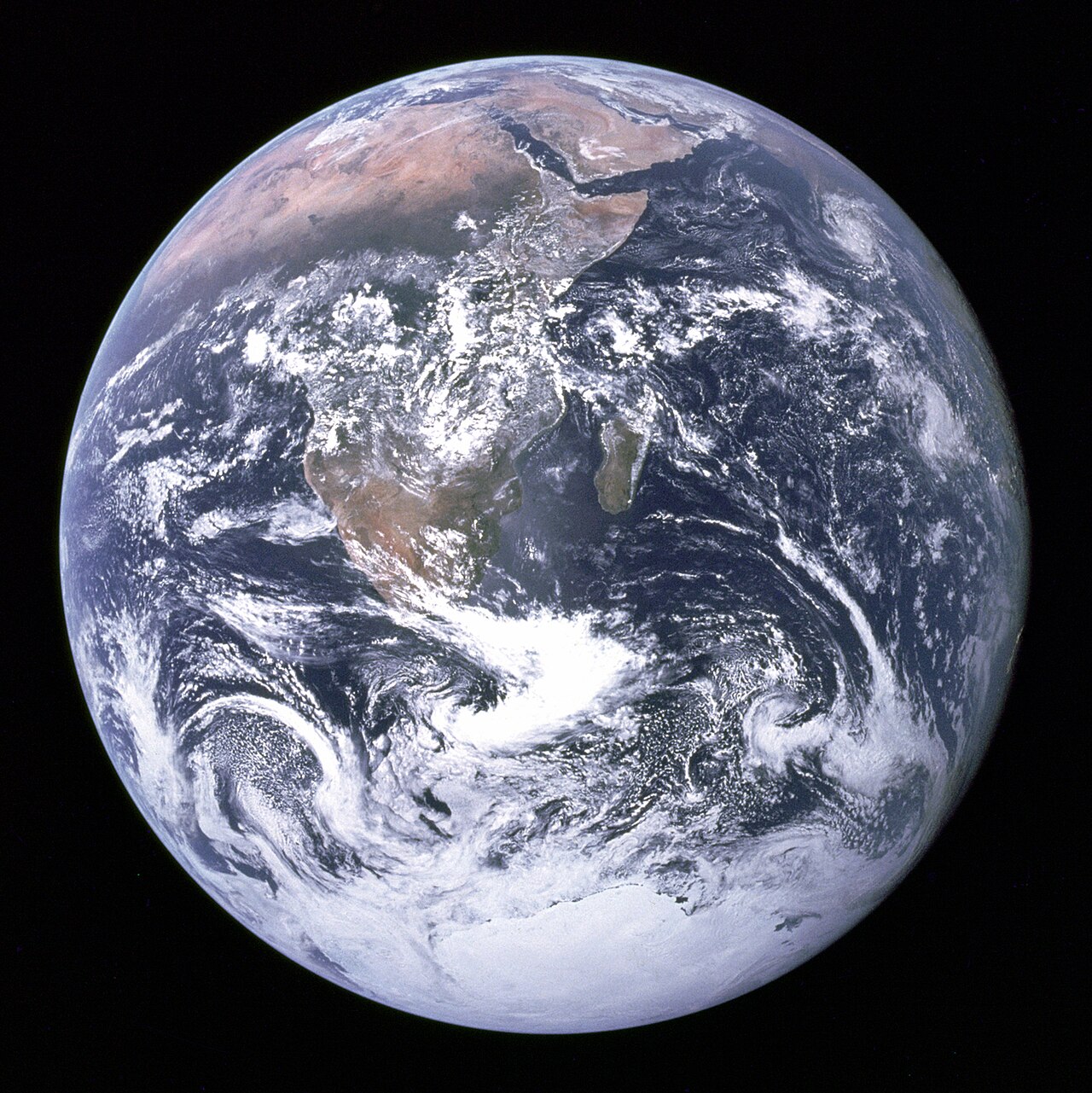
The Blue Marble, photographed in December 1972 by the crew of Apollo 17, the final Apollo mission, on the way to the Moon. Africa, where our species arose about 300,000 years ago, is near the top.
NASA / Apollo 17 crew, via Wikimedia Commons · Public domain · Image source ↗
WHERE THE EVIDENCE STANDS
How sure are we?
Any two people share the vast majority of their DNA.NHGRI: about 99.6% identical on average when single-letter changes, small insertions and deletions, and larger structural differences are all counted; the often-quoted 99.9% counts only single-letter differences (about one every 1,300 letters). The Smithsonian gives the 99.9% figure.
Most human genetic variation lies within populations, not between them.Rosenberg and colleagues (2002): 93 to 95% within populations and 3 to 5% among major groups, from 377 DNA markers in 1,056 people from 52 populations. The Smithsonian summarizes research from Lewontin (1972) onward: in general, 5 to 15% of variation lies between large groups on different continents.
Modern humans arose in Africa and later spread around the world.National Academies (2023): anatomically modern humans arose in Africa about 300,000 years ago, and their descendants spread across much of the world within the past 100,000 years. Jebel Irhoud fossils are dated to 315,000 years ago, give or take 34,000 (Hublin and colleagues, 2017). The 1000 Genomes Project found the most genetic variants in people from populations with African ancestry, as the out-of-Africa model predicts. The exact place and time of origin, and the pattern of later movements, are still being studied.
Everyone alive today shares family-tree ancestors who lived only a few thousand years ago.Rohde, Olson and Chang (2004) found this in two models, one worked out mathematically and one run as computer simulations, that include people choosing partners from their own group and the partial isolation of groups living far apart. It is a model result, not a measurement, and the National Academies (2023) call it likely. Shared genetic ancestors at any one stretch of DNA are typically much older (Matsen and Evans, 2008).
Race categories match clear-cut genetic groups.NHGRI calls race a social construct and notes more genetic variation within self-identified racial groups than between them. The National Academies (2023) describe a poor correspondence between racial groups and the pattern of human genetic variation, which changes gradually with distance, and recommend that researchers not use race as a stand-in for genetic variation.
Exactly where and how our species first took shape in Africa is still being worked out, and so are the details of how people moved out of Africa and back again. The dates for our shared family-tree ancestors come from models, so they are estimates.
WHAT WOULD CHANGE THIS ANSWER
Finding that people fall into sharply separate genetic groups would change this answer, but large studies find gradual change across geography instead. New fossils or ancient DNA could shift the dates for when our species arose and spread.
Very closely. Pick any two people on Earth, from any two countries, and their DNA will be almost the same. The U.S. National Human Genome Research Institute (NHGRI) says two people’s genomes are, on average, about 99.6% identical when every kind of difference is counted. You may have heard 99.9%. That figure counts only differences in single DNA letters.
People ask this for many reasons. Some are curious after an ancestry test. Some wonder whether the lines we draw between nations and races run deep in our biology. Some simply feel wonder that billions of strangers could belong to one family.
Here is the core picture. Our species, Homo sapiens, arose in Africa about 300,000 years ago. Its descendants spread across much of the world within the past 100,000 years. That is recent in evolutionary terms, and groups of people have moved and mixed again and again, so most of our genetic variety is shared across the world. In one large study, differences between people within the same population made up 93 to 95% of the genetic variation. Differences between major groups made up only 3 to 5%.
Family trees overlap, too. Each generation back doubles the number of places in your family tree. Soon there are more places than people who were alive, so the same ancestors show up again and again. Family-tree models suggest that everyone alive today shares ancestors who lived just a few thousand years ago.
What about race? NHGRI and the U.S. National Academies of Sciences, Engineering, and Medicine describe race as a social label. It matches poorly with the way human genetic variation is spread, which changes gradually from place to place. The essay Before We Are Nations, We Are Life, on this site, argues for human dignity. This page sticks to the science: how much DNA we share, where our family tree leads, and what race does and does not capture. What we owe one another is a question of values that science alone cannot settle.
THE LONG ANSWER
THE LONG ANSWER · ABOUT 8 MINUTES
You’ve read your 3 free long answers this month.
The short answer, how sure we are, what we don’t know, what would change our mind and every source stay free on every page, for everyone.
All Access members read the long answer: the evidence piece by piece, the strongest objections, and how to check it yourself.
The complete set of DNA instructions in a cell. One copy of the human genome has about 3 billion DNA letters, and most cells carry two copies.
Genetic variant
A place where one person’s DNA differs from another’s, from a single changed letter to a large stretch that is added, missing or moved.
Genealogical ancestor
Anyone in your family tree, such as a parent or great-great-grandparent. Most of your distant genealogical ancestors passed no DNA to you.
Genetic ancestry
The paths through your family tree by which you inherited DNA from particular ancestors.
Cline
A gradual change across geography in how common a trait or gene variant is.
Homo sapiens
Our species. It evolved in Africa about 300,000 years ago and now lives worldwide.
Sources & further reading
(10) · Checked Sep 29, 2026
Human Genomic Variation (fact sheet) ↗National Human Genome Research Institute (NHGRI), last updated Feb. 1, 2023About 3 billion nucleotides per genome copy (about 6 billion in a diploid genome); the frequently stated 99.9% is based on one single-nucleotide difference every 1,300 nucleotides or so and is an over-simplification; any two genomes are on average ~99.6% identical and ~0.4% different; typical inventory vs a reference: ~5,000,000 SNVs, ~600,000 indels, ~25,000 structural variants, ~27,000,000 nucleotides in all; some variants influence eye color and height; some directly cause diseases such as cystic fibrosis and sickle cell disease.
Race (Talking Glossary of Genomic and Genetic Terms) ↗National Human Genome Research Institute (NHGRI)Definition: race is a social construct used to group people, constructed as a hierarchical grouping system, often based on physical appearance, social factors and cultural backgrounds. Narration (Vence L. Bonham Jr.): genomic scientists are investigating the relationship between self-identified race and genetic ancestry; there is more genetic variation within self-identified racial groups than between them. The page’s “updated” line shows the day it is viewed (Sept. 28 for the writer, Sept. 29, 2026 for the checker), so it is not a content date; the wording was re-read on Sept. 29, 2026.
Using Population Descriptors in Genetics and Genomics Research: A New Framework for an Evolving Field ↗National Academies of Sciences, Engineering, and Medicine (2023), doi:10.17226/26902Summary: race is a socially constructed designation and a misleading and harmful surrogate for population genetic differences; human genetic variation is continuous and complex; Recommendation 1: researchers should not use race as a proxy for human genetic variation. Chapter 1 (https://www.nationalacademies.org/read/26902/chapter/4): modern humans arose in Africa about 300,000 years ago and spread across much of the world within the past 100,000 years; the human population is very young; between-group differences substantially smaller than within-group; about 1 in 1,000 sites differ in humans vs 3 in 1,000 in chimpanzees; common alleles shared across populations; allele frequencies vary continuously with distance, with slightly larger differences across oceans or mountains, boundaries that do not correspond to racial groupings; many loci aggregated to assess similarity and assign labels; poor correspondence between racialized groups and genetic variation; continental labels such as European, African and Asian described as very broad by workshop researchers the report cites. Chapter 2 (https://www.nationalacademies.org/read/26902/chapter/5): genealogical vs genetic ancestry; most remote genealogical ancestors did not transmit DNA; by several thousands of years ago all modern humans likely share all their genealogical ancestors (Rohde et al. 2004); “modern humans are all embedded within the same enormous family tree, with some members more closely related than others” (quoted in full on the page); ancestry group labels come from nongenetic characteristics.
One Species, Living Worldwide ↗Smithsonian National Museum of Natural History, Human Origins ProgramAll living humans belong to one species, Homo sapiens; we are much more alike than we are different; the DNA of all human beings living today is 99.9% alike; roots extend back 300,000 years to the first modern humans in Africa. Homo sapiens page (https://humanorigins.si.edu/evidence/human-fossils/species/homo-sapiens): evolved in Africa about 300,000 years ago.
Human Skin Color Variation ↗Smithsonian National Museum of Natural History, Human Origins ProgramSkin color variation is adaptive and correlates with geography and UV radiation (melanin as sunscreen near the equator; lighter skin for vitamin D where UV is lower); people look remarkably diverse on the outside, but humans are genetically far less diverse than many mammals; the central African chimpanzee subspecies Pan troglodytes troglodytes has more diversity than humans globally; in general 5 to 15% of genetic variation lies between large groups on different continents (Lewontin 1972; Jorde et al. 2000; Hinds et al. 2005); variation described by clines.
Ancient DNA and Neanderthals ↗Smithsonian National Museum of Natural History, Human Origins ProgramNeanderthals contributed up to 1 to 4% of the genomes of non-African modern humans; a 2020 study (Chen et al.) found Neanderthal DNA in African Homo sapiens, pointing to gene flow back and forth over time; even with some interbreeding, most of our genome still derives from Africa.
Genetic Structure of Human Populations ↗Science 298 (2002), Rosenberg, Pritchard, Weber, Cann, Kidd, Zhivotovsky and Feldman377 autosomal microsatellite loci in 1,056 individuals from 52 populations; within-population differences 93 to 95% of genetic variation, differences among major groups 3 to 5%; six main genetic clusters found without prior information, five corresponding to major geographic regions. Related: Witherspoon and colleagues, Genetics 176 (2007), doi:10.1534/genetics.106.067355 (between-population share modest; individuals from different populations can be more similar than individuals from the same population; enough data allows accurate classification; with 100 polymorphisms classification is accurate but the overlap measure remains sizable even for sub-Saharan Africans and Europeans; traits controlled by a dozen or fewer loci expected to overlap substantially).
Human genetic diversity: Lewontin’s fallacy ↗BioEssays 25 (2003), A. W. F. EdwardsAbstract (PubMed): it is often stated that about 85% of the total genetic variation is due to individual differences within populations and only 15% to differences between populations or ethnic groups; the conclusion, due to R. C. Lewontin in 1972, that the division of Homo sapiens into these groups is not justified by the genetic data is called unwarranted because most of the information that distinguishes populations is hidden in the correlation structure of the data. Lewontin, The Apportionment of Human Diversity, Evolutionary Biology 6 (1972): 381–398 (volume number from the National Academies report’s reference list), doi:10.1007/978-1-4684-9063-3_14, is paywalled, so the 85/15 figure is credited on this page to Edwards’s summary.
Modelling the recent common ancestry of all living humans ↗Nature 431 (2004), Douglas L. T. Rohde, Steve Olson and Joseph T. ChangAbstract (Nature page and PubMed): the random-mating model ignores population substructure, such as the tendency to choose mates from the same social group and the relative isolation of geographically separated groups; two models incorporating substantial substructure, one analysed mathematically (probabilistic analysis) and one computationally (Monte Carlo simulations); the MRCA of all present-day humans lived just a few thousand years ago in these models; among all individuals living more than just a few thousand years earlier than the MRCA, each present-day human has exactly the same set of genealogical ancestors. Related: Matsen and Evans, Theoretical Population Biology 74 (2008): 182–190, doi:10.1016/j.tpb.2008.06.003 (coalescent-based approaches show that genetic most recent common ancestors for a given non-recombining locus are typically much more ancient).
A global reference for human genetic variation (1000 Genomes Project) ↗Nature 526 (2015), The 1000 Genomes Project Consortium2,504 individuals from 26 populations; over 88 million variants; individuals from African ancestry populations harbour the greatest numbers of variant sites, as predicted by the out-of-Africa model; most common variants shared across the world, rarer variants typically restricted to closely related populations (full text via Europe PMC, PMC4750478). Related: Hublin and colleagues, Nature 546 (2017), doi:10.1038/nature22336 (Jebel Irhoud, Morocco, 315 ± 34 thousand years; the emergence of H. sapiens involved the whole African continent; exact place and time remain obscure).
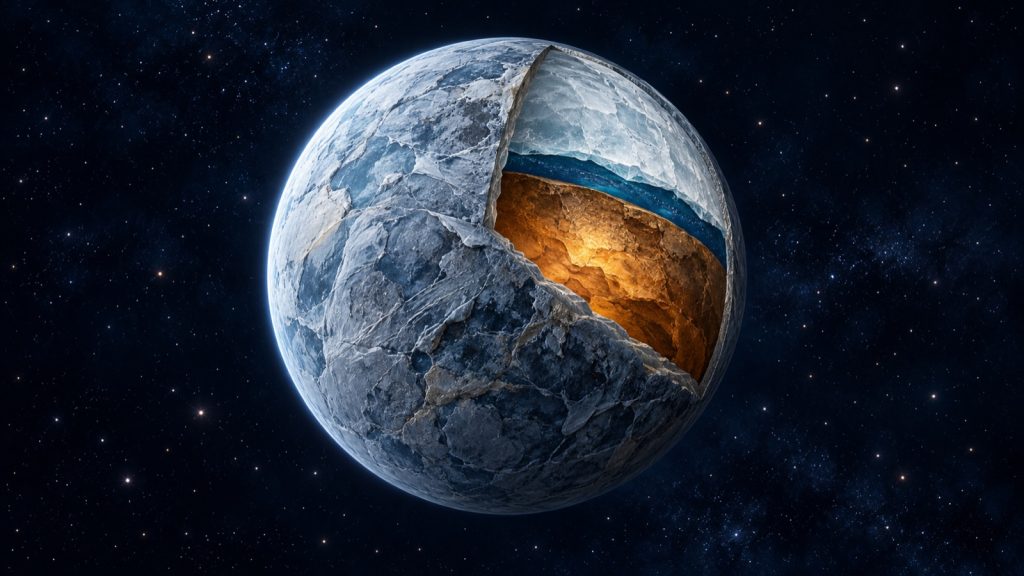
A world with no sunrise could still have internal heat. The question is whether it can keep water liquid and supply usable energy.
Open question4 min read
THE OCCASIONAL LETTER
Stay curious.
New stories, book updates, and notes from God Plays Dice, delivered when there is something worth sharing.
EMAIL UPDATES ↗
500 DIGITAL COPIES • GIVEAWAY PREVIEW
Be first to know when the 500-copy reader giveaway opens.
Join for the book launch, verified retailer links, and the announcement for a planned giveaway of 500 digital copies. The giveaway is not open yet: dates, eligibility, a dedicated entry form, and Official Rules will be published first.
Privacy · Check your inbox to confirm your subscription. Newsletter signup alone is not a giveaway entry.